How about some machine shop equipment such as a medium sized lathe, drill press, work bench with a vise, and a Bridgeport milling machine?
Before I retired (10 years ago) I was doing 3D modeling on ProEngineer. That was some mega-software. What are hobbyists using for 3D modeling? What hardware is needed to run it?
I am using Autodesk Fusion 360, I can get it for free as a student.
“Atlas has a line of 3D printed accessories:”
I checked the Atlas offerings. With the exception of the propane tanks, the other items are offered by other vendors in injection molded parts. Recently I saw a post somewhere for 3D transformers and electric motors. The prices weren’t outrageous, but the finish was poor.
There are a number of free-for-hobbyists CAD tools available that will run on any PC, and will benefit from improved graphics cards and faster processors if you have them.
I liked using Sketchup Make, but Trimble has phased it out for a pricy paid subscription model and a free browser-based version that’s lacking in many of the features that made Make appealing (especially a photo matching tool that let you import perspective photos of buildings, trains, etc. and easily derive unknown dimensions from one known measurement).
That has had me looking into Fusion 360 like Harrison recommended, (which I believe is free even for commercial use if your company grosses less than $100k/yr ), as well as OnShape (https://www.onshape.com/products/free), which is fully browser-based and saves your work in the cloud, and is free for non-commercial use.
Despite its reputation as a toy, I know someone who designs and sells highly-detailed HO traction models on Shapeways using Tinkercad https://www.tinkercad.com as the modeling tool.
Do a search on Shapeways for “Bridgeport milling” and you should find some stuff.
Thanks!! That’s what I was looking for!
The link I posted earlier shows a shaper, they have a lathe, too, perhaps they offer more by now?
"Mass-manufacturers are beginning to embrace the technology. Here is an HO machine tool made in 3D plastic from Kibri:
https://www.modeltrainstuff.com/kibri-ho-38676-horizontal-shaping-machine/
Faller has some machinery, although not 3D printed, but you might find useful:
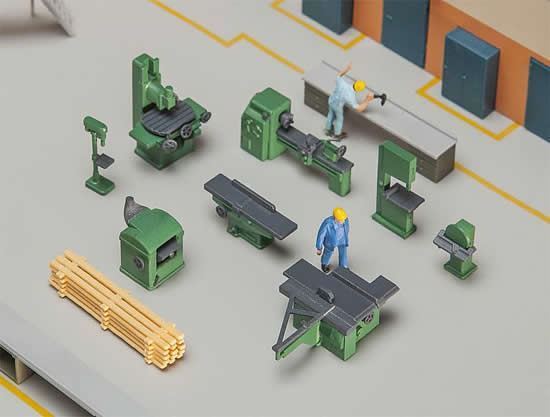 Faller_shop by Edmund, on Flickr
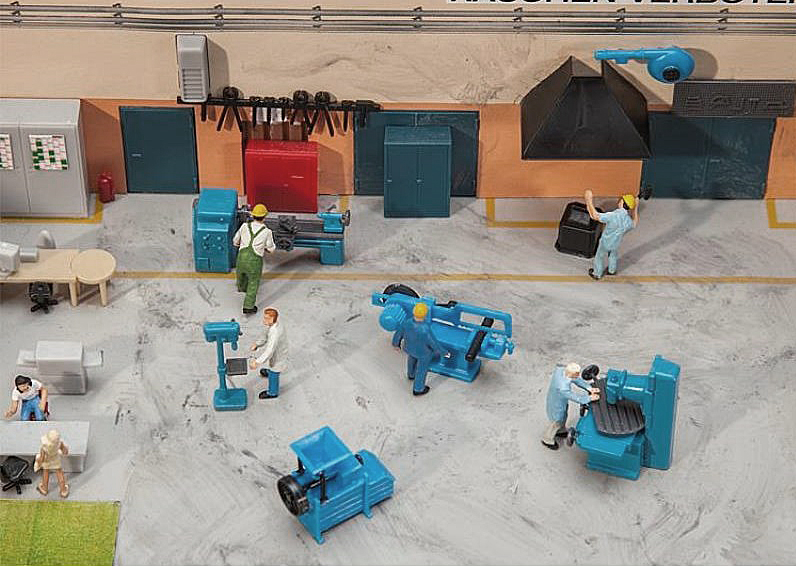 faller-180456-ho-187 by Edmund, on Flickr
Cheers, Ed
Those are great pictures Ed, but I think you need to get some of that carbon black and give the area a dusting. [(-D]
Just kinding! your work is beyond excellent.
As far as the 3D printing, I want my dry bulk trailers! There is more than enough 30’s, 40’s, and 50’s stuff to go around already! [:'(]
Mike.
My work? [:$] Naw, those are just stock photos from the Faller site, Mike.
I do have a passion for machinery and related tooling but I’d rather not clutter up this thread with all that. I’ll save it for WPF or “show me something” threads.
Still — thanks! [:D] Ed
How about 1/12 size models of old Lionel Standard Gauge equipment to run on Z gauge mechanisms to be used in doll houses??
Edit: Make that 1/8 size models. Z gauge of .256 scales out to about 3" gauge in “doll house” of 1/12. “Standard” gauge trains have a gauge of 2-1/8". I feel that such trains would be better proportioned to track size than to “environment” size unless they were unpowered.
For those interested: Kathy Millatt shows how she used Autodesk Fusion to design and 3D print some oil drums in resin in this 3 part series on MR Video Plus. Here’s the link:
The printer that she references in the video (Anycubic Photon, UV-cured resin printer in the $500 ballpark) is a game-changer. I think it’s still too small a build volume for cars, but I’ve gotten a friend who has one to do some HO-scale figure prints for me, and the quality is close to that of the fine detail plastic from Shapeways.
-
People, in the exact posture, clothing, and colors you want. I have few on my layout bacause they all look phony. The guy above with the drums looks like he’s pushing a heavy lawnmower more than an empty dolly. And few have hats because they are too thick when molded. Hats back in the day were on every head. That’s a big advantage of 3D: thin stuff without flash.
-
Cinder blocks. I bought several bags of them in HO but spent hours sorting good from bad. Too thick, too much flash, out of scale, etc. Plus they were white.
Thanks again to Dan, “Southgate”
Got my Alco engine blocks last week and gave them a quick shot of primer:
 Alco_engine by Edmund, on Flickr
They are just a little rough in spots but for the cost, they are excellent representations.
I bought the N&W boiler from a Shapeways designer. Now this is a work of art!
 Boiler_on_flatcar2 by Edmund, on Flickr
The boiler shell is hollow and even the flue sheets are modeled! The firebox walls are separate sheets just like a real boiler. Amazing stuff!
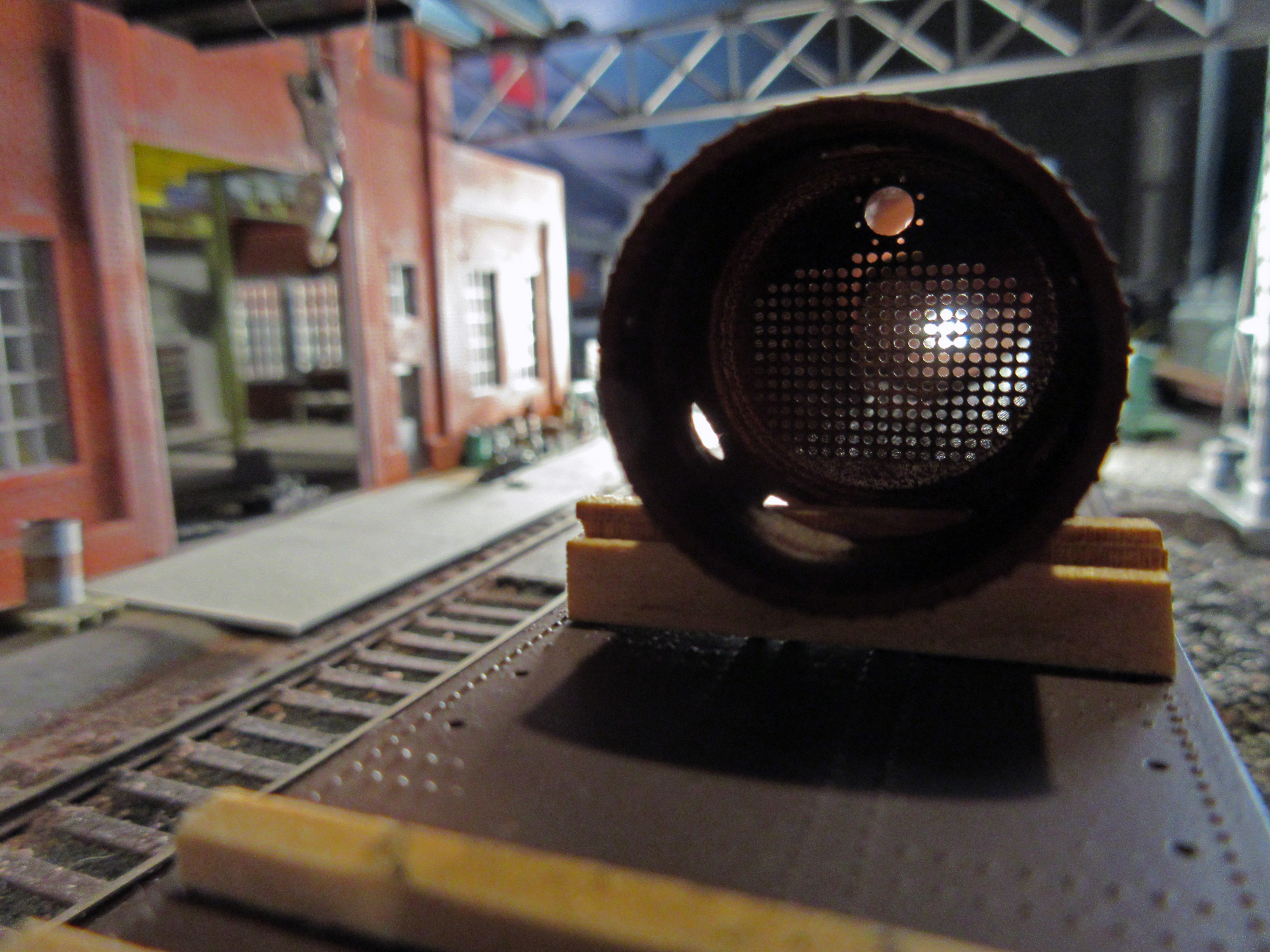 Boiler_on_flatcar by Edmund, on Flickr
One little caveat is that I notice in curved designs sometimes the rendering is made up of multiple flat planes to make the arc. In other words it looks like the sheet was bent using a multiple brake rather than rolling stands, if you know what I mean. Sometimes the part can be sanded but other times there is rivet detail that would interfere. There’s probably a way to make the “sampling rate” higher to mitigate this but for now I live with it.
You can see what I refer to in the Alco generators in the photo above.
Cheers, Ed
Ed,
The boiler looks much better now that it is painted. It’s easier to see all the details.
I wonder if the problem with multiple flat planes could be resolved by printing the generators on end, or any cylindrical object for that matter? I think I can see the same effect on the boiler.
Dave
Yes, it is on the boiler, too, Dave. There must be a way of making the rendering “sample rate” or resolution higher. There’s probably a trade off between resolution and production time, perhaps?
I’m sure it is something that can be overcome. I’ve seen many examples of nicely rendered curves in other 3D items.
Regards, Ed
Harrison, do you have your own 3d printer? Or do you borrow one from your school?
The reason I ask is because I have access to a 3d printer for free, but you have to buy your own filament and actually go to the place to get your stuff printed. And they are name brand printers, which means filament is more expensive…
I want to buy my own knock off, but prices for those are also high. I’m wondering if anyone has found a good deal that I missed in my research…
My robotics team has a Prusia i3 MK2.
Ah ok. Thank you.