I thought it was two but maybe it was four. I thought the act needed to be renewed at two and if renewed Amtrak could drop routes at four. I’ll go over my notes again.
As the government contributed capital it received preferred shares. But initially they were loans. Under the premise they’d be paid back. At incorporation the only shareholders were the railroads common shares.
I’ll double check my notes but I’m fairly sure on that.
It’s more useful to cut and paste the pertinent section of the Rail Passenger Service Act of 1970 (Public Law 91–158).
(c) The articles of incorporation of the Corporation shall provide
for cumulative voting for all stockholders and shall provide that, upon
conversion of one-fourth of the outstanding shares of preferred stock,
the common stockholders shall be entitled to elect four directors and
the preferred stockholders shall be entitled to elect three directors:
upon the conversion of one-half of the outstanding shares of preferred
stock, the common stockholders shall be entitled to elect five directors
and the preferred stockholders shall be entitled to elect two directors;
upon the conversion of three-fourths of the outstanding shares of pre-
ferred stock, the common stockholders shall be entitled to elect six
directors and the preferred stockholders shall be entitled to elect one
director; and upon conversion of all outstanding shares of preferred
stock, the common stockholders shall be entitled to elect seven directors.
Any change of directors resulting from such stock conversion shall
take effect at the next annual meeting of the Corporation following
such stock conversion.
The next section of PL 91 is more important, but I wasn’t able to copy.
But this is a good article on the whole process:
And here is the Public Law:
Amtrak has never turned an operating profit let alone one on a fully allocated cost basis. As of the end of FY24 it had an accumulated deficit of approximately $45.6 billion. According to the Congressional Budget Office (CBO), the accumulated deficit, when adjusted for inflation, is approximately $87 to $90 billion.
In FY24 the NEC had Adjusted Operating Earnings (AOE) of $267.8 million as opposed to $-251.5 million for the State Supported Trains and $-635.1 million for the Long-Distance Trains.
The NEC AOE averaged $19.08 per rider compared to an average loss of $17.35 for the State Supported Trains and $148.69 for the Long-Distance Trains. The losses for the State Supported Trains do not reflect the subsidies provided by their state(s) sponsors.
For the four years ended FY24, the NEC had an AOE of $136.7 million. The State Supported Trains had an AOE of $-773.9 million, and the Long-Distance Trains had an AOE of $-2,264.1 million.
The probability that Amtrak will achieve positive AOE for system operations by FY28, based on its history, appears to be an exercise of hope over experience. The long-distance trains are the 800lb gorilla in the room.
EY is Amtrak’s external auditors. This statement is contained in all of its audit reports: “the Company has a history of operating losses and is dependent upon substantial Federal Government subsidies to sustain its operations and maintain its underlying infrastructure.” I expect to see the same qualification in the FY28 and beyond reports no matter how management plays with the organization or numbers.
Expecting Amtrak to show a profit by any measure is a forlorn hope. The same is true of many public services: roads, schools, defense, etc. Profitability is an inappropriate metric to use. It stems from a notion that the profit motive is the only way to judge the utility of all endeavors. Even Adam Smith recognized that fallacy.
Sorry I took so long; I had other concerns to address:
The relevant section is 404(b)(3) and as far as I can see the reference is 2 years out (1973).
The reference I see to four years (1975) is section 405, concerning employees.
Since when have Governmental Services been expected to be profitable? How much profit do each of the armed services generate in comparison with the costs associated with those services?
Just because the legislation for a service mentions ‘profit’ doesn’t mean that profit is an actual possibility in the operation of that service.
It was already posted.
Had it open in the draft and didn’t check the current state of the thread before posting.
Amtrak Improvement Act of 1973:
1 Like
Very useful to fill out early history of Amtrak. Thank you.
At some point as a nation (or in your region or state) we need to decide whether we want a half-a**ed) passenger rail system or one people can realistically use as transportation. Something to be proud of, not feel ashamed of.
Note the can of worms that could be opened by the amendment to section 305 that inserted section (d) if the Federal Government had retained an interest in advancing the Texas Central project. I cannot imagine the Kleinheinzes were unaware of the potential here, if in fact that section is still in force as amended…
Note the insertion of 403(d) which calls for one new experimental route per year to be implemented (!) and then operated for two years before it could be dropped as ‘unprofitable’. Note also that the ‘deadline’ to start dropping unprofitable routes was only pushed out one year (from 1973 to 1974), not two years.
Meanwhile, consider the version of history encapsulated in the introduction to S.1500 (the Senate bill intended to put teeth in 49 CFR 24308(c).
(HR 2937 had the same text, and here is DeLuzio’s link for HR 9961…)
S.1500 doesn’t even cite the phrase “just and reasonable” in full…
Definitely a political can of worms, with opponents of improvement using misleading “summaries” and dubious interpretations to advance their agenda.
Speaking of a can of worms, look at the potential legal and Constitutional issues raised by HR 341, which nominally establishes ‘local option’ in dealing with blocked crossings. I personally find it astounding that someone in the House would word legislation this way, even with language supposedly ensuring a fine focus on the issue. Davidson gets points for not trying to tie it to “safety” (as in the omnibus rail bills after the East Palestine accident that tried to get this under the FRA purview of ‘safety’ by claiming a blocked train might impede ambulance or fire service) but I 'd argue it would be better, or anyway less dangerously quixotic, to establish a Federal bill with standard penalties about blocking certain classes of cross traffic while operating on ‘the national system of transportation’.
I had it exact opposite. The act lasted for 4 years and they could drop routes after 2. Sorry about that.
1 Like
Here is Amtrak’s statement of stock ownership as of July 31, 1971, after 3 months of operation. No preferred stock at that time. Not sure when the preferred started. I’ll research more.
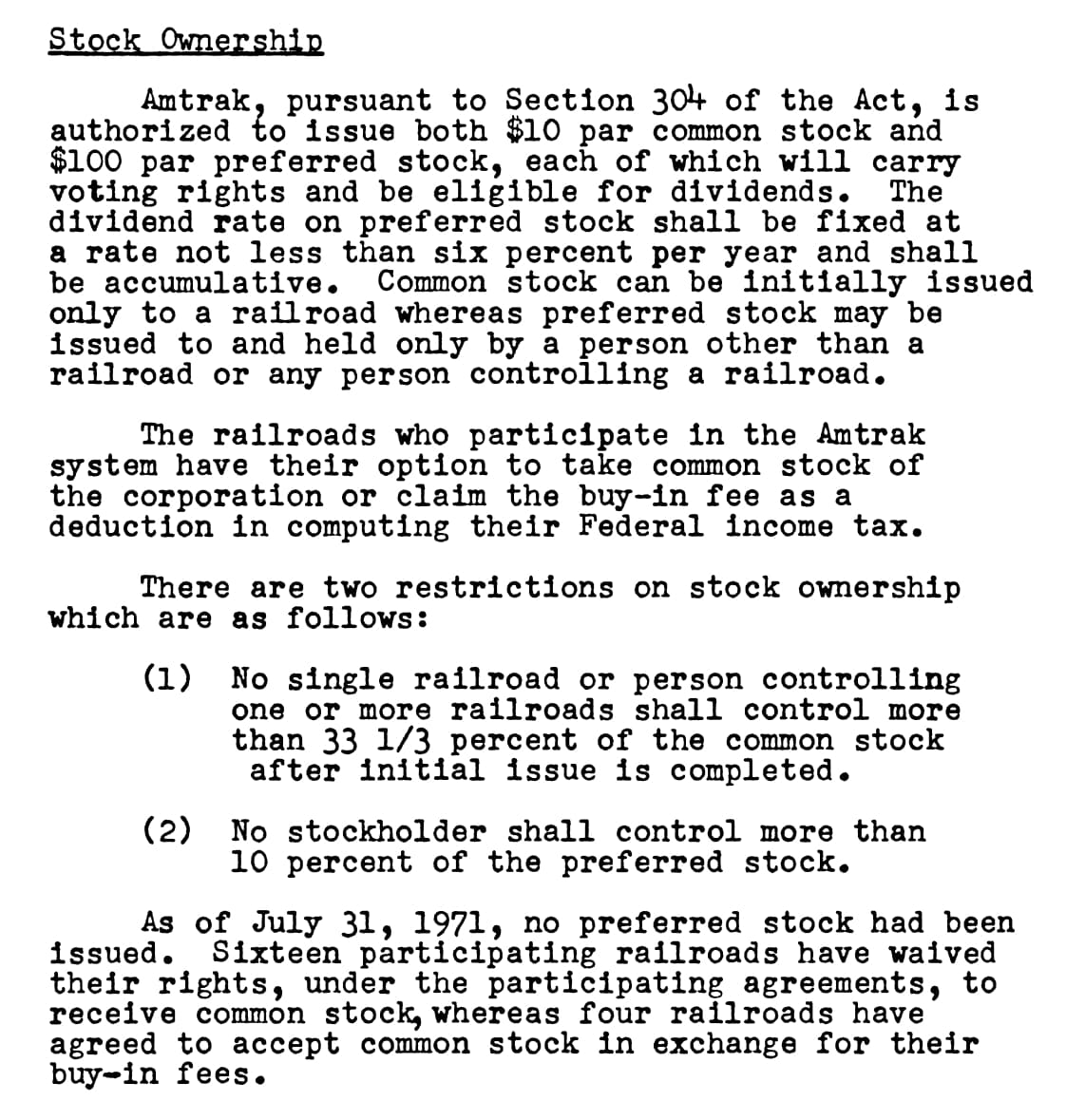
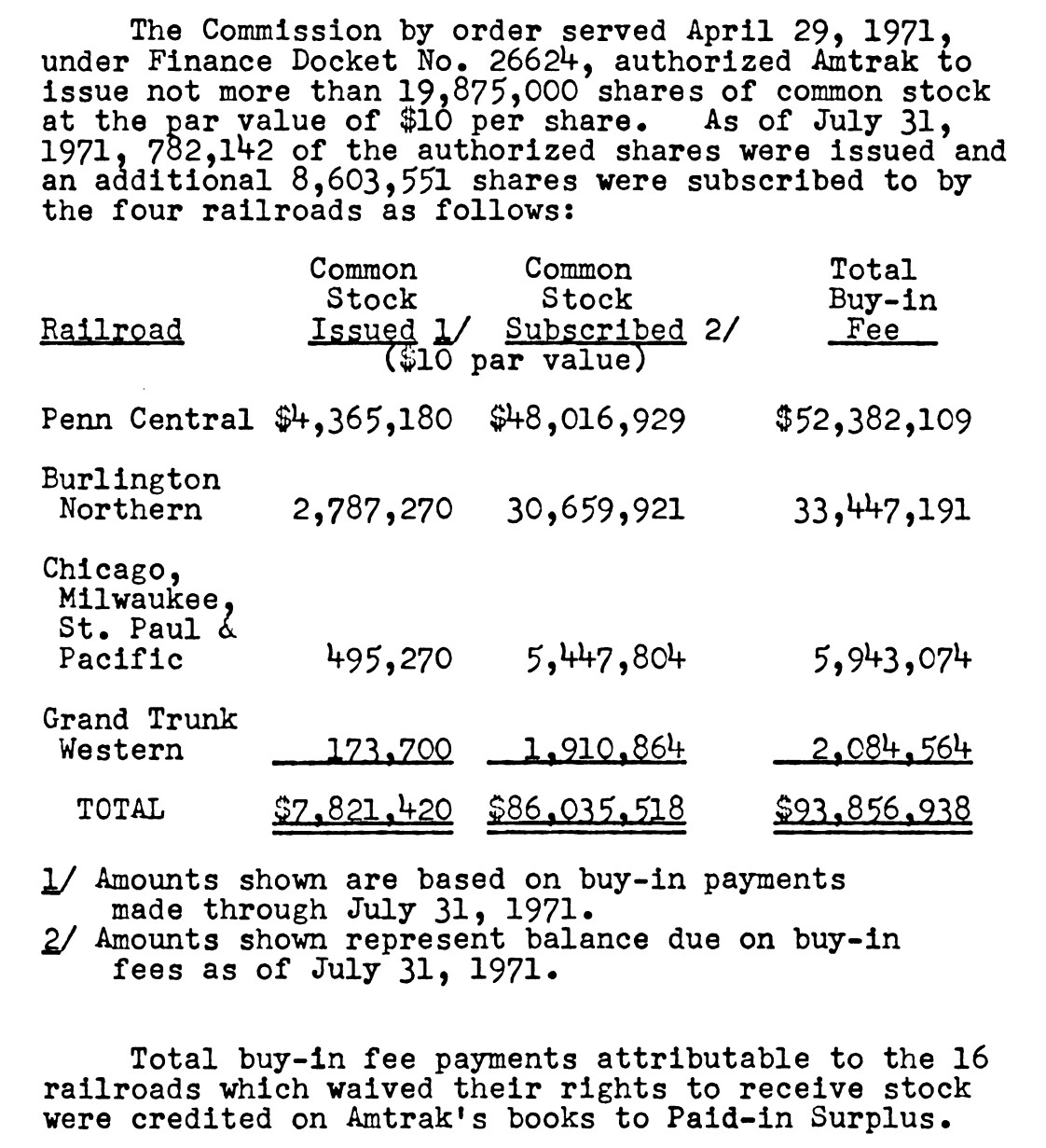
It looks like preferred was to be issued to the public but even in 1971 they thought no one would buy it.
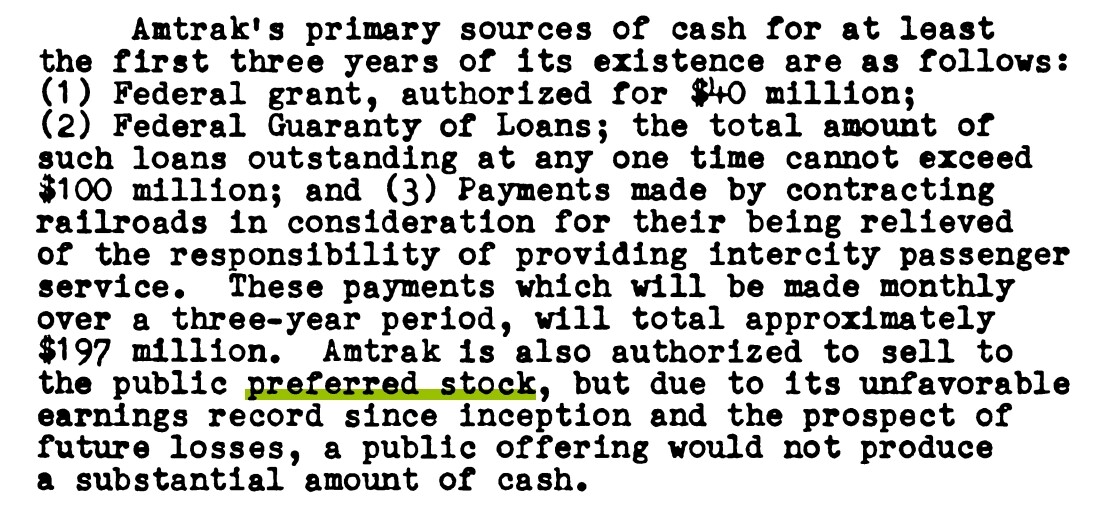
Railroads could not own preferred shares.
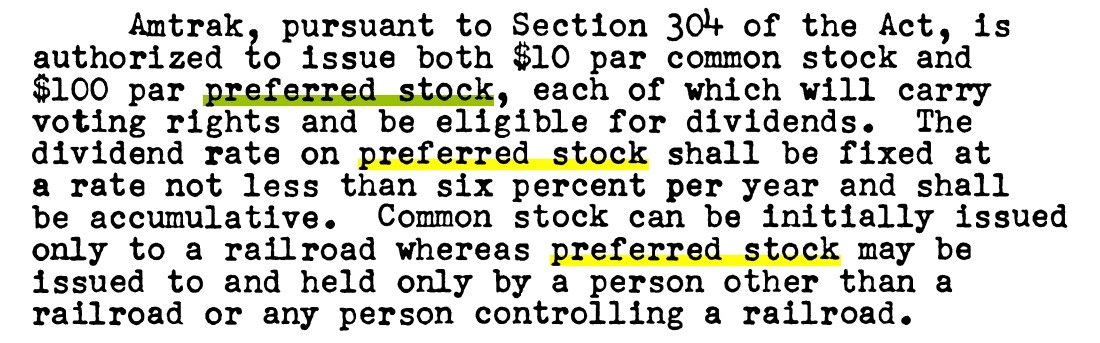
Still researching when Amtrak starting issuing preferred.
I had the impression the preferred was to stimulate private investment in ‘passenger operations’. Note that ‘no less than 6% dividend’ when we were still supporting Bretton Woods (end August 1971) and the return on bank deposits was fixed at 3%…
It was. But no one bought. A 6% return means nothing if they thought it might go out of business.
Preferred shares do not guarantee a dividend. Only that any dividends be paid before common shareholders. If a company has never made money they won’t be paying dividends. They can’t. Dividends are paid out of retained earnings.
Remember it was incorporated as a for profit company. In the first couple years they thought it could be so.
I’m out now but I found a site I’ll link later with Amtrak annual reports going back to its founding. Should make for interesting reading.