Best freight car kits to improve my skills?

Installing grab irons on Proto 2000 kits is not really a difficulty. It’s the stirrups that are challanging to remove from the sprue without breaking. And the stirrups are the ones that are most apt to break after installation if handled incorrectly, or if the car is laid on its side.

On a few Proto 2000 cars with broken stirrups I just replaced all of them with the proper type metal stirrup from A-Line. (You’ll destroy the car before bending or breaking one of those.) The challenge is drilling the holes straight from the bottom side into the narrow wall of the shell. They do look great when done well.

Tom

Nope. The small drills needed for this purpose are specialty hobby items and will need to be obtained from a hobby retailer or someplace like Micro Mark.

McMaster-Carr is a good source from small drill bits and screws at good prices. You’ll also want a good pin vise(s) small enough to handle #61-#80 drill bits.

Tom

[quote user=“tstage”]

Pennsy_I1

Pennsy_I1
…I’m looking to improve my skills.

Gidday, Ok, all very good advice so far but depending on what skills you’re actually wishing to improve, I’m going to put it out there that an Athearn blue box freight car kit is a great step.

Unless you can get an undecorated kit, you can learn how

to paint strip,
to remove cast on moulding,
to thin roof walks,
to make your own grab irons and steps,
to drill # 79 holes (preferably with out breaking them, a problem that the Bear has

[quote user=“dknelson”]

The O.P. mentioned that price was an object, and I understand that when new skills are being learned. And there might be money that needs to be spent on some tools that have not been needed up to now. The original LifeLike Proto2000 freight car kits are often seen unbuilt at train shows (remember those? ) for as little as $5, and of course you take what you can get in the way of prototype. I’d start with the flatcar if you can find it.

The days are long gone when the first of what I’d call “complex” plastic freight car kits was the Kurtz Kraft PS-1 boxcar kit from the late 1950s. It came without trucks or couplers in a plastic bag and sold for 89 cents! Or was it 79 cents? Separate ends, sides, roof and floor, separate ladders and grabs - and this came at a time when plastic had the reputation of being for inept modelers and kids. Not many modelers actually had any skills back then working with styrene. Just about the time modelers got good at assembling Kurtz Kraft kits, the line disappeared. The next similar car a few years later was the Pacific HO mechanical reefer which Silver Streak and later Walthers ended up selling. But again once you learned and got good at it (meaning your first car might be a bit rough around the edges and there were also design flaws inherent in the Pacific HO mechanical reefer that Walthers was never able to cure) there was little to no other line of plastic kits that your newly acquired skills could be applied to.

That is why the Gould plastic kits - tank car, flat car, locomotive crane – were such a revelation at the time when they came out, oh I think 1980 or so. And once again skills had to be learned, although by that time there was more kitbashing and scratchbuilding going on in plastic as well as kit modification, so for some guys the skills were there. The Gould

The Bowser freight car kits are, imho, a good bang for the buck. Fun to assemble and, with detailing and weathering, look pretty nice.

They’re not Genesis level but are a nice step above the traditional Athearn blue box kits.

Great! Thanks for giving us some price “boundaries”, Pennsy. And I get needing to find a job and watching your pennies. Been laid off twice in the past 6 years.

Okay, next question: What type PRR steamers are you looking for? Switchers? Mikados? Large steam? If you give us your preferences we may be able to hunt something down for you.

Although I don’t know why a NYC guy would want to help a PRR guy. [;)]

Tom

Just to note, most PRR steam engines can be had for very little. They may need some work, but imo thats much better than scratch building, unless thats your thing :wink:

Nearly every single PRR steam engine thinkable has been made in brass (A5,B6,E5,E6, G5, K2, K4(and both streamlined), K5, H6, H8, H9, H10, L1, M1, I1, N1, T1, Q1, Q2, Turbine, etc. )

MOST can be had for around $170 (unpainted,stock motor) if you look long enough on ebay. Others, notably the larger engines not so much. Some will need some work, but I think its worth it in the long run.

Aim for Olympia, Gem, Alco, United, PFM, Sunset, and Westside brass makers.

BLI PRR engines can also be had for cheap too, M1s these days are selling like hot cakes for around $100-$150, and others for less than $250(if you really look hard enough).

Im not saying dont scratchbuild, but if youre doing it soley for the purpose of saving money, I dont think its worth it.

Cheers!

Charles

Dave: That was an excellent post. I enjoyed reading it all the way through.

Thank you.

-Kevin

Wow, I’ve never considered myself skilled kit builder but Ive built around 5 proto 2000 boxcars and a couple of gondolas and a covered 3 bay hopper. I guess that guy freaked out when he saw all those bitty parts. I used a xacto blade to cut the parts off the sprue by a few years later got a sprue nipper at a train show and it makes despruing a breeze. I’d have built more boxcars but they are a bit too early for my late 70’s theme layout.

Many years ago I started out my kit building experience in HO with an Accurail boxcar. My 2nd kit? A Proto 2000 tank car. Wow! - What an awakening! [:O] As I remember it, it took me 8 hrs to assemble it…but I did it. The 2nd tank car? A little over 3 hrs.

Even now I prefer kits to RTR. However, other than Accurail and undecorated versions from Tichy and Tangent, very few manufacturers are making new kits anymore. Thankfully, there are some still available at train shows and on eBay. And one of my LHSes still has quite a number of Branchline AAR boxcars on the shelves. It’s too bad that most don’t fit my era. [:(]

Tom

My thoughts on the Proto freight cars are somewhat ambivalent…I like the idea of the free-standing details, such as ladders and grabirons, but didn’t at all care for the overly thick plastic grabirons. They were a pain to install, apparently, as I picked up dozens of partially-built ones off the “used” table at my then LHS.
I used Evergreen styrene rod to plug the holes in the body shells, then drilled suitable holes for installing metal grabirons, either from Tichy or, when necessary, ones custom-bent from Tichy’s .125" phosphor-bronze wire.
When LifeLike changed to r-t-r cars, that same hobby shop, which almost never had a “sale”, put the remaining unbought kits on at very good prices, I cleaned-up on them. It was a relief to not have to do repairs on the screwed-up kits from the used table.

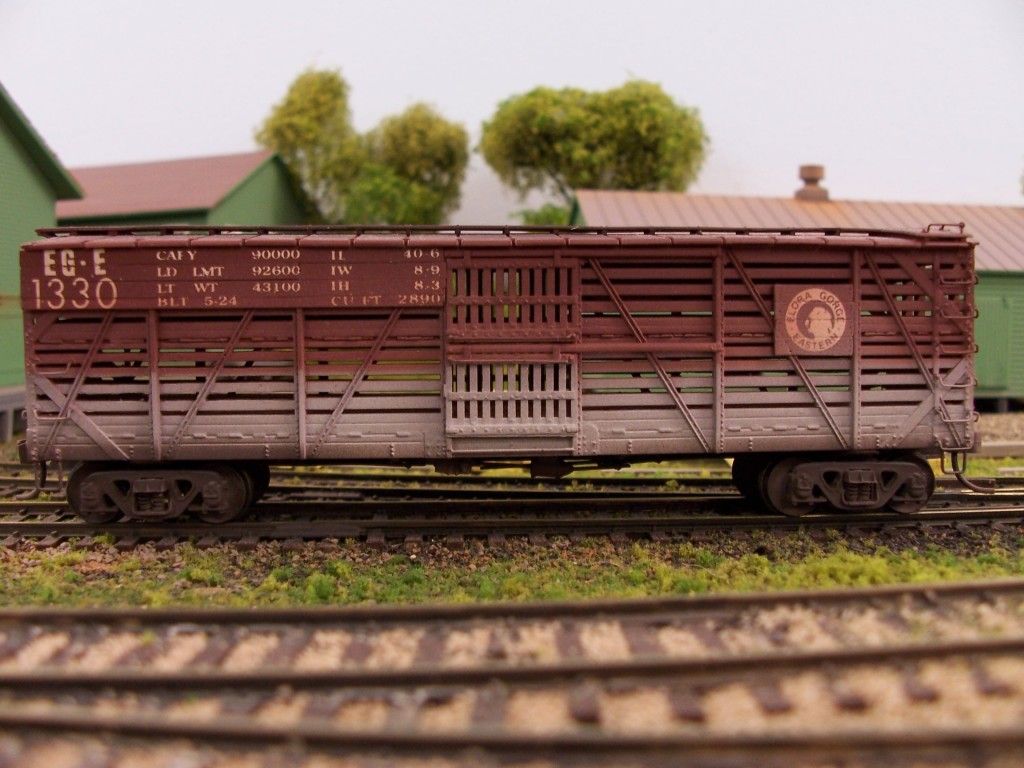
Here are a few re-done Proto cars, mostly recovered from that “used” table in multiples (all of the photos should enlarge if clicked-upon)…

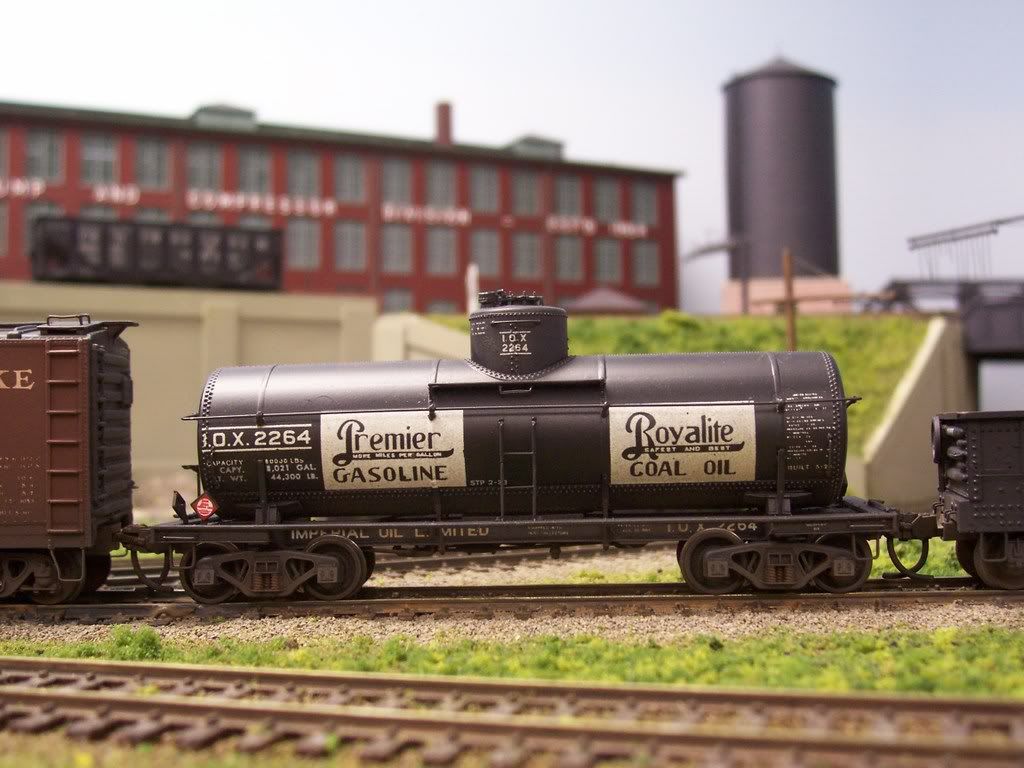
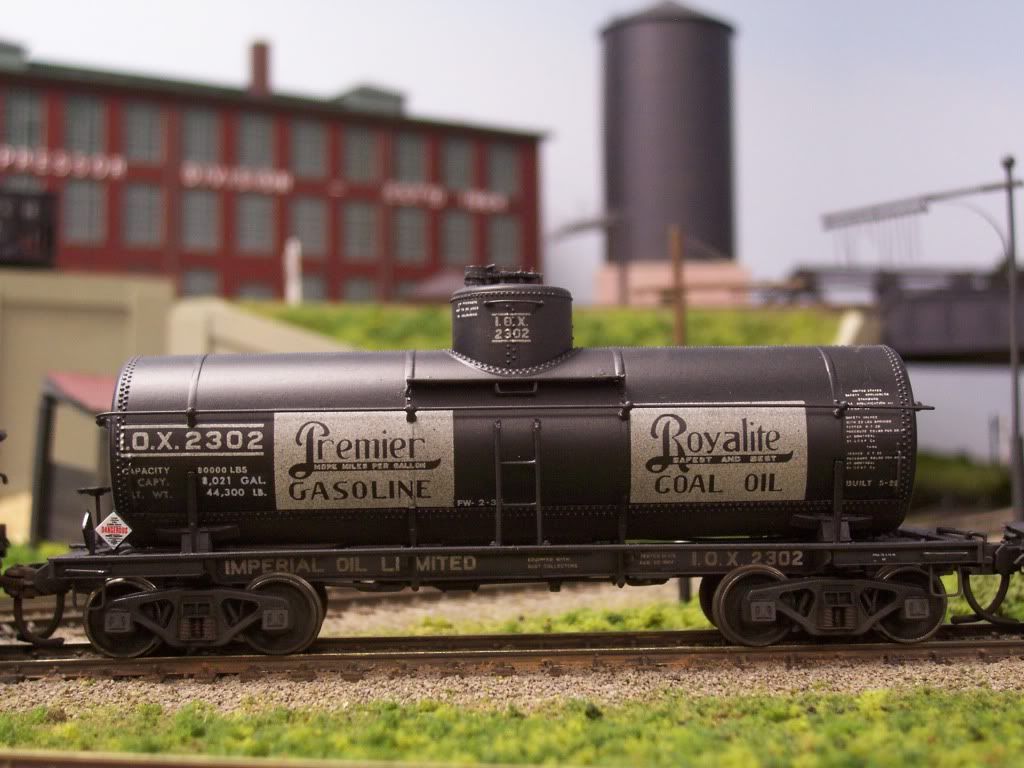
…and a couple of the many tank cars, at least one of which was factory-lettered as shown, but was in such rough shape (ca all over the place, along with broken plastic grabirons) that I stripped it before rebuilding it, then stripped a second one in a paint scheme that was too plain for my tastes, repainting both and lettering them with similar C-D-S dry transfers…

I did buy quite a few of the Proto gondolas, many lettered in very obscure roadnames, and therefore eventually put on

Wayne,

I think you just broke your own record for longest post and most photos - LOL! Good stuff, as usual. [Y][:D]

Tom

Thanks, Tom, I guess I did get carried away a bit.

The latest version of photobucket really makes including photos quite the onerous process. Most of my albums there have, due to some glitch in their software, I think, multiple copies of the same photos, so an album that might have had 150 photos now has over 600.
They also did away with the page-by-page album format, so instead of going to the page (or near the page) where I recall the photo to be, the process now involves scrolling to find the desired photo.
Once that photo (perhaps of the kit parts) is first “viewed”, then “copied”, to be pasted here, when I return to get the next photo, I have to start again at the beginning, and scroll through again looking for that second picture. The fact that there are multiples of each photo make the process very time consuming - creating that long-winded post took over four hours, mainly due to hunting for images to illustrate the words.

I’ve approached photobucket multiple times to reinstate the page-by-page format, at least as an option, but if it’s not changed by the date of my next renewal (in August), there will be no more pictures from me, and likely no more input here either.

I think that most folks here will skip a long-winded written-out process, but will at least tolerate it if there are also some decent pictures to view. (I generally do read the long written posts if the topic is of interest, but often would appreciate a few photos if the poster has them.

Wayne

I thought the scroll button would do it but my finger was getting tired. Next time I’ll used the scroll bar on the right hand side. [B)] Maybe Wayne is working on the “captain Kirk” award. Ain’t he some’tin?

Wayne

Why don’t you just go to a Google Blog as a picture host. You could make your own picture archives and organize them anyway you want.

You could call it Dr Wayne’s pictures and your own text describing them.

I’ve been using my blog for my picture host since the big Photo Bucket rip-off.

I use the Pages portion without posted addresses or indexing for the picture archives.

All I have to do is click on “Copy Image Location” and paste to the Forum.

Mel

My Model Railroad
http://melvineperry.blogspot.com/

Bakersfield, California

I’m beginning to realize that aging is not for wimps.

Sorry for the late response. Lots going on still, especially with the holidays getting near.

According to the info I found, I1 Decapods were the most common, with L1 Mikes, M1 Mountains, and various 2-8-0s appearing quite a bit on freight. E6 Atlantics and the occasional Pacific handled the passenger trains, with B6 and B8 0-6-0s handling the yards. There was a single A5 0-4-0 in Williamsport to serve some industrial trackage. No streamlined, articulateds, or the later big engines went up the Elmira Branch due to clearance and weight restrictions, though if I find one I might run it for fun or during open houses.

The NYC did have trackage rights on the Elmira Branch north of Southport Yard (near the end of my layout). So a few NYC engines (probably Mikes, not too

Victoria,

Just for ease of recommendations I’ve listed out the locomotives you mentioned from your response above…

PRR:

  • 0-4-0 A5 switcher
  • 0-6-0 B6/B8 switcher
  • 2-8-0 H1-H10 Consolidated
  • 2-8-2 L1 Mike
  • 2-10-0 I1 Decapod
  • 4-4-2 E6 Atlantic
  • 4-6-2 K4 Pacific
  • 4-8-2 M1 Mountain

NYC:

  • 2-8-2 H-5/H-6 Light Mike - H-7/H-10 Heavy Mike
  • 4-8-2 L-1 thru L-3 (freight)/L-4 (dual-purpose) Mohawk

Erie

  • ???

I also listed the NYC locomotives that would most likely be found on the Elmira Branch. Mikes and Mohawks were the main freight haulers. The L-4 Mohawks were “dual purpose” and could be used for both freight & passenger service. The Niagara was primarily a passenger locomotive because of the large (79") drivers.

Tom

[quote user=“tstage”]

Pennsy_I1
According to the info I found, I1 Decapods were the most common, with L1 Mikes, M1 Mountains, and various 2-8-0s appearing quite a bit on freight. E6 Atlantics and the occasional Pacific handled the passenger trains, with B6 and B8 0-6-0s handling the yards. There was a single A5 0-4-0 in Williamsport to serve some industrial trackage. No streamlined, articulateds, or the later big engines went up the Elmira Branch due to clearance and weight restrictions, though if I find one I might run it for fun or during open houses.

The NYC did have trackage rights on the Elmira Branch north of Southport Yard (near the end of my layout). So a few NYC engines (probably Mikes, not too familiar with NYC freight steam. I do have a Niagara, so that’ll be there). Occasionally the Erie would run detours when their mainline was blocked, and I do plan to model the Elmira station.

Victoria,

Just for ease of recommendations I’ve listed out the locomotives you mentioned from your response above…

PRR:

  • 0-4-0 A5 switcher
  • 0-6-0 B6/B8 switcher
  • 2-8-0 H1-H10 Consolidated
  • 2-8-2 L1 Mike
  • 2-10-0 I1 Decapod
  • 4-4-2 E6 Atlantic
  • 4-6-2 K4 Pacific
  • 4-8-2 M1 Mountain

NYC:

  • 2-8-2 H-5/H-6 Light Mike - H-7/H-10 Heavy Mike
  • 4-8-2 L-1 thru L-3 (freight)/L-4 (dual-purpose) Mohawk

Erie

  • ???

I also listed the NYC locomotives that would most likely be found on the Elmira Branch. Mikes and Mohawks were the main freight haulers. The L-4 Mohawks were “dual purpose” and could be used for both freight & passenger service. The Niagara was primarily a passenger lo

Hi,

I’m a bit late to the party… but here is my answer to the OP’s original question.

Decades ago I started out with Athearn and MDC kits and of course they were pretty easy. But later on I modified them with KDs, steel wheels, weathering and so on. They turned out to be very reliable runners, and good looking too!

But the next steps - for me - was (in order of my difficulty) were kits from Walthers, Red Caboose, and Ulrich. Ulrich was a totally new twist as they are metal, and have sprung trucks, and so on.

Anyway, these kits are still on Ebay, so you have a lot to choose from.