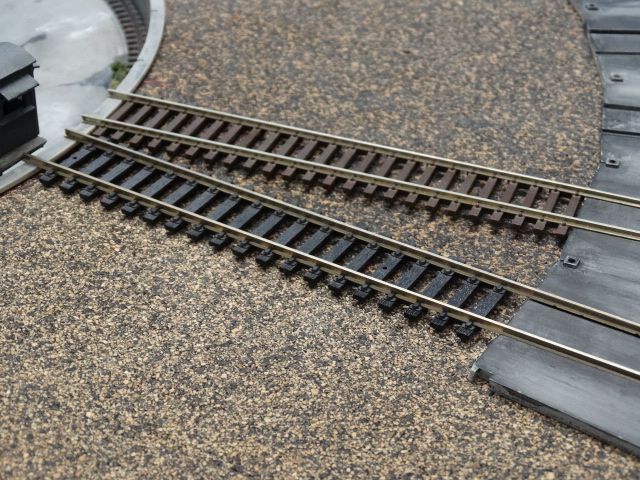
Just for the sake of interest, here are Atlas Code 100 and Code 83 side by side:
My old club decided on Code 83 when we started our new layout in 2017. We initially decided to use Atlas flex track and Peco turnouts, but when we added up the cost of the Peco Code 83 Streamline Electrofrog turnouts vs Atlas Code 83 Custom Line turnouts, we decided to save ourselves $1000 in turnout costs by using Atlas.
Note that there are a couple of things that may be different between the club’s situation and your own. One is that we used Tortioses on all the turnouts. Had we used Peco turnouts we would have had to remove all of the throw bar springs which kind of eliminates one of their strong points. If you are going to use Tortoises then I would suggest considering Atlas Code 83 Custom Line turnouts instead of Peco. The Atlas turnouts work really well.
Another thing to consider is that, because you are building a switching layout, you may want to power the frogs. If you are going to use two axle switchers then you will definitely want to power the frogs. Both the Peco Electrofrogs and the Atlas Code 83 turnouts allow you to do that. The Peco Electrofrog comes with a frog feed wire built in whereas the Atlas requires that you tap the hole that is already built into the metal frog and then use a suitable bolt or screw to attach a frog feed wire. (That’s easy to do, but you don’t want to tap the hole all the way through. You want the bolt or screw to be an interference fit in order to obtain a good electrical connection. The Atlas frog is very difficult to solder to, although it can be done.)
When it comes to track appearrance, skinnier is always better. A very similar debate happens in HOn3, where many swear by Code 55. I’ve got a little, Most of what I use is Code 70. Once you weather and dirt it in, it’s a lot harder to tell the difference. And the older I get, the less I can see the difference. But Code 70 is marginally sturdier than 55, so that’s also a good thing IMO. You can either obsess over track or you pick your dragons to slay and those you just send on down the line.
I am stockpiling code 70 supplies for the day when I start my branchline railroad. I am also awaiting Peco’s code 70 switches; seems like they have been in limbo forever.
After you paint code 100 rail it looks much smaller than it does in bare bright nickel silver. I lucked out on a stash of used code 100 track for free and so my layout is all code 100. After I brush painted the sides of the rail in rail brown the code 100 looks quite decent.
The standard for our portable modules was code 100 and Peco insulfrog turnouts. After painting various shades of rust the rails look dramatically different.
For my home layout I was considering code 70 for the mains and a combination of code 55 and 40 for yards and spurs. All hand laid on CVT ties. But after the grandkids moved in I have lost the space. I did experiment with some N scale code 40 on the CVT branch line ties but it really does not look all that great. The rail base is way too small for the tie plates and the HO wheels are gigantic in width. Unless you are going scale wheels track code makes little sense to worry about.
Here we go again. If anyone’s interested in earlier discussions about it on this forum: http://cs.trains.com/mrr/f/88/t/109265.aspx. See you in six months to discuss this topic again!
I notice that you are building a switching layout. Are you building it mostly to enjoy switching and operations or are you also going for a high level of accuracy in your modeling?
Normally I’d just say go Code 100 and save some bucks, and if you’re just building for operations, then that’s still how I’d go. However if you’re building a smaller layout and are going to be going for a high level of accuracy, then I think it would behove you go go with code 83 or less. As for Peco Vs Atlas Vs, whatever, I would buy switches based on accuracy-to-prototype.
Friend of mine did his old N scale layout with code 40, hand laid the turnouts. Looked nice. He tried some code 25 for sidings - code 25 ‘rail’ is just wire pressed into an oval shape, there is no web, head, and base detail - because you couldn;t see it. You don’t notice that unless yoou use a magnifier. But he also said, never again, it was just too small to work with.
If you want availablility, robustness, and relatively less spendy, use Code 100.
If your priorities are different, say if you want realistic dioramas or scenes on a layout where your camera will be down at ‘eye level’, go with Code 50-ish and up to Code 83.
Here is how large Code 100 looks:
As you can see, it’s right up around the equivalent of 165 pounds/yd.
Code 83 is quite noticeably more modest in size, but you probably won’t notice until you see similar images side-by-side, or the tracks themselves in situ.
I’d add that my view is that I’d maybe see '83 as more future-proof, possibly.
Also for peco the turnout check-rails are metal not black plastic and the ties and their interface with the rail is more finely modeled.
I used peco 83 for years without issue, although I do know that many exhibition modular modellers here in the UK opt for code 100 as it’s seen as more robust.
In praise of code 100 this layout uses Shinohara code 100 and I think it looks perfect for the modern US prototype.
Building my new switching layout and I’m between code 100 or 83. My past layout was all atlas sectional code 83. I’m going to be using peco and wanted to get a good opinion from people who use 100. I like code 83 but the PECO 83 turnouts are $10 more than the 100. Is it worth it to spend a little more for 83?
On layouts that depict heavy hauling the code 100 track would be accurate verses lighter loads using the code 83, but to answer your question I would use the 100. there is a trasition piece of track that is 83 on one end and 100 on the other. that way you keep 83 laid track and new addition track would be 100.
If it’s a small switching layout, why not hand lay the track? Get a FastTracks jig (or two), some pc and wood ties, some ME rail, and go at it. I have ~30 turnouts on my layout and I built them all. They operate flawlessly. The code 83 jigs also work with code 70 ME rail, so you can build either/both. I have a #6 turnout jig and a #4 wye. I’m sad I don’t have any more to build, I really enjoyed it! The two jigs (~$100 each), amortized over 30 turnouts, plus rail/ties/spikes, is less than $10 per turnout.
The OP’s profile says he is 20 years old, so more power to him. At my age, I’d rather just chew on track spikes, then lay my own track, while I mail order track.
I started in the hobby when life was much simpler. You chose code 100 or built model airplanes. The second layout offered two choices and I was bitten by the code 83 bug. The third layout was/is a switching layout with a lot of in-street running, a lot of sidings and track shared with a fleet of streetcars. C83 gave me all kinds of grief, especially in ‘push’ maneuvers. Out came the code 83 and the Atlas #4’s. What helped the decision was Peco’s code 100 turnouts. No need for switch machines and the need to hide them under the table - at least those close to the layout edge - and especially for those in in-street running. I overcame the toy-train stigma of sectional track and like it because it provides an accurate radius for my streetcars (I use 15" radius, and yes for all you bigshots with minimum 32" radius Atlas does make it. Yeah, I’m not crazy about the tie size, but again, for the track buried in the street I couldn’t care if the ties xame in pink. For the rest of the track, I paint the ties and rail and ballast and it’s a done deal. No derailments.
Also, a big decider was at the time I was thinking about changing to Peco, the only turnout in code 83 was their wye.
Bottom line, don’t beat yourself up over the code. The nitpickers will move on to another part of your layout to criticize. If I were building a switching layout I would go with Peco and determine the code by the availability of turnouts.
I mean you can do both, there are transition joiners that can switch between Code 100 to Code 83 even down to Code 70 if you really want it. Create a cool effect with a heavy Code 100 mainline that slowly drops down to a Code 70 rail spur.
Also remember if you choose to follow a modular standard on any future project, different modules have preset standards, Free-Mo for example is Code 83 on mainline rated modules and can be Code 70 on branchline. I don’t know what the NMRA “Triple track” module standard is, but it likely is Code 100. All the codes have their purposes. 83 is my personal favorite, but many people are just as happy with 100.
From a usual viewing distance of two feet (or a little more), I doubt that anyone can really tell the difference between painted, weathered and properly ballasted code 83 and code 100 track, unless the are laid side by side.
Plus, code 110 wheels, which are the norm, are too wide. Smaller rail just emphasizes that even more. Unless you’re into proto87 with scaled down wheels, I don’t think it matters much.