You know, there’s a happy medium too  I have a small coffee table layout in progress, and I have two full controller setups- 1 DC for older and/or decoderless runs, and 1 DCC for my prime movers and the newest stuff. With the layout being designed around simplicity and allowing guests to operate it, there’s no sense in locking myself into one technology! (imagine trying to tell a newb how to switch locos and maintain speeds and blah blah… no thank you! So yeah, you might say I stand on “both sides of the tracks” about the issue
Observation - those of us happy with DC don’t use block toggles. Those using DCC keep telling us that block toggles are the problem with DC. I guess that explains it.
Sheldon
Jeff,I don’t use blocks on my ISLs so no block flipping for me…If I did use blocks I would use Atlas selectors anyway and would leave my route lined…
I used DCC and found its ok but,overkill for a small 1 horse ISL.
You don’t need toggles when you only run one train at a time.
The way my control system and layout are designed, I can run 4 trains at a time on the mainline, and four more on branch lines and industrial areas, and still not flip any toggles.
Fact remains, toggle switches or rotary switches are likely the worst way to wire ANY DC layout. Yet these poor examples of clumsy DC systems are all that many have ever seen.
Sheldon
i didn’t want nothing to do with dcc. it scared me just like computers and dc was good enuogh. one day a guy i knew showed me his ho railroad. i saw him run engines on the same track going different ways. i had to know how he did it. i lookd for bunches of wires but there was only a couple of them. he said it was dcc. he gave me a little card showing how engines program and how cv works. was easy. i didnt feel so dumb anymore and went dcc later. i like runnin engines anywhere i want with out it messing with the other engines in the block.
You’ve got me curious. Without toggles or slide switches like the Atlas Selector, how is it you are able to independently control so many trains. Way back in the 1960s my brother and I bought a used 4x8 HO layout that had two power packs, each controlling a different loop of track, so there was no need to for switches. Is there another way to assign a train to different throttles without the use of some type of manual switch?
I agree I think DCC is the greatest improvement the hobby has made in 50 years. Take away my DCC system and I start modeling airplanes. - Nevin
Yup, DCC did a lot to enhance operation and to ease wiring - for me! I would not want to go without it. Finally, it is an issue of personal preference - if your happy with DC, why not!
Ditto. I just can’t see how a train on a DC layout can negotiate a return loop without a set of toggles to change the polarity.
Tom, don’t they live under bridges and start flame wars?
Cuda Ken
Sheldon,
Please enlighten us on this amazing control system that you have that allows 4 trains to be run on your mainline without using switches. Is this some variation of the “magic wand” system our japanese modeling friend uses to throw his twin coil switch machines. A red wand, a blue wand, a yellow wand, and a green wand and when I wave it in the air the trains move? Please explain how your system works. Pictures would be even better.
I am scratching my head over that as well…
Well first let me say that it does involve some advanced planning and wiring. And is not easily explained in a short response. But, using a combination of wiring methods developed over all the many years since DC trains began, it is very possible to wire a layout for multiple train operation with very minimal “operator input” in terms of assigning cabs to track sections.
If you have access to any old MR’s, you could start by reading the series of articles by Ed Ravenscroft that appeared throughout 1974. And, Paul Mallery’s “Electrical Handbook for Model Railroads - vol 1&2” covers many methods of advanced cab control which minimize or eliminate “flipping switches”.
Some of it is done automaticly by turnout postion. This is more than simple power routing that you may already understand, but actually involves hard wired logic that connects some sections of track differently based on turnout positon.
I use a pushbuttion system that allows the few “cab asignments” that are needed, to be made from multiple locoations as you walk around with your train, just like wireless DCC. And, my throttles are wireless DC throttles from Aristo Craft.
OR, on the mainline, as the Dispatcher aligns your route and gives you clearance, his actions at the CTC panel assign your power for you. All you do is run the train. Signaling and CTC operation is a big part of my model railroading goals. My signal/CTC system is built right into my control system and my turnout control system. It is all intergrated.
Far as running 4 trains on DC with no switches or toggles, that easy!
K-10 model train has two DC loops on his layout. Each loop has around 10 MRC 9500’s. Each one controls around 30 feet of track, then plastic rail joiners, then next 9500 picks up from there.
When I was DC, I could run two trains at the same time. Only switches I had where to kill power to spurs so engines could sit.
Time to get out of here before there is incoming!
Cuda Ken
Hahahaaaaa!!! Where the heck are all those wires going?? I love this picture- subliminal nonsense, like a horse with a fuel filler cap on its arse!
In my case, return loops are only used in stagging areas. Trains pull in to the loop and stop. The turnout is thrown, the once west bound train is now east bound so the operator reverses the direction on his wireless throttle, and he can now go back the way he came.
As you stand and look at any train, with your Aristo throttle in your hand, the left direction button sends the train to you left, the right one sends it to your right. Simple.
The “reversing” is done by relay contacts that mirror the switch machine.
Sheldon
This too is a time honored method of DC control that works very well for some layout designs.
Track plans and control systems should be tailored to the needs/wants of the user. There is no perfect track plan and no perfect control system.
Sheldon
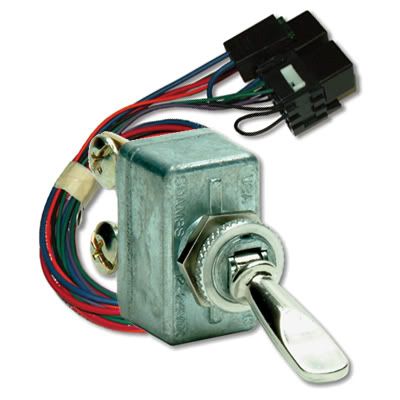
Actually come to think of it plug and play toggle switches for model railroading would be nice…
A P/P toggle switch could be used on DC or DCC layouts.