Digital Cameras

I agree with you there. Usually I’m shooting at f22 sometimes up to a minute exposure. That wouldn’t fare well with a moving train.

I would like to play with stacking and also the High Dynamic Range, which requires “exposure” stacking. I think Photoshop will do the latter but not the former. I thought Lightroom had stacking capabilities but I could be wrong.

I’ll have to look into stacking software a little more thoroughly.

Regards, Ed

Adobe Lightroom has high dynamic range stacking, but not focus stacking. I’ve used it, and my experience is that Lighroom’s HDR stacking does nothing to improve my model photos taken under the indoor lighting on my club’s layout. We have pretty good and uniform daylight-balanced lighting at the club.

The almost-head-on Wisconsin & Southern model train photo with the depth-of-field problem I attached above was not a moving train; it was stopped and posed for the picture, with exposure f/40 at 5 seconds.

http://petapixel.com/2015/01/21/stay-focused-app-brings-focus-stacking-iphone-camera/

I agree, and once you’ve used it for a while, you’ll have a better idea of what you need.

I started out with Kodak CX6200 borrowed from my daughter. It’s a 2 megapixel point-and-shoot, with very limited options, so very easy to use for pictures like this:
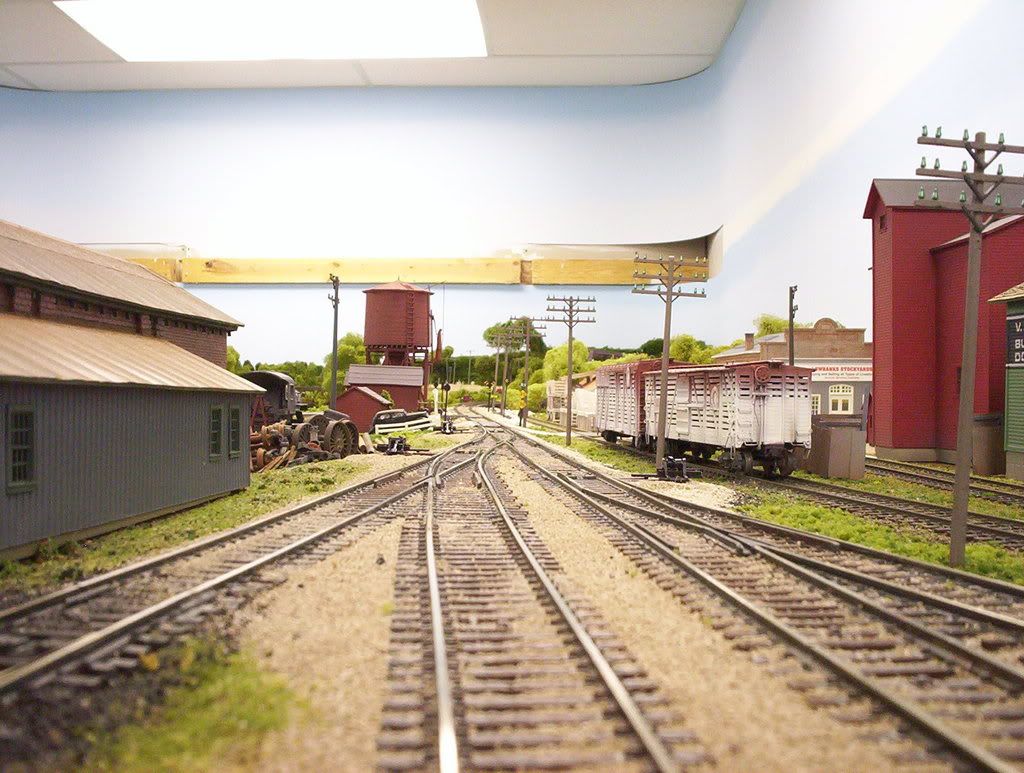
…or this:
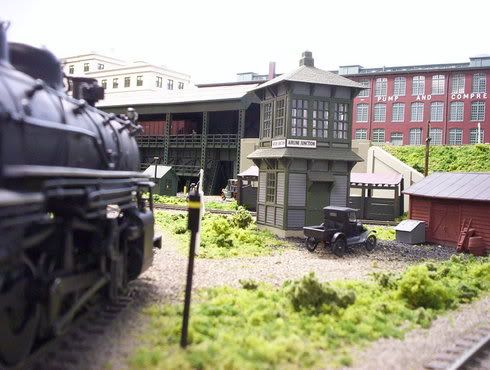
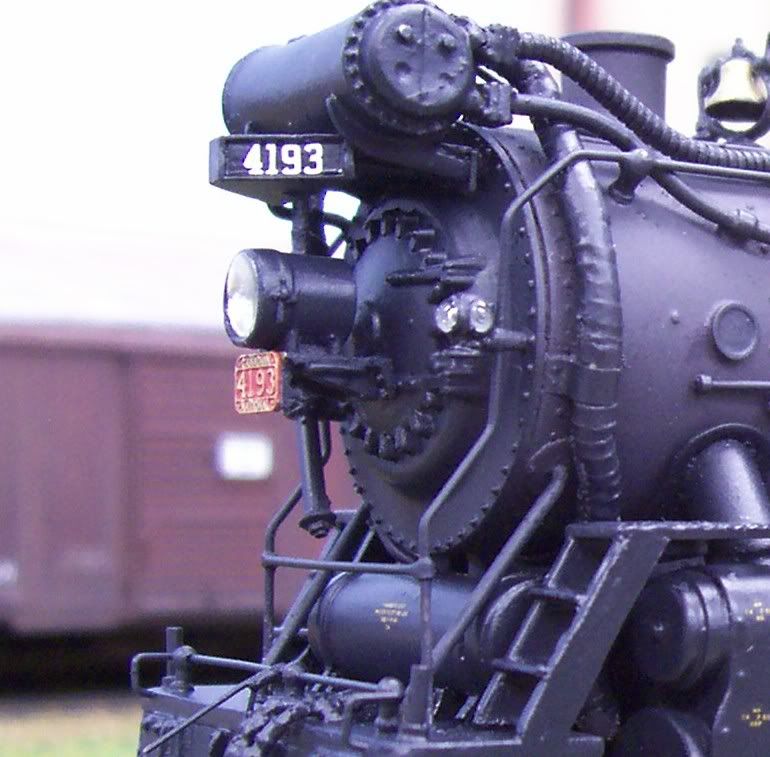
I later got my own camera, a Kodak C330. It’s also a point-and-shoot type, but with a few more options, including a zoom lense. At 4 megapixels, it’s more than adequate for pictures posted on-line. For close-up detail shots, I simply used it through my Opti-visor:
Unfortunately, that camera met its demise when I knocked over the tripod during a photo session. [banghead]

I replaced it with another Kodak, a Z700. It’s also 4mp, and was not too bad until it simply quit - some problem with formatting the memory card. [sigh]

I now use a Fuji X10, a gift from my brother. It’s okay, but way too complicated for my simple needs, and the user’s manual is like a small 'phone book. It’s biggest plus for me is that it will shoot pictures in various formats, such as RAW, TIFF, and PNG, useful if I ever do something good enough to publish. [:P] [(-D]

I have used a couple of digital SLRs, too, and while they were easier to use than the Fuji (I used to do a lot of photography with SLR film cameras), their capabilities were far beyond what I need.

However, the one thing that real

Amen to that!

We have all this free (or nearly so) bandwidth and storage capability (on photo hosting sites) yet, as Doctor Wayne points out, a disproportionately few threads include photos.

I can often glean modeling ideas from seeing someone else’s work, even if it was not the original purpose for posting the photo, I’m always looking for other ideas and inspiration from fellow modelers.

This site has a few work-arounds that are needed to post photos but once you have that figured out it really is easy to do.

Sometimes when someone needs a question answered here I can pop down to the layout, snap a few pics, get them extracted into a folder, perhaps do a bit of cropping and lighting enhancements (I like Photoshop Elements) and get the selected photos uploaded to Photobucket in about the same time it took me to write this paragraph—well, almost.

I enjoy participating in the “Show Me” thread and the Weekend Photo Fun thread. The photos don’t have to be blue-ribbon prize winners but I’d love to see them just the same.

I hope this doesn’t constitute a “hijacked” thread, but I’m with Wayne. The internet is now a visual medium (I remember when it was text only!)

Let’s give it your “best shot”

Regards, Ed

While not my best shots, they are some of my newest…

Steam 1

HO Diorama

And, one of my best railfan shots ever…

2 for 1

All were shot with my Canon Rebel XS.

And yes, the two NS trains WERE both moving, that is a perfect example of what a DSLR has as an advantage, no chance a point & shoot could do that! (As proof, a friend who was also there with a P&S camera could not get that shot, while standing right next to me.) That particular photo won front page on rrpicturearchives.net about 2 months after taking it, and was one of the most viewed at that time.

And, what I tell everyone who is getting into professional photography, as a paid job, is this: Never, ever, set that camera down. If you are the hired photographer, Always, and I mean always, have it on you, always have it ready. I have seen one too many amatuer pro’s miss a excellent shot do to not being ready.

If you have the ability, always shoot in the format your camera was designed to shoot in. (My Canon, as with most Canon DSLR’s, is designed to shoot in RAW format. It is a space hog, but RAW offers way better resolution and color than JPEG.)

I have some others, but, no more for tonight.

My wife bought me a Canon T5 last year. I’m still learning how to use it to its best effect. For backup, I have an Olympus point and shoot that also does pretty good video,and my trusty Minolta X-370 that I bought when I graduated from college too many years ago.

Something that nobody has really mentioned is that a good light or two makes all the difference in the world. The more light you have on the subject the smaller the aperture can be which means a larger depth of field, which means more of your shot will be in focus. This is important for miniature photography.

j…

Yeah, kinda like how “practice” never comes up in a discussion of the best golf clubs. [:)]

Why not stick with tried and true film? I don’t do model photography (no modeling to photo yet) but when I do photography I grab my go to Canon SLR. 35mm film is easy to come by, my local Walgreens at least still has 1 hour processing, the local Walmart and CVS still have mail-order processing, and you can get a unique look with film and camera’s that can be done with out digital editing.

I do have a digital though for times when needed. It’s a Canon Powershot SX400. A very nice little camera that looks like a more expensive removable lens type, but it is just a fine point-and-shoot. That being said I wish I would have gotten something different. I started into photography with 70’s era manual control SLR’s, so I quickly found that I wasn’t happy with out having any manual controls. There is a program mode where ISO can be selected, but that’s it. But still a very nice digital.

I changed to digital cameras because it was so much work to scan all my negatives to get them into the computer.

My Canon EOS digital cameras have all of the manual capability that their film ancestors had.

That said, the fact that it is always on my person results in the majority of my images being taken with my phone. The inconvenience of carrying the camera bag limits its use to events where photography is the primary purpose of the trip.

I haven’t shot a frame of film in almost 20 years. I sold my 35 mm and 6x7 cm film cameras years ago. I do still have a 2 1/4 x 3 1/4 press camera, but it is in a display case with my Ansco box camera, my Sawyers 3D Viewmaster camera, my old Polaroid cameras, and my Kodak Brownie.