do model RRs need signals other than STOP, APPROACH, CLEAR?

Greg,

Signal systems have to be adapted to endless possible track arrangements.

BUT, at its most basic level, at an interlocking, the top head indicates the status of the mainline or highest speed route.

The second head indicates the status of the next highest speed/importance route, the third head indicates the lowest, most speed restricted route - even if the routes are not phyically in that order.

The branch to the yard may be the first route you physically come to, but it will be indicated by the bottom head.

So, a single turnout interlocking would have a two head signal as you approach the points. If the top head is green, the turnout is set for the main and the track ahead is clear. The bottom head WILL be red in this case, there is no other choice.

If the turnout is set for the diverging route, the top head WILL be red, and the bottom head will be red, green or yellow depending on the speed restriction and track status ahead.

So, if you approach that turnout and see R/R, you do not know which route is set, but you don’t need to know that, you know that you have to stop. But when the signal changes, then you will know which route is selected. If the top head goes green or yellow, the mainline route is set, including the turnout.

If the bottom head goes green or yellow, the diverging route is set, including the turnout.

You can believe me or not, I don’t have 100 pages of prototype “proof” at my fingertips to direct you to. And I don’t have time to dig thru my library, search 70 years of MR for articles, etc, to give you references to look up.

Sheldon
I’m not looking at any of them, there is more to signaling than those charts. I learned all this four decades ago, I can get by without the chart.

In real life the railroad have reasons why they use the charts and teach the engineers from a perspective that is different from how the signals work on a mechanical level - mainly that not all engineers are mechanically minded people.

But if you can find some old relay diagrams of how the signals are wired, you will see that what I am telling you is correct:

Top head = mainline

2nd head = primary diverging route or routes

Bottom head = secondary diverging route or routes

All conditions must be met to get a clear indication - one of those conditions is turnout position.

Only one route can show clear at a time, so I guess that means the turnout is set to that route if the signal is anything but red.

Sheldon

Do you mean what book? Try this one.

https://www.amazon.com/All-About-Signals-John-Armstrong/dp/0890245029

It was written 67 years ago.

You want to get way into the details, find a copy of “Railroad Operation and Railway Signaling” by Edmund J Phillips Jr, copyright 1942, reprinted 1953 by Simon-Boardman Books.

or,

“Guide to Signals & Interlockings” by Dave Abeles, 2021, Kalmbach Media

or

“Operation Handbook for Model Railroads” by Paul Mallery, 1979 by Tab Books, reprinted 1990 by Carstens.

or

“Model Railroad Electrinics” by James Kyle, 1977 by Tab Books.

or

Find Bruce Chubb’s orginal relay based signal system articles in MR, sometime in the early 70’s.

You will then spend hours and hours boiling down that information to what I have already explained three or four times now.

Sheldon

Sheldon has explained this very well! I’d just add that a few railroads (New York Central) used two-head signals as block signals because with the combination they had of high speeds and relatively short blocks in some areas, a train getting a yellow (slow prepare to stop at next signal) might have less than a minute to slow down to be able to stop. I think (going by memory here) green-over-green was clear, then when a train passed it went red-red, then yellow-red, then yellow-yellow, then green-green.

On my layout, I get by with two-head/two-light interlockings for the most part. If you’re on the main and come to a switch that could send you to a branch line, green-over-red means you’re continuing on the main. Red-over-green means you’re going on the branchline. I haven’t set up detection yet, but red-over-red would mean the block ahead was occupied and you had to stop.

BTW a single red signal in real railroading can often be ‘permissive’, you really just have to slow way down or stop and then proceed. Two head signals can be used to ensure the crew of a train knows that it’s an absolute stop, red-over-red. In some cases, like where a railroad crosses another railroad, one head might be a ‘dummy’ head that only can show red. So green-red, you’re OK, red-red, you must stop.

Any indication that has “Diverging” or a speed indicated in it, implies a different route being taken.

“Diverging Clear”, “Slow Clear,” “Medium Clear” are all “reduced speed through (diverging route of) turnouts and interlocking” and clear to next signal.

“Diverging/Slow/Medium Approach” are all "reduced speed through turnouts/interlocking at next signal.

“Approach Diverging/Slow/Medium” will generally imply that the next signal is showing a reduced speed (because of a divering route lined)

No not really. The meaning of the signals is laid out unambiguously in the rule book. However the possible indications and the reason a specific indication is displayed on a signal depend on the possible routes and conditions at the location of the signal.

But different railroads have different rule books and different sets of signal indications. You’ll note that the NORAC and GCOR rule books you mentioned are completely different.

Yes, but it isn’t in the signal, it’s in how the railroad uses signals.

In block signaling, one head displaying two (red or green) or three indications (red or yellow or green) usually is enough. Red means the next block is occupied, yellow means the next block is clear but the one after that is occupied, and green means the next two blocks are clear.

Interlocking signals are used at places where railroad lines diverge or cross. I believe the term came about because in the days of mechanical linkages and levers being used to throw the switches and signals, the linkages were ‘interlocked’ in such a way that a towerman couldn’t set the signals in a way that could cause an accident. Like say where two railroads crossed each other at grade; setting the signals to clear for one line automatically changed signals for the other line to stop. There would be no physical way to change the one line to clear while the other one was at clear.

Interlocking signals virtually always use two or three heads. This is partly so that the signals are recognized as being ‘absolute’…a red signal doesn’t always mean ‘stop’ on a real railroad, but if there are multiple heads (2 or 3) all showing red, it always means stop. When two railroads cross each other, you want to be sure one trains stops to let the other go by!

Interlocking also tells the crew of a train how a switch or switches are set. Green-over-red means you’re clear to continue on the track you’re on. Red-over-green means you’re diverging off that line - onto a branchline, onto the other line of a double-track main, or onto a passing siding.

In more recent decades, railroads have switched to signals based pretty much only on speed. They often use multi-head and blinking signals to convey speed settings. So altho

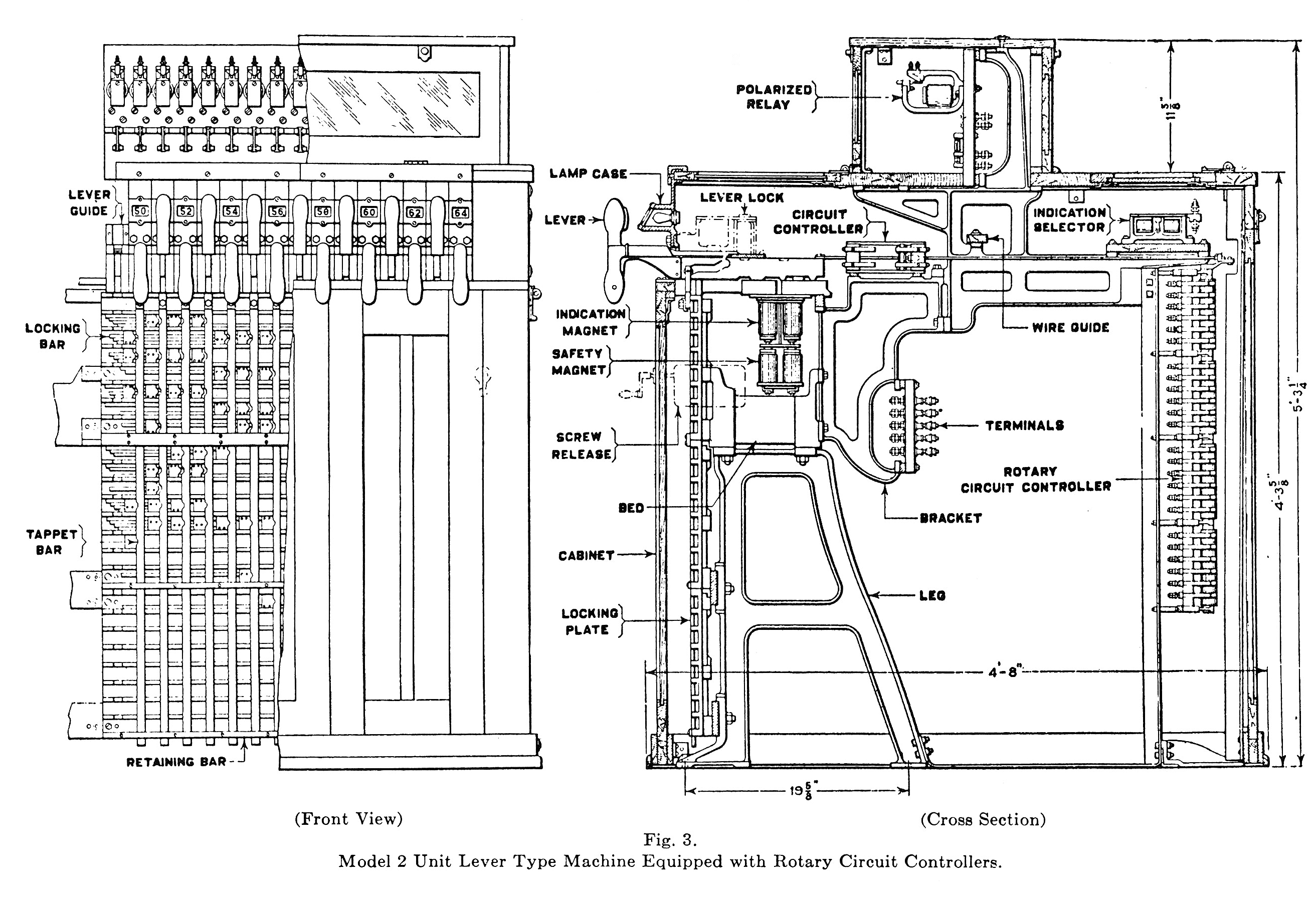
Here’s one look at how the levers are connected (interlocked) with movable tappet bars and locking bars so that a proper route can be established and as you point out an erroneous signal cannot be displayed.

Interlocking Machine by Edmund, on Flickr

I think the New York Central “Signal” film has a segment explaining and showing the levers moving. You can find it on YouTube.

This should begin at the ‘interlocking’ segment:

Regards, Ed

Great explaination Chris, especially this part:

The meaning of the signals is laid out unambiguously in the rule book. Howev

BTW if you go about 5 minutes into the NYC film, it explains their two-head (in this case, semaphores) block signaling, where having two heads allows for four indications instead of the usual three for block signaling.

it’s clear to me that signals can be interpreted in different ways depending on era, RR and situation.

my questions was what makes sense for model RRs who aren’t trained to interpret the wide variety of possible signals or who may be unfamiliar with the unique situations on a particular layout.

here in Cumberland, CSX has 3 headed south facing (compass) signals at the fairgrounds. the bottom signal indicates that the northbound train should stop before the access road to the fairgrounds. the top signal indicates that it is clear thru Viaduct Junction. but the middle signal indicates to stop at the bridge to avoid blocking city streets or for a possible crew change (note the woodend staircase between the track and road)

i’m told there is a similar situation on the tracks from Pittsburgh leading into Cumberland. there’s a crew change point at a billboard in the narrows.

2497

In “How to Operate Your Model Railroad” author Bruce Chubb had a good section on signalling. He said that for most model railroads, very simple signals (one head with two lights, two heads each with two lights, and one head/two light dwarfs) would really be all you need. He pointed out that making a rule that a single red light always means ‘stop’ (unlike the prototype where it can have different meanings) helped a lot to make things simpler.

I’d say too that to keep it simple, you would want to keep it consistent. Having say green means you’re clear to proceed, red means stop, and yellow means you’re turning off onto a side track or branchline or whatever, isn’t perfectly prototypical, but could be a simple, easy way for people to understand what’s going on.

I have no thoughts on the prototype situation you describe, it has no bearing on what is practical for our model layouts.

On our model layouts we can simply make do with a limited number of aspects and only use interlocking or absolute signals in all cases.

So, signals with one head, red = stop, yellow = approach prepare to stop at next signal, green = clear.

Two heads assumes an interlocking, G/R = main route clear, Y/R = main route approach, R/G = diverging route clear at specified speed, R/Y = diverging route approach prepare to stop at next si

One other note, my simplified signals use even less aspects than I listed above.

Two and three head interlocking signals never show Yellow “approach” on the two upper heads. My blocks are long and with DC control the status of the block past the one you are entering is not important.

Secondly, in place of those “approach” aspects, there is a single head signal half way thru the block, it is an approach signal for the next interlocking and never shows “stop”, it shows green when the next signal is green, and yellow when the next signal is red.

This provides more information while using fewer aspects for the operators to learn.

Sheldon

In or about 1977, the entire Star Wars genre began with a simple declarative statement of fact: . . . a long time ago in a galaxy far, far away . . .

Who doesn’t love a place where the rules are clear cut and concise?

Robert

Agreed, and the interesting thing is that the aspects I do use are pretty much correct for the situations and the era I model.

wjstix refered to Bruce Chubb and his early work on signals and operation, much of what I do is based on his work, as well as Paul Mallery and Ed Ravenscroft.

Too many people in this hobby today have failed to understand the idea of “selective compression”, not just in physical size, but in complexity.

Sheldon