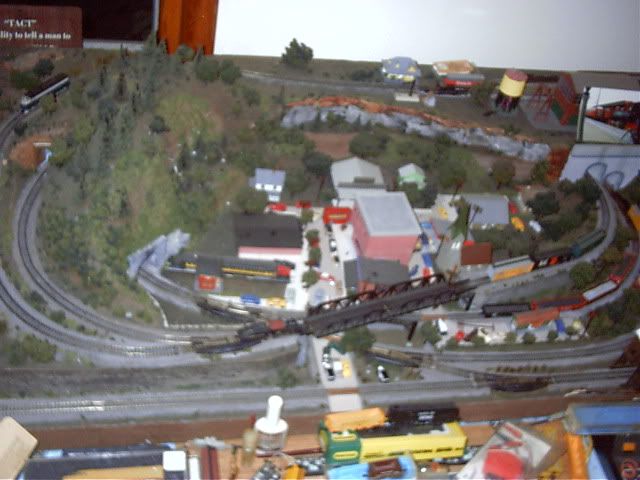
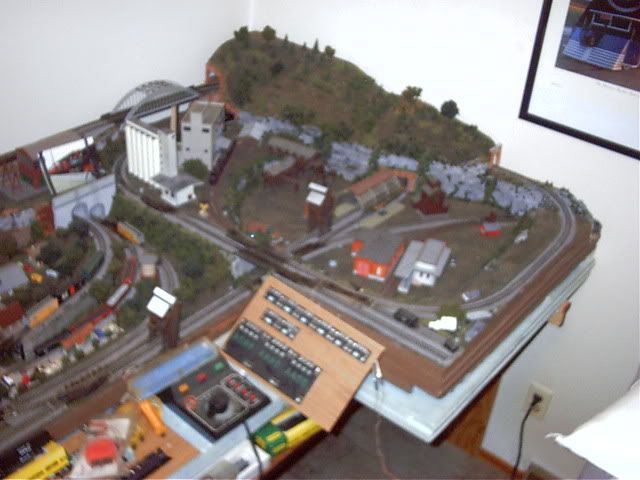
In light of my model railroad budget going from tiny to near non existent, and no foreseeable likely hood of change, I’m now in “do something with what I’ve got” mode. What I’ve got is some 2" and 3/4" pink foam. My plan is a 42"x 69" N scale portable layout, that is meant to sit on top of a table when in use. I have three main questions right now.
First, if I glue/laminate the foam I have together to make a 5-1/2" thick slab, will that be sufficiently rigid without a wood support frame under? At the 42x69 dimensions, all but about 9" on one end will sit flat on the table top. The only cut outs would be shallow 1/4" wire channels in the bottom, an 1" to 1-1/2" deep winding stream in the top, and possibly one small gouge of an inch or so for a road-under-rails underpass.
Second, assuming the above is a reasonable plan, what would be the best glue to use for a balance of cost, user friendly, and contributing to the rigidity of the foam lamination?
Third (and probably most subjective), I could possibly go to a full 4’x6’ size for the slab, giving more scenic possibilities and a bit less crowding…but I would sacrifice some degree of portability, and make it such that when on the table in it’s running position, I would have to slide the layout around on the table to get access to 2 sides of it (no turnouts, cross overs, etc, just main on those two sides). Is the scenic space likely to be a worth while gain in light of the losses?
I get my foam at construction sites for free. I picked up the equivelent of 4 full sheets of 2 inch last week. Just ask.
Two inches of foam should support it just fine. More will allow you to dig a canyon or a lake. Mountains should be added on top. I put my quarry in by cutting the hole and glueing the quarry underneath .
I use acrylic caulk for most glueing, but for edge glueing I add dowels, The skewers I use for trees work just fine.
For glueing up mountains I use low temp hotmelt glue, but that costs a bit and all it gives is speed.
Art’s right. A 2-inch layer of foam will support itself and a layout very nicely, as long as you give it a reasonable frame underneath. I put 16-inch centers on my supports, and even that was probably too much. The foam is very stiff and doesn’t show any perceptable bending on my layout once everything is on top of it. Some people like a layer of plywood under it, but that’s not necessary from a structural standpoint. Nice if you’re using Tortoise switch motors, though.
So, save the thin foam for scenery. It works great for that, too.
I use Liquid Nails for Projects. I use if for pink foam-to-benchwork, WS Foam roadbed to pink foam, and track to roadbed. Great general purpose stuff, and under a couple of bucks for a big caulking gun tube.
The OP asked whether the foam would be rigid enough for a portable 42"x69" layout without a wood frame.
Chances are the foam - especially the 2 layers - will be rigid enough, but I can’t say from experience. My portable Christmas layout used an outside frame of 1x3 lumber with a 1/4" plywood on 1.5" foam. Size was 46" x 60".
Usually, some kind of hard surface is applied to the outside edges of the foam to avoid denting and breaking chunks off. It can be very thin wood, masonite, or even a foam core product with a hard face. Anything of this type will also add rigidity.
White/yellow glue is the cheapest foam-compatible glue, but can take a very long time to dry (several days) between 2 layers of foam. I used yellow glue for my foam to wood joints without any problems. I have not tried latex caulk, so don’t know how that would do for bonding the sheets of foam well enough to add strength. The commercial foam-compatible glues (Liquid Nails for foam, possibly Gorilla Glue) will be very strong, but will also cost more.
My question is whether you will be handling and carrying the layout by yourself, or will have somebody to assist. The weight is not as much of an issue as the sheer bulk. Most modules that will be handled by one person are limited to about 2ft x 6ft, and 4ft is considerably easier.
There are several reasons for not going with a wood frame. The first is cost…I’m trying to do this with a minimal amout of investment. Second is environmental…the layout is not going to be in a climate controled area, and distant past experience with trying to build an HO train table in this environment with “one-by” lumber resulted in a lot or warpage. Third is trying to reduce weight for when it does need to be moved and stored. Since I will be using Unitrack, I do not need plywood backer for switch machine mounting.
The current plan for the edges is strips of plexiglass glued on and extending a bit above the top surface, to act as a plummit guard. on parts of two sides I was planning on fastening these strips with velcro to allow access to inside a tunnel area in case of derailments and for cleaning.
Glue is something I’m going to have to invest in on
Zandoz, I believe you will find that the typical adhesives that one can/should use for adhering foam sections to either other foam or to other materials is necessarily going to have the give that will not afford your layout sufficient rigidity by stacking layers to get a good base thickness. In other words, you should scout around and find actual 2" foam, or lightly frame and support either 1" or 1.5" foam. In fact, you should protect the edges of your foam anyway with even something like masonite, doorskin, luan, 1/4" ply strips…whatever, to prevent this intended mobile layout from getting marred at its extremes.
As others suggest, ingratiating yourself at tear downs or construction sites, digging into dumpsters, and other means of availing yourself of useful materials is a sensible thing to do. Calling out to guys siding new homes to see if they might have some foam scrap takes seconds, and if done politely will quite often result in a friendly reply…maybe even an agreement to set some aside for you.
What I have is two 4’x6+’ sheets of 2" foam that I was planning on laminating to make the bulk of the thickness of the slab…the main 4" total “structural slab”. The two 3/4" pieces, I was planning on adding to the top of that slab are for the cutouts for a river/stream and underpass without compromising the structural slab.
Okay, I get you now. Thanks for your patient explanation. In that case, and since the 2" stuff ought to be plenty stiff by itself, any cheap latex caulk is the way to go. In fact, if you have some left-over yellow or white glue, those should be fine, even if used together.
I am guessing you want the stacked 4" in order to provide substantial relief in topography? It will mean quite a bit of gouging and digging out whereas simply cutting out rough shapes to glue them in stacks might be simpler and faster overall…just a thought.
If you are only stacking them because you feel you will need the strength, I don’t believe it will be necessary. The 2" foam is very strong. Even the 1.5" stuff I used this last time for my flat locations quite strong and stiff. One inch foam, not so much; you would want to laminate it or to support it on 20" or less centres.
bout 3.5 years ago, I was in your boat. No space, no money, but alot of ideas.
I went out and picked up a 2" thick, 4x8 peice of white foam. I cut it down to 3 feet wide. My son and worked with this for awhile until we moved. The white stuff is softer then the pink or blue so this might be relative. I know I had some issues when I picked it up and moved it would sag. Wasnt going to break, but if I was tryign to build a nice layout on it, I would have been worried about stuff pulling apart. Over the 8 foot span, it would sag a couple of inches,
I would try taking one piece and maybe putting some books around the corners, to act as weigth and pick it up… see if it moves at all. Then, you can make the call about adding the second peice, which, would be rock solid over kill… or maybe getting some strips of wood and just glueing them to the bottom to act like spines.
Either way, I would just test it first with some weight and go from there.
oh, here is a few shots of my first layout, post child hood.
First night… as you can see, that room is the family room, living room. I am standing in the dining room. Should have seen my wife face when I brought that in… Ha Ha Priceless! Only thing better was the kids face!
After a few nights, it involved into this.
Now its in the dinning room and kitchen. When we were done, I would put it up on top of the entertainment center. Ah, the good ole days.
canazar ir right, white foam will sag. Pink, blue, yellow, green will not. The pink and the blue are easiest to find around here, though the pieces of green were the nicest. They were used as insulation underneith a poured concrete floor. I have only seen it on the one job.
My reasoning for going with the stacked 2" slab is for rigidity when being moved, and for prevention of over-time sag for the 8-10" that will overhang the table top on one end. The only cuts I intend for the stacked 2" slab is 1/4" wide and deep channels for wiring on the bottom side of the slab…the cuts for stream/river, underpass, and other contours will be limited to layers of 3/4" foam on top of, but not into the slab. I had intended to rough cut those 3/4" layers.
What I have and intend to use for the slab is the pink and blue extruded foam. I have some 1/2" white beaded foam, but I have no intention of using that where any structural integrity is needed.
Foam is an excellent material for layout construction, especially given your restrictions: MONEY!
My current layout is built almost entirely from blue foam, mostly 2" thick or laminated 1" thick sheets. The original layout is 30" x 48". It sat on top of an old kitchen table (28" x 42"). I never had a problem with sagging. I used Liquid Nails for Projects to glue the laminated pieces because that’s what I had seen recommended in magazines. If I were todo this layout today, I’d use cheap latex caulk. Here is a photo of the original section of the layout:
Later on, as most of us will do, I added another 30" x 48" section to form an “L”. This addition was made from laminated 1" foam. From the beginning, I knew the combined sections would be to big for the old kitchen table, so, using 1" x 2" common lumber (the CHEAP stuff!), I built an L-girder framework to support the layout. The L-girder framework sits on top of the kitchen table and the layout sits on top of the framework. Here is a photo of the addition under construction:
Note how the layout has been built up with 1" foam, starting with the base and building elevated areas with cut out pieces of foam.
Here is a photo of both sections, although not all of the original section (on the left) is included in the photo:
Now for some detail shots. The first photo shows how the addition was built up with 1" foam:
Notice that there is an underlayer of foam BELOW the layout separated by spacers. This open space is used for wiring runs. Also no
Foam is an excellent material for layout construction, especially given your restrictions: MONEY!
My current layout is built almost entirely from blue foam, mostly 2" thick or laminated 1" thick sheets. The original layout is 30" x 48". It sat on top of an old kitchen table (28" x 42"). I never had a problem with sagging. I used Liquid Nails for Projects to glue the laminated pieces because that’s what I had seen recommended in magazines. If I were todo this layout today, I’d use cheap latex caulk. Here is a photo of the original section of the layout:
Later on, as most of us will do, I added another 30" x 48" section to form an “L”. This addition was made from laminated 1" foam. From the beginning, I knew the combined sections would be to big for the old kitchen table, so, using 1" x 2" common lumber (the CHEAP stuff!), I built an L-girder framework to support the layout. The L-girder framework sits on top of the kitchen table and the layout sits on top of the framework. Here is a photo of the addition under construction:
Note how the layout has been built up with 1" foam, starting with the base and building elevated areas with cut out pieces of foam.
Here is a photo of both sections, although not all of the original section (on the left) is included in the photo:
Now for some detail shots. The first photo shows how the addition was built up with 1" foam:
Notice that there is an underlayer of foam BELOW the layout separated by spacers. This open space is used for wir
I am doing a HO layout using 2" foam on 2 foot spaced wood L griders. The biggest problem I have discovered is that were I did not glue the edges of my 2 by 8 ft sections to my 1’ by 8’ sections or were 2 pieces come together the foam will seperate. I dicovered this after adding scenery so I have gone back in and added expanding foam were I can. I also dicovered that the 2 by 8 sheets are not perfectly flat so glueing it down to the wood means adding weights to hold it.
Keeping the whole thing flat has been a point of ponder. My thought is to do the laminating laying on the table it will eventually be used on…hoping that with enough weight while drying, the slab will conform to the table. Since the table is in the dining room, I’m hoping to find a suitable glue that will have minimal fumes issues.
it may very well be worth your time to clear a space on the floor and just let it sit over night. As far glueing, there are alot of glues mentioned here that will work just fine. But to sela it good, I have found books rule for glueing foam sections like that. Phone books can be pefect, large, heavy and flat.