Rich,
Where you show the un-gapped short there is a gap on Both Rails existing
I have been thinking about this i may have an idea basically it involves making the upper 4 tracks on the yard and the turntable track same polarity/phase as the turnout from the main line under the helix. this will make this easier to wire. Plus extend the turnout to the helix further into the helix giving me enough space on tnew track to gap it as a reversing area. Note the lower loop from bottom mainline does not go into the yard, (as you have shown) only the upper loop feeds into helix as well as yard and turntable just to harbor area. thus can be left as is. I will try draw this soon and post
thanks
Vik.
Thanks
OK, but you don’t show those gaps on your latest drawing,
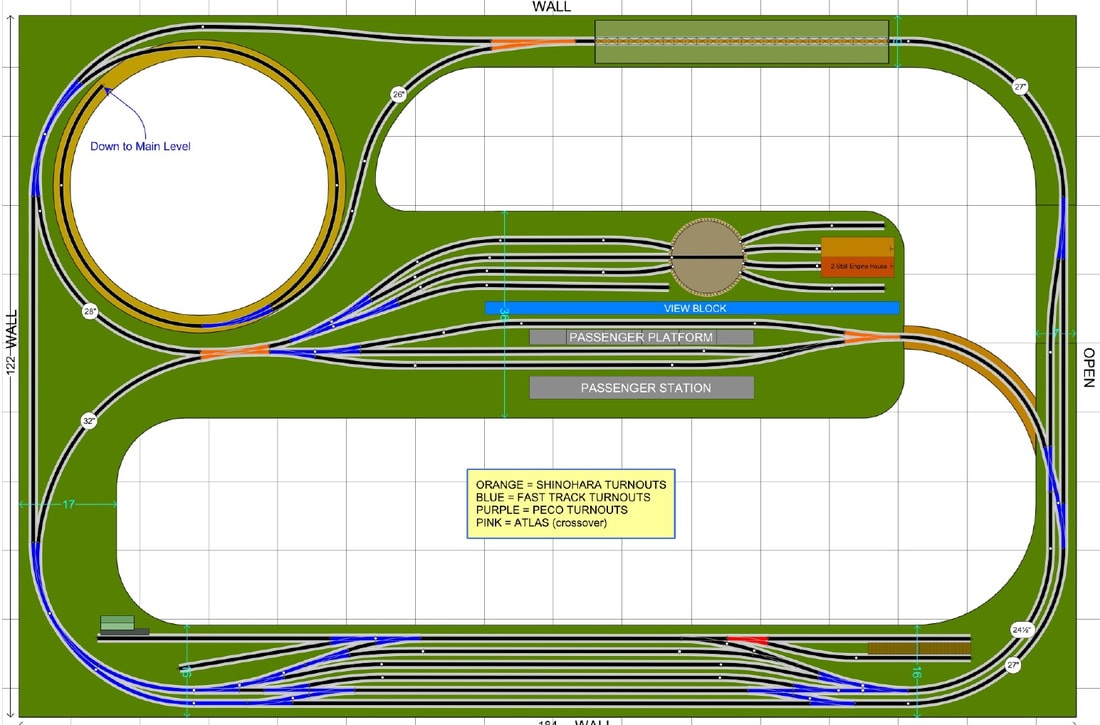
Looking at your original diagram, at the lower left corner, the outer track continues up the left side with a divergent track that crosses over a track before entering the helix. That crossover has separate polarities from the two tracks intersecting there, so no short. The inner track in the lower left corner connects to the track running horizontally through the crossover. There are mismatched polarities at the point of the turnout. That point must be gapped. So, if you want to leave the gap further down the track, fine, The gaps on the outer track can be removed as they serve no purpose.
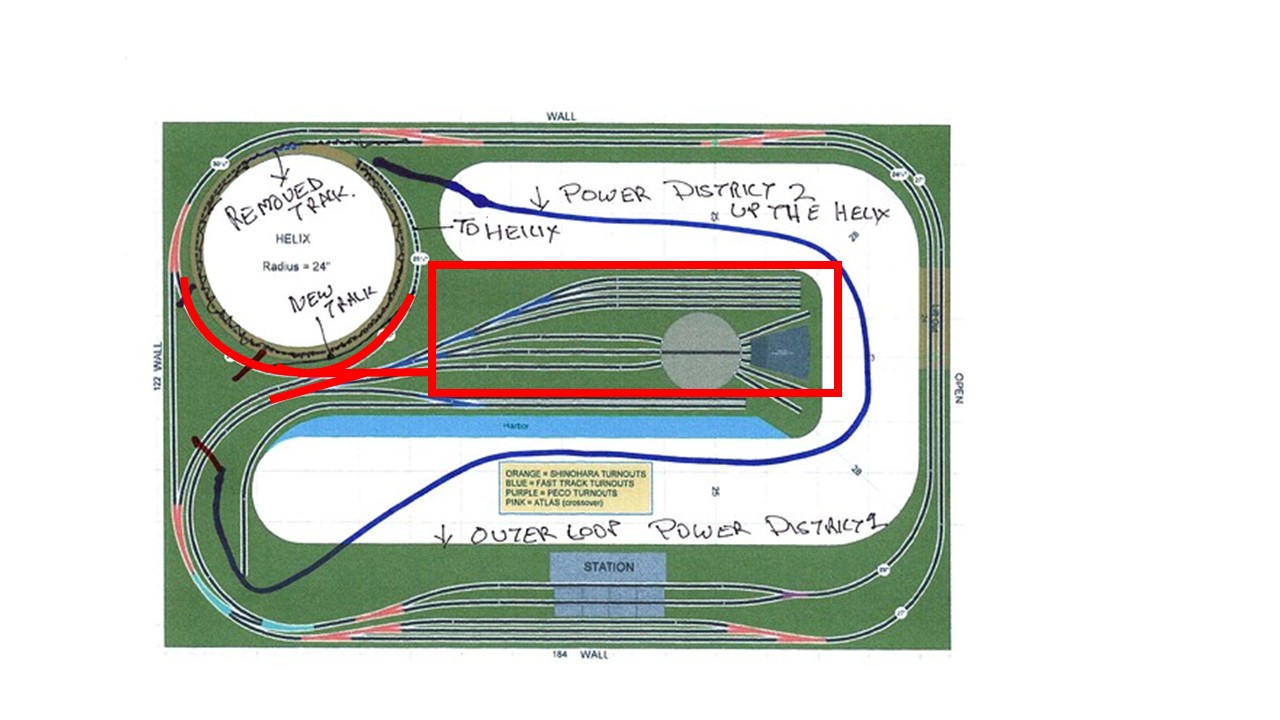
But a short remains unless you isolate the reversing section. My diagram does that.
This is the area that should be isolated without changing the wiring.
Rich
Rich,
my bad
An addition to my last post. If i extend main l;loop into the yard (reversing the phase) and then carry the upper loop from the bottom are of main lien into the helix i will not have to have a reversing section on the bottom deck. Just a thought I will try draw this and see
This constant reference to “loop” is confusing.
At the lower left of your original diagram, there is an outer track that runs straight up the left side with a right side divergent track heading to the helix. Is that what you are referring to as the “outer loop”? Is the track curving up from the bottom and leading into the yard what could probably be referred to as the “inner loop”?
If so, remove the gaps in the outer loop and make sure that no feeders from the auto-reverser connect to the outer loop because it is not part of the reversing section.
The inner loop does contain a point of opposite polarity as it connects to the turnout leading into the yard, so the inner loop must be gapped.
There is no need to change your wiring protocol if all of the preceding is correct.
Rich
Rich,
Yes you are correct as to two divergent tracks Upper one leads to the Helix Via the crossover and also to the yard and turntable
Bottom divergent goes to harbor
I will try draw it out soon
Thanks
I already drew it. 
Rich,
At the moment the input into the PSX-Ar is on the main line r loop before the divergent track underneath helix leading to crossover.
I would appreciate it if you could let me know proper placement of auto reverse unit in your schematic
Thanks and where should input output go
Regards, You have been a tremendous help
I used my most recent diagram with a few modifications. I added a par of gaps, as noted on the diagram, and I added a yard track.

The PSX-AR could pretty much go anywhere, but I placed it close to the reversing section. The important thing is to wire it directly to the main bus and not downstream of other devices.
The red and black feeders connect from the main bus to the input side of the PSX-AR. The blue and green feeders connect the reversing section to the output side of the PSX-AR.
If you set up your wiring and gaps this way, it should work. If it doesn’t work, further investigation will be called for.
Rich
Rich,
I will install this next week and keep youupdated
I could be wrong, but again it seems you are making this harder than it is.
Look at the obvious “wye”, if you install gaps on the two legs of the wye near the turnouts at the outer loop around the room, and install gaps in the inner track that comes around the room from the bottom of the diagram before it joins any other track on the peninsula, you will have isolated both the “wye” functions between the outer loop and the peninsula and helix trackage.
Then the whole peninsula and the wye can be a single power district and a single reverse section at the same time.
Sheldon
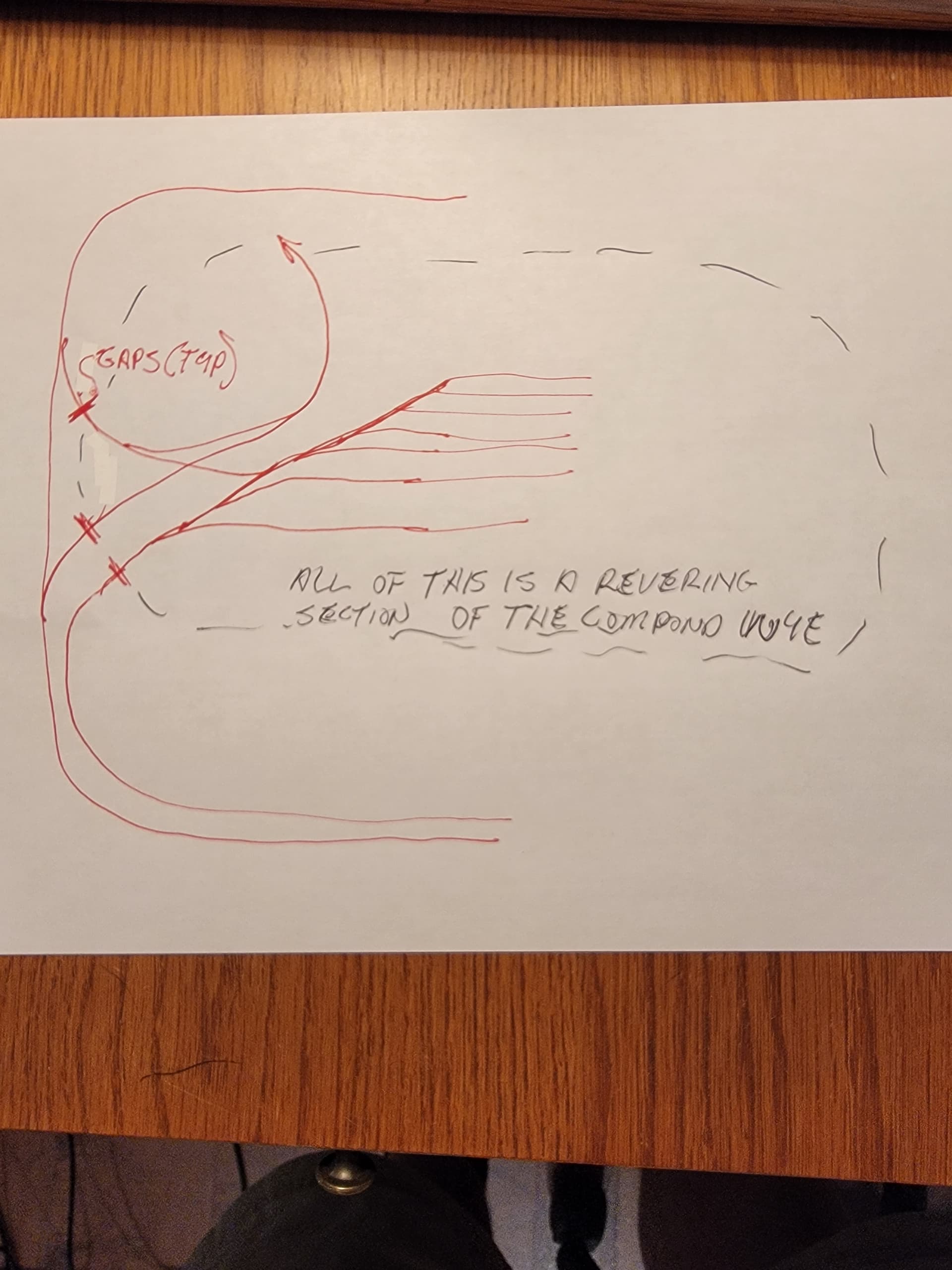
That won’t work, Sheldon, because you haven’t gapped the point where the “new track” connects to the helix, so the reversing section is not totally isolated and a short will occur.
Also, that gapping on the outer loop is meaningless because the outer loop is in-phase with the helix that it connects to.
Rich
Who says the helix needs to be constantly in phase with the loop around the room? The helix is effectively one leg of the wye just like the peninsula trackage is a leg of the same wye relative to the loop around the room.
I asked the question much earlier and got no reply - where does the helix go? If it is a dead end like the other peninsula trackage, than the helix and the peninsula can be treated as a single reversing leg of the wye.
The PSXR will change the polarity of the whole peninsula and helix relative to the direction of travel in or out of the loop around the room.
Sheldon
This is the intended reversing section, and it complies with the way that the OP has shown his layout to be wired.
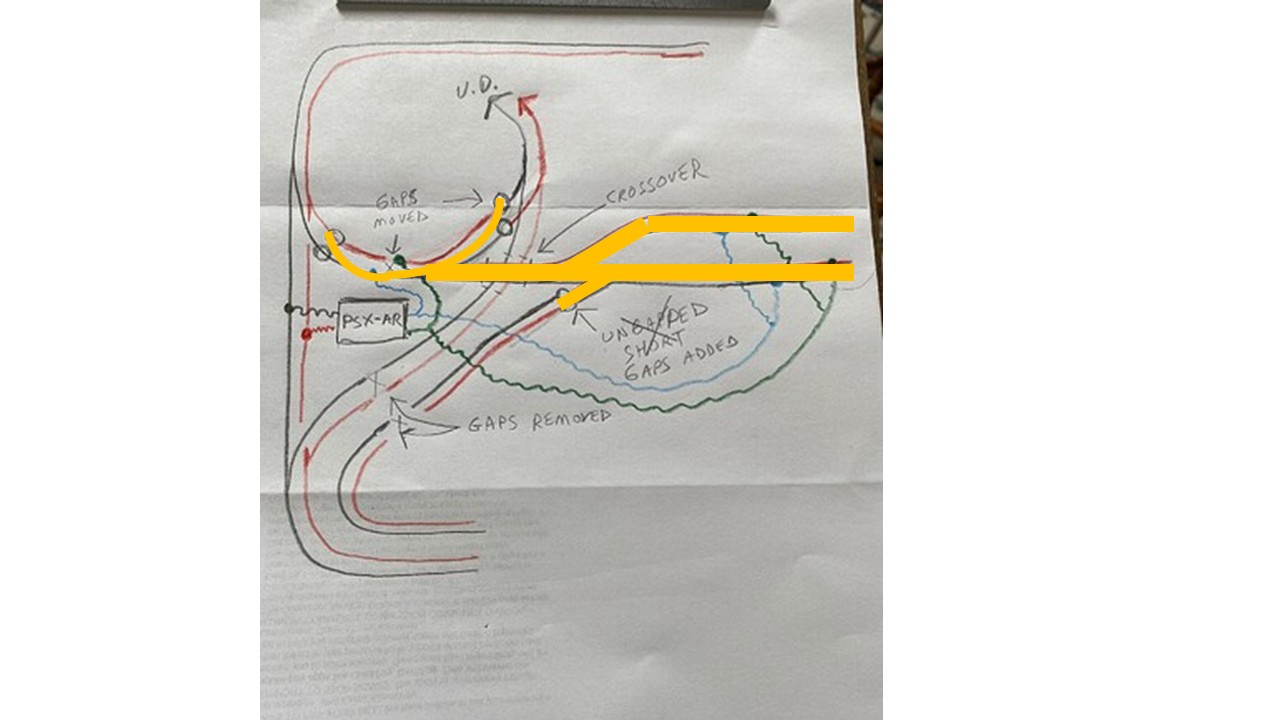
So I’m still asking why that has to be the reversing section?
There are two wyes that share one common “mainline”. In the drawing below, you are dealing with the helix wye using the figure 1 approach and using the figure 2 for the peninsula wye.
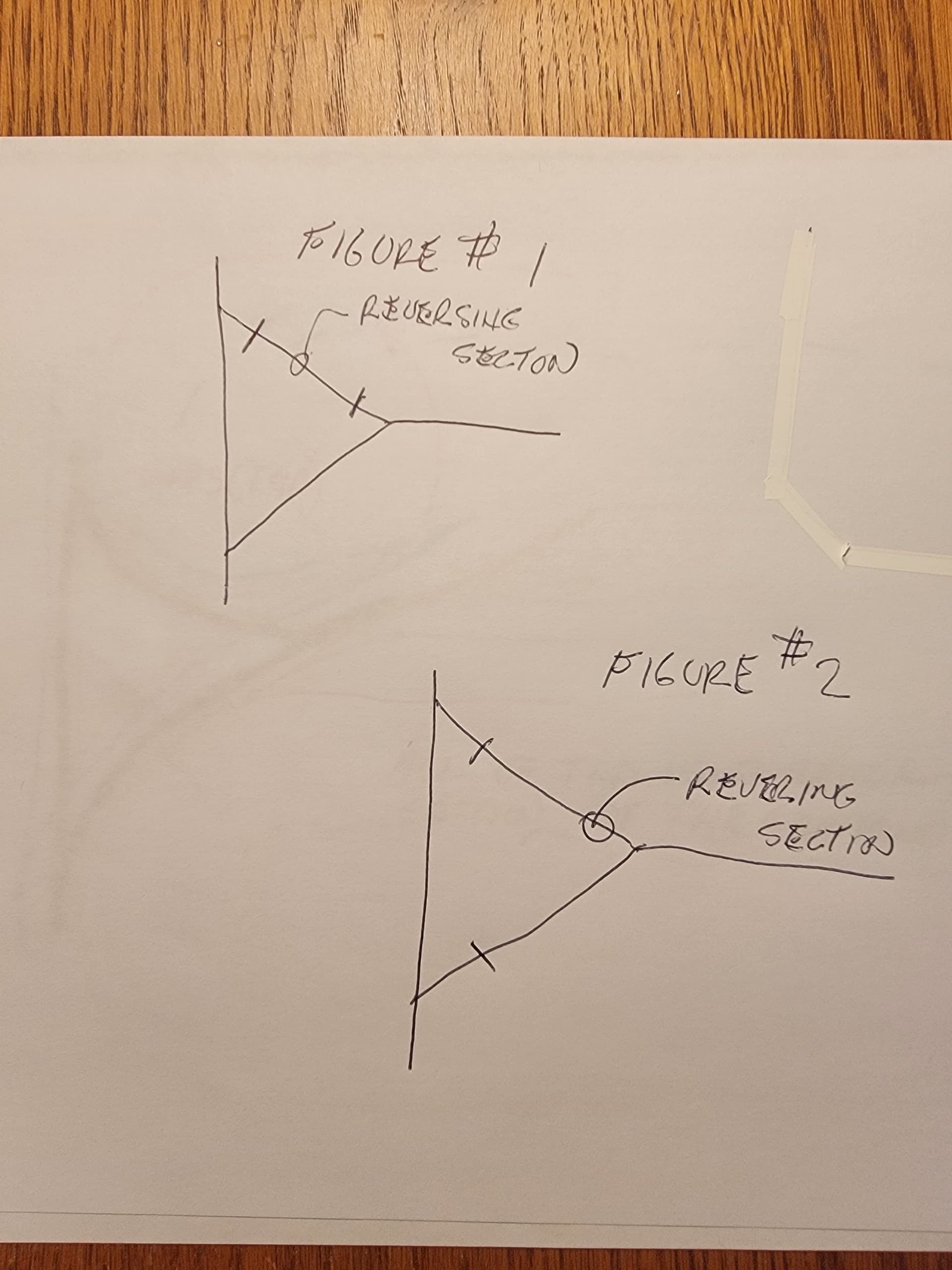
Maybe it does not matter, but I would never wire a wye using the figure 1 approach. On a DC layout the figure 1 approach would be a disaster.
Sheldon
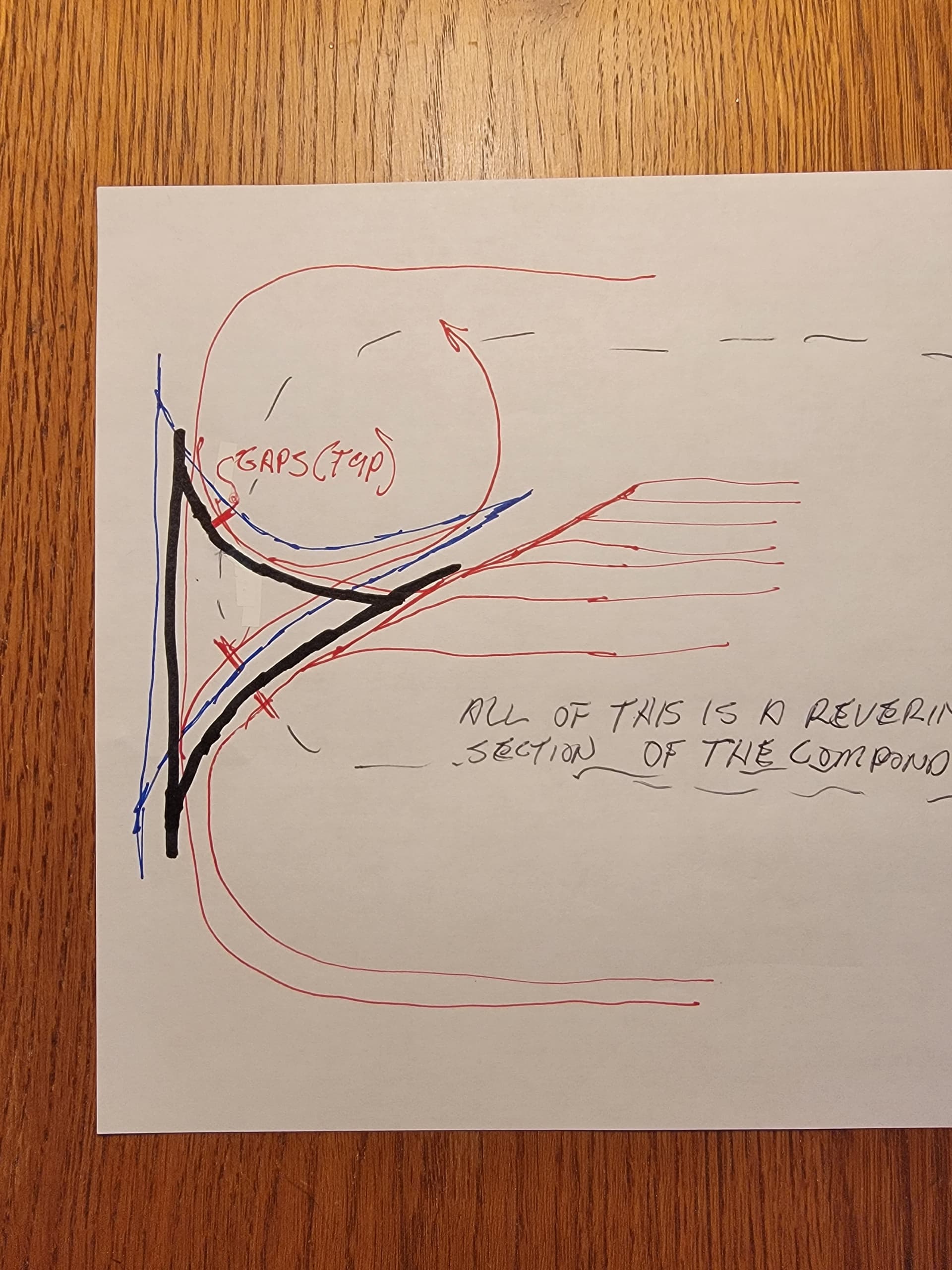
The track configuration may look like a wye, but it is not a functional wye as a railroad would use one, and the OP does not intend to operate it as a wye.
A bit earlier in this thread, the OP posted a 2-color track diagram, red/black, to illustrate how the rails are wired. The outer loop connects to the helix in-phase. As the outer loop diverges, via the “new track”, it leads into the helix in opposite polarity causing a short.
Furthermore, in order to function like a true wye, a train has to pass into helix and then back up through the “new track”, again in opposite polarity causing a short.
The crossover track does not permit a train coming up from the lower left portion of the outer loop to connect to the top of the wye configuration like a true wye would.
Rich
OK, I will leave you to it.