No, but if a locomotive is in the vicinity of a powerful magnet it might pose a problem.
Ok here’s an idea (just putting it out there) would a roller coaster style chain lift work? (of course in a down hill sense)
I watched the video from above and I also watched this one.
https://youtu.be/9bkI9r5I2d0?t=344
I’m guessing the prototype would never operated that way, right?
Kadee uncoupling magnets won’t hurt a decoder, or the loco motor, or anything else. Lots of people have kadee magnets on their layout, I’ve even used very tiny up super powerful magnets to make a more precise uncoupling spot and had no issues with DCC locos running over that track. In a hump yard the loco wouldn;t even run over the crest, and putting 2 or 3 Kadee magnets in a row doesn;t make them stronger, it makes a logner area where uncoupling can occur. Kadee couplers are designed to not uncouple if there is tension on them, and with a hump and cars of varying size, the place where the car to be cut is far enough downhill to keep coasting yet not too far to put too much tension on the coupler is going to vary, and the length of one uncoupling magnet usually isn;t enough to account for that. We had 3 in a row in ours.
–Randy
My response eariler was based on an assumption that you were trying to use magnets as a retarder. Yes you would use kadee magnets for uncoupling.
As someone stated earlier the weight of the cars does not scale down correctly to keep the momentum looking right. I think that if you experiment with making the cars much heavier you can reduce the grade needed. this would look a lot more realistic. Of course then you would need to beef up the coupler pockets and modify all your rolling stock to match.
watch some videos of the real thing vs. the models. real 5-10mph vs. models 50-60mph
Steve
Steven,That is not a hump but,a unloading dock for loading lake or sea going vessels and yes,that’s exactly how they work once a hopper car been through the rotary dumper its shoved by a electric mule and the car rolls down grade through a spring switch rolls upgrade,stops and rolls downgrade through the switch and into the holding track…
This should give you a general idea how it works.
Cars are also humped in flat yards. If we’re gonna model prototypical practices, someone needs to take a crack at that.
That’s called kicking cars. I would love to be able to kick cars while switching.Kicking is done to save time and unnecessary switch moves.
It can be done but,how is the question.
John Armstrong (yeah that John Armstrong) built a box car with a big flywheel in in (O scale of course) so it would coast for quite a distance once kicked, but that’s not exactly practical to do to every car in your fleet, and getting a train of them moving would be interesting to say the least.
–Randy
As for actual, constructed scale model hump yards . . . I’ve seen one. Built by one of the best modelers I know. N scale, about 40 feet long. I have photos, but they’re on another computer. I’ll try posting them later.
The yard kinda worked. I think the biggest problem was inconsistent free rolling caused by over-weathering the cars, the wheels, and the rails.
The neat thing was his retarding feature. He used monofilament fishing line in small bundles of three or four short threads sticking up between the ties at 6-inch intervals or so. They looked like frog hairs or isolated tufts of grass or something. They worked by brushing the axles of cars that passed over.
Like I said, the hump yard worked, but a lot of fidgeting involved with it.
Robert
Retarding all cars by the same amount doesn’t really work realistically – not only because different cars weigh different amounts and roll differently, but also because one needs different amounts of retardation as the various bowl tracks fill. This is one of the common failings of many model “hump yards” .
It will work for some number of cars in some number of tracks, but if cars can roll fast enough to pass through the bristles and roll near the end of the bowl tracks (first into that track), later cars into that same track will be going too fast and slam into cars already on that track.
This can be seen in a number of model “hump yard” videos.
I agree. The whole process is fraught with problems, but you gotta admire someone who takes a good stab at it.
As mentioned earlier, here are photos of the yard I was talking about. Standing in about the middle, looking left and right. The model construction was about half finished when these photos were taken. The complete buildout was about 25 or so tracks.
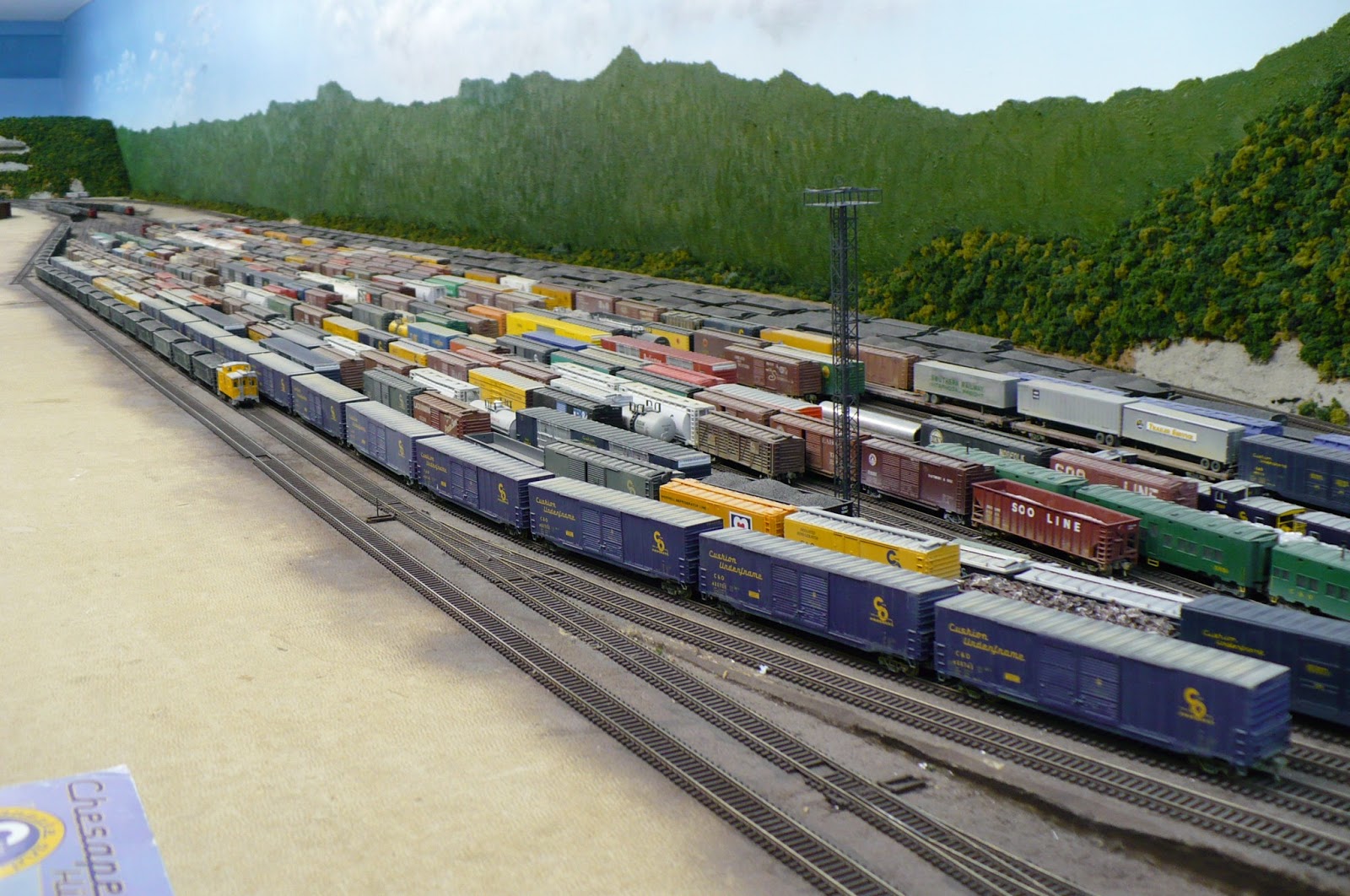
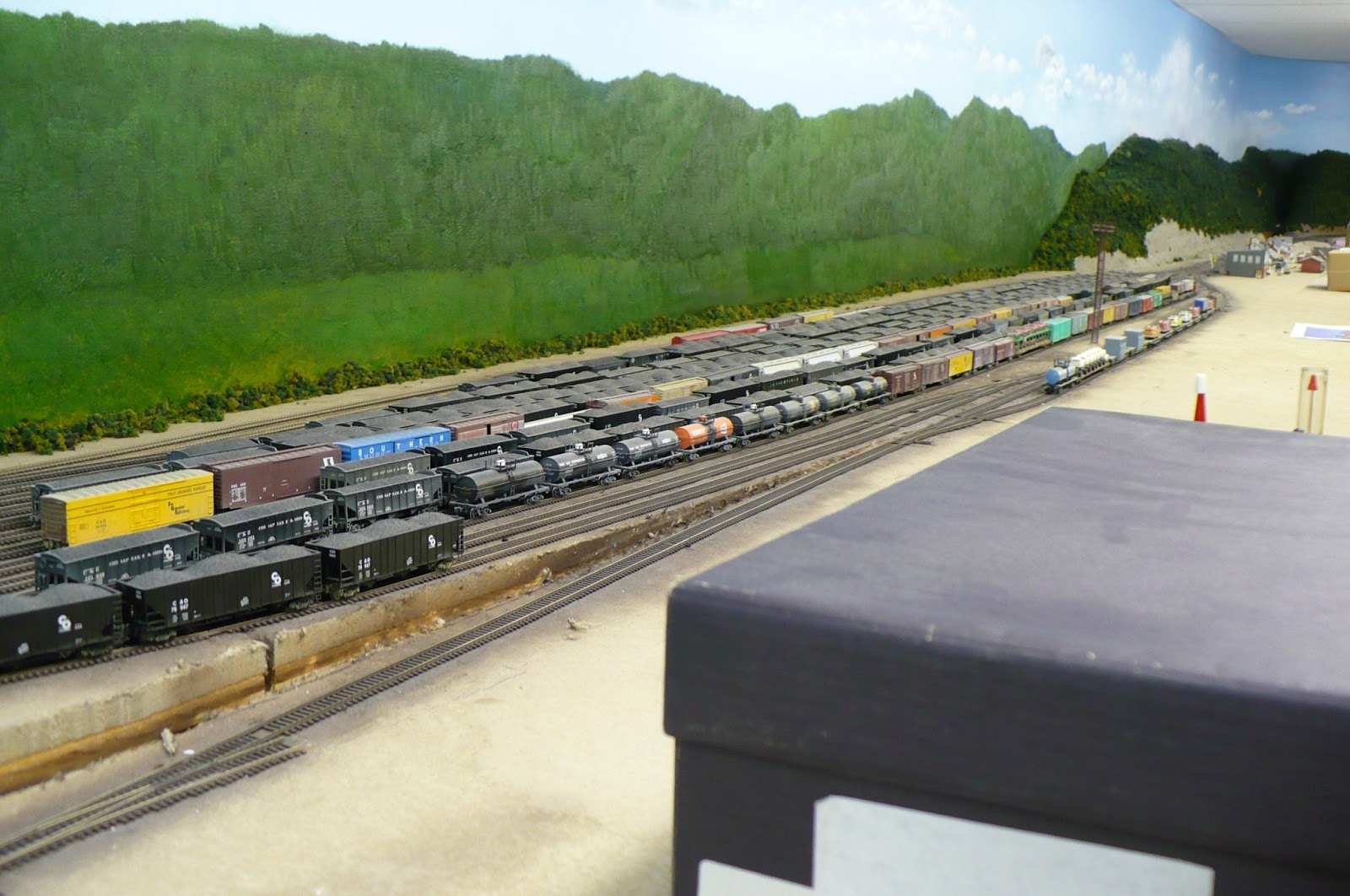
I agree…To much resistance in a normal train.
While that is a dated thought I’m sure there is a way to add a gimzo in order to kick cars.
When it comes to such thinking one must be open minded like any invention and the same goes for a gizmo that will give us a workable hump yard. It can be done but,how??? Recall not so long ago the nay saying “experts” said on board sound couldn’t be done.
Air hump yards works quite well but,it demands a skilled hand to operate it and the air compressor could become noise pollution for the rest of the family…
The one I operated used working retarders like the prototype that are spring loaded. A fishing weight closed them as I was told when it was released, the only changes to the cars I was told about involved metal wheelsets many of the cars are old tyco and not many other upgrades other than body mounted kadees.
Unless you are modeling a specific protoptype yard, I would skip the hump yard. It might seem like it might be fun but after the novelty wears off, you might find it a bit gimmicky. I have lots of fun sorting cars in my flat yard and it requires a lot less space and fancy engineering. Some things just don’t scale down well. Gravity is one of them. I think you will find even if you can get the retarders to work reliably is the cars will roll much to fast to seem realistic. But as the saying goes, it’s your railroad. If you are determined to go ahead with it, I wish you luck.
Larry Keeler did it back in the early 70’s, with an early computer system as well. Mechanical retarders as well. It was the subject of a story in MR at the time. There was a huge amount of setup he did, calibrating every car and storing them in the computer, so that as a car came over the hump he keyed in the last 4 digits or so of the car number and it selected the destination track and applied the retarders based on the car’s programmed characteristics and the number of cars already in the destination track.
Even that, though, could change based on temperature and humidity in the train room, and if an axle was slightly dirty, or whatever.
–Randy
That sounds like a good system of course in the early 70s I was in the Army and MR magazines came far and few between.
At next month’s train show I will nose through the old magazines to see if I can find that article simply because I’ve always been interested in such things…
January 1979 is the one you want. Page 92. For whatever reason, this article does not appear to be indexed by ANY of the model railroad mazaine indexes, the only hit you ever get for Larry Keeler is a 1984 article in RMC. WHich may also have information on the hump yard, but Russ Larson’s interview in the Jan 79 MR definitely talks about it. I always remember that one because it’s one of the first if not the first issue of MR I ever bought.
Sadly, in searchng for the article, I discovered Larry passed away last January.
–Randy
So am I correct that the hump yard in the video is not prototypical?