My 24’x24’ around the room HO DCC layout was built as four planned extensions, (with three large peninsulas), so that I ended up with six reverse loops, three wyes, and 110 turnouts. Each of the lengthy reverse loops and wyes is controlled by automatic reverse loop modules. By connecting every yard of flex track to the main Bus wire, and dividing the layout into four independent power districts, there is plenty of power in each section and no shorts This set-up allows for 16 different routes around the layout for each train Obviously, it would be impossible to operate without the use of automatic reverse loop modules. Bob Hahn
To be honest, after years of avoiding reverse loops, once I installed one I found it pretty simple to wire it up. Admittedly this was more of a “point to loop” layout so trains only went thru the loop once, plus the way the track plan worked out, most all trains either stopped at the station located within the reverse loop, or stopped in the loop to do some switching, so I didn’t have to reverse trains in motion. It was a lot easier once I converted to DCC and got an automagic reversing gizmo though.
I had a folded point to point layout, and added a section that put a turntable at one end of the line and a reversing loop at the other:
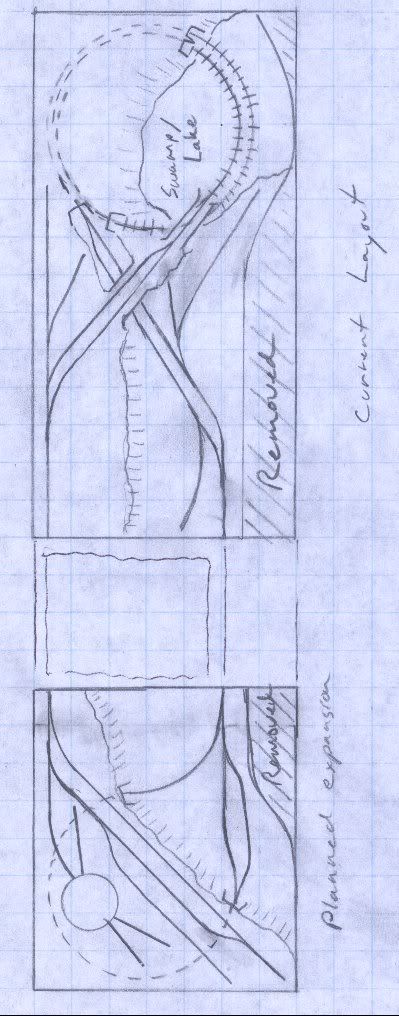
The issue I have with them is that loops on layouts seem like they are not prototypic and just look weird (my opinion), because our curves are so tight and because loops of any sort are so rare in the real world. So the challenge was disguising my loop.
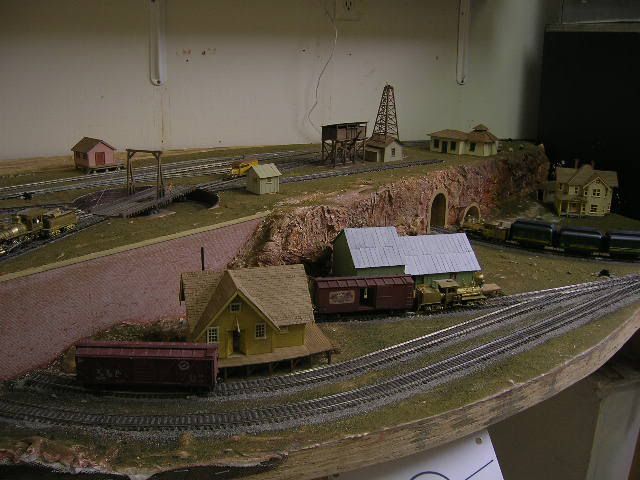
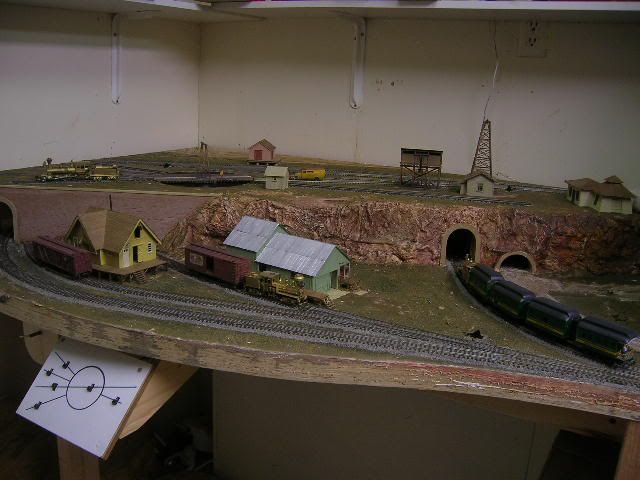
Most of my loop is inside of a tunnel and I think that helps to hide what it is. I generally stop the train in the tunnel and do something else for a while - making the loop/tunnel a staging track, too. When another train is heading for the loop, I put it on a siding and pull the first train out. The second one goes into the tunnel and waits while I finish operations with the first one. I can alternate trains like this for as long as I want and keep something moving on the layout all the time.
Here’s a shot of my loop and turntable (I didn’t end up following the drawn track plan, exactly):
For what it’s worth, I found the wiring simple enough (Atlas makes a special little control box that simplifies things). Operation is easy, too; there is sort of a rhythm to the switches that control the polarity.
BTW, Crandell, It’s great to see an overall picture of your layout. Nice work! I’ve wondered what the whole thing loo
My planned reversing loops are because my PRR corridor plan is six tracks wide and create what was called years ago a dogbone layout. This works well because the outside two tracks are basically locals. The next two are freight and the inside two are passenger so the overall layout is a loop within a loop within a loop. This way trains going into staging are held on a loop so they can return in the opposite direction. Without them it wouldn’t work.
My track plan is an around the room dogbone with the reversing loops stacked in one corner of the room, which reduces the amount of space they eat up. Each loop has three tracks which act as hidden staging yards. I can get two long trains or three short ones in the loops. The only limitation is that each track of the loop must be operated on a first in-first out basis. That has been fairly easy to schedule around. I have a DCC layout and I use a single MRC auto-reverser which is wired to both loops. As long as you don’t have trains entering or exiting both loops at the same time, that works fine. Since I am a lone wolf operator, there is little chance of that. For a multi-operator layout, it would probably be a good idea to have an auto-reverser for each loop.
My main classification yard and also the main passenger station are near one of the end loops. Operationally, this plan gives a great deal of flexibility. Some trains simply run over the road from one end loop to the other. Others will arrive from one loop or another and terminate at the yard or station. Other’s will originate from the yard or station and exit into one of the staging loops, to return later. I can also use the upper loop tracks as a fiddle yard if I choose to do so. I have a couple seldom used cutoff tracks which bypass the loops and turn the layout into a large double track oval if I choose to run that way. The real purpose of these tracks though is to allow me to run paired coal trains in opposite directions. Eastbound loads, westbound empties.
Staging loops increase the amount of mainline running to switching which depending on your perspective can be a good or bad thing. My large classification yard plus dozens of industries gives me pleny of opportunity for switching so it is nice to have some trains that simply run through the layout.
Quick and dirty way to ‘hide’ a reverse loop in plain sight:
Build a flood-loader over the spot on the loop equidistant from the entrance-exit switch. Then lay a second, parallel track that doesn’t pass under the loader and use it as the mainline. That way you won’t be routing your Empire Builder under the loading bin.
Unfortunately, my favorite prototype reverse loop is 1:1 scale hidden track. It wraps around the lower level of New York’s Grand Central Station.
Chuck (Modeling Central Japan in September, 1964)
My previous layout was a point to loop with the loop in hidden staging. The staging represented the end of a branch. Since it was a branch, every engine that went to the end came back the same day or the next day. A perfect situation of a reverse loop. The laoyout had a peninsula that the visible track went around, with staging and the reverse under it. So there was zero additional footprint requirement and zero effort to “hide it”.I had another “reversing loop” (actually a continuous running connection) where a interchange track and an upper level staging track connected. When not running continuous, the left hand end of the track was staging and the right hand end was a PRR interchange. Once again, zero additional foot print. In both cases the reverse loop or connection was hidden (loop on the lower level staging, connection behind a low backdrop, about 6-8" high).
I used DCC and used both MRC and Tony’s Train Exchange reversers. I did have some issues since the loops were “far” from the command station, the reversers couldn’t detect the voltage drop fast enough. I was advised to run a separate bus from the command station to the reversers, but by the time I learned that I was about to disassemble the layout to rebuild it.
My current track plan has a “reverse loop” in it where a continuous running connection ties into a wye, but that portion of the trackwork isn’t built yet. Once again, the continuous running connection adds to the foot print, but not the reversing section and since the tail of the wye/continuous running connection goes through the back drop its, not visually obvious as a reversing track.
I just re-read your post and don’t understand. The dual DPDT method is the age old standard way of wiring a reversing loop. Flip the polarity of the main while the train is in the loop… But I wasn’t talking about controlling. I was speaking about moving the train. I just meant that in a wye or a turntable the train has to stop then proceed. Perhaps I didn’t understand your post. Is there another way to roll a train into an opposite direction?
Perhaps I shouldn’t have used the photo of my wye to illustrate my original reply. [;)] Of course the train must stop when using either a wye or turntable, but the original question was about revers(al)e loops - the DPDT switch is used in all three applications, but the train can move uninterrupted through a reverse loop (unless the operator forgets to throw the turnout after the train is completely within the loop and has not yet exited, going in the opposite direction). [swg]
Wayne
How do I feel?
I find them useful. My mountain line is loop to loop about 150 feet long. Each end has a reverse loop with a tortoise on the TO feeding it. I use the tortoise aux contacts and some unorthodox wiring to throw both the TO and main line polarity from EITHER end with a single pole double throw momentary switch (one at each end). Hold switch until points move about half way then let go and the tortoise continues until stall. (Like a latching relay without the relay).
My next step is to wire in detection IR detectors in parallel to the manual switches. Total automation IS possible in DC but the wiring becomes a bit sophisticated. I suppose that for most people DCC and auto-reversers are the best way to go.
Karl
Doesn’t Grand Central have loops on BOTH levels?
Yes
Well, not really. Run the mainline to the reverse loop switch, which is at least a junction, run the loop back to the switch, there is another junction with a whole mainline ahead to run. So, your time table has two additional junctions
Place a small station or industrial spur and, perhaps a short siding in the loop and the loop becomes a section of mainline itself. Pad the time table to allow for some switching and problem solved.
Anyway, that’s what I do.
Topic is 15 years old. Some members may not even be on the forums anymore, or even alive.
ahh, yes, a newbie and a first time poster. Why does that not surprise me?
I couldn’t resist reading through this ancient thread, and I have no idea who Billy Joe Bob is even replying or exactly what he is saying.
As I have often suggested, if you cannot resist the temptation to reply to a necro thread, why not just start a new thread and provide a link to the old thread?
But, now that I took the time to read through this old thread, one reply noted that reverse loops don’t look good on a layout. Maybe so, but I have four “reversing sections” on my layout, and you cannot tell by simply looking at my layout.
My layout is a large and long folded dogbone that widens to a 4-track mainline in the center. I use four double slips to permit trains to change directions and cross over to any of the other three mainline tracks.
Rich
Newbie? You talking to me? You talking to me?*
Here is a real surprise – I haven’t been a newbie in this hobby for 68 years. (August 21, 1955 - a Penn Line freight train set: I was hooked!) But, thank you, kinda makes me feel like old school meets Taylor Swift.
Couple of days ago I went to the Google and entered “model railroads with two reverse loops” and landed smack on this 14 year old post. I do have some ideas for ‘Create a New Discussion Topic’ See, us old dogs can learn new tricks!’
- Robert De Niro is a hoot!. He always takes me for a ride.
Here are a couple of snaps my abuilding train set.
https://live.staticflickr.com/65535/53864629219_e364253c52_m.jpg
https://live.staticflickr.com/65535/53864686355_49eddfc617_m.jpg
https://live.staticflickr.com/65535/53864690525_c0954cf011_m.jpg
https://live.staticflickr.com/65535/53864629219_e364253c52_m.jpg
Poster only posted 13 years ago and has not posted since.
Newbie to the forum? Not the hobby.
It was obvious to me as soon as I opened it that this was an old thread, but it was like a step back in time seeing all the old names of the posters no longer here for whatever reason.
I wanted a way to turn my engines and I did not want a giant turntable to do it. The CPR roundhouse in Vancouver had a small TT and a balloon track around the the RH to turn the passenger trains, so I emulated that somewhat.
I can turn a Hudson on the TT but nothing larger. The 2-10-4s go around the balloon track which can also accommodate whole trains, though a larger passenger train gets turned in two or three sections.


I love the ballon track & the overall concept