I think that everyone who replied said that he can do that.
Now we are trying to figure the ma. for the Walthers lamps and discussing the DCC option.
Rich
I think that everyone who replied said that he can do that.
Now we are trying to figure the ma. for the Walthers lamps and discussing the DCC option.
Rich
I just thought I could put this argument to rest.
Let me add to my orginal post. I intend to run separate bus wires independent of my bus wires for my track feeders. These bus wires will be for lighting only. I will be installing Atlas and Walthers street lights. (15) Atlas street lights and (3) Walthers street lights. The package for the Atlas lights states: they operate on 16V DC or AC, LED is the light source ,they are 3 Volt LED with resister and diode for connection to 16 Volt AC/DC, red is positive, blue is negative. The Walters light package states that they can be connected to a AC or DC power souce with a maximum output of 12 Volts. Walthers lights are not LED. That is all the information on the packages. Can they all be connected to the same power source, or does the Walthers need to be on a separate power source? Thank You for all your ideas and comments.
woodman, the Atlas street lights will work just fine off of that Bachmann power pack. So, if you want to use a fascia-mounted set of bus wires connected to the power pack for the Atlas lights, you can just tap in along the bus wires. The LEDs are fully protected in those pre-wired Atlas light kits.
The Walthers street lights pose a bit of a problem since they are only rated at 12 volts. To prevent premature burnout, you are going to need to reduce the output voltage if you connect them to a 16 volt power pack. You can use resistors or diodes or something like a step down voltage regulator which you can buy cheap. Or, with only three Walthers street lights, you could tap into your DCC bus. Depending upon your DCC system, the voltage may not be much higher than that required for those 12 volt incandescents, so it wouldn’t take much to reduce the voltage to 12 volts to power those three lamps.
Rich
He could set the throttle on the DC pack to 12v and hook up the lights to the variable DC output instead of the fixed 16v accessory terminals.
I think that it depends upon the type of power pack that he has from that train set. The typical Bachmann train set has a 16 wall wart that can be connected to a speed controller (e.g., 44212). I don’t know if it has those two sets of terminals. The wiring setup may need to be cannibalized somewhat.
Rich
Does it look like this starter system? The op needs to tell us if he has both pieces or what he does have.
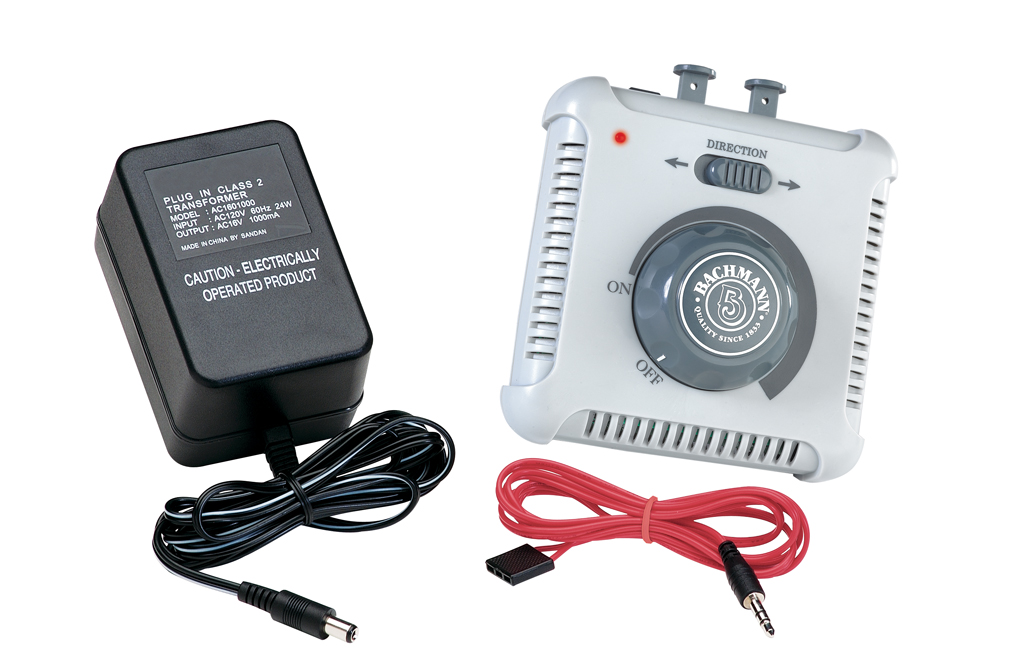
Jim, I agree. It would help to know which model the OP has among the various power packs.
I have an older Bachmann train set power pack that I use for testing purposes. It is Model No. 6607, and has four terminals. Two of the terminals are 17 VDC for DC track, and the other two terminals are 20 VAC for AC accessories.
But the newer Bachmann train sets include the Model No. 44212, and that power pack apparently has different voltage output arrangements.
Rich
The power pack does not look anything like that, I have three Bachmann power packs from train sets that were at least 25 years old. The power packs are brand new in the box, I have not looked at the specs on the power packs, I only tested them on running trains and they work perfectly. I was told by a neighbor that all I have to do is throttle the power pack down and I can use it for the Walthers lights. I did not realize how complicated just hooking up some street lights to my layout was going to be, I am now thinking of returning all the lights and just forgetting the idea of having lights. I appreciate all the replies to my posts, but with each reply it has become more and more confusing for me. I just think I am way over my head in trying to accomplish this task. Once again thank you all for your advice, you kept me from making an expensive mistake.
Your neighbor is exactly right. Just connect the lights to the track screws and throttle down as you say.
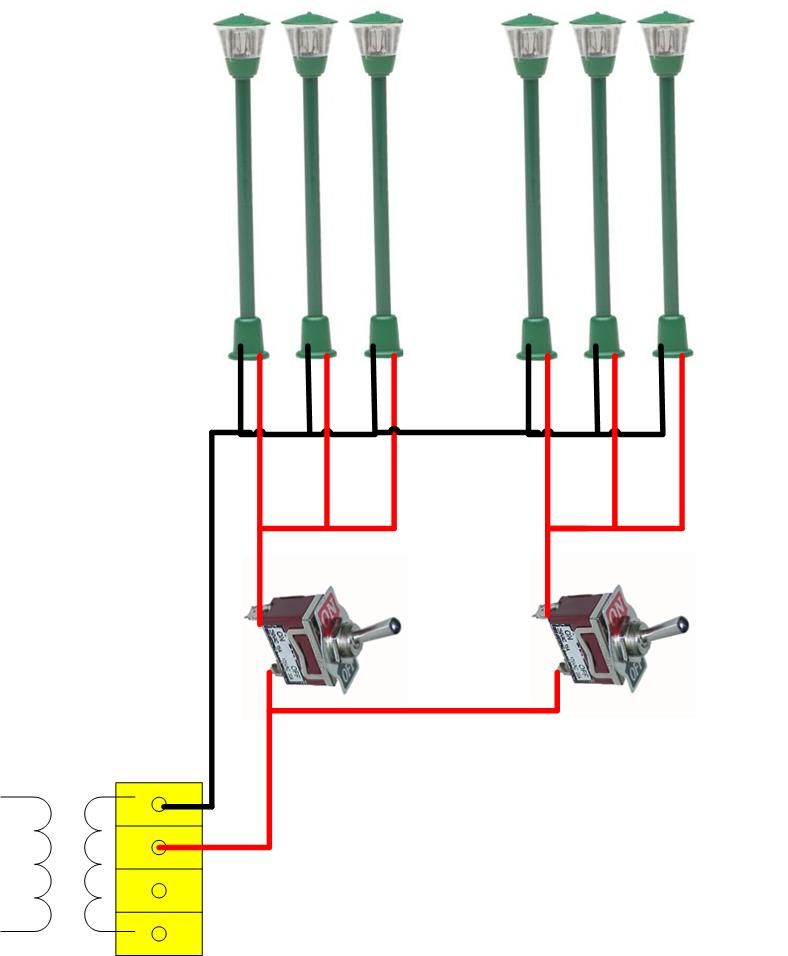
The switches are optional…
My old Bachmann power pack looks like this one.
http://www.ebay.com/itm/like/201157695156?lpid=82
Is yours similar to it?
What is the model number on your power pack?
Rich
woodman, it can be a bit complicated. You have two different sets of lights, one with LEDs and one with incandescents. Each has its own power requirements. And, you have a power pack with voltage outputs currently unknown to us.
Take a look at the power pack. It should have a model number stamped or printed on it, and it should give the output voltage for DC and AC. Give us those details and we can put this matter to rest.
Rich
It’s not complicated, it’s just that you have two different types of lights with two different voltage requirements. The EASIEST thing to do is to obtain 2 power supplies, each one meeting the specifications of the lights you intend to hook up, and keep it all compeltely seperate. That may not be the CHEAPEST option, or the best use (reuse) or existing resources, but it’s simple and you know each set of lights will be getting the proper voltages.
–Randy
We allready have the necessary information to make a determination, the model of the pack is not important. As long as it is a variable DC is all that matters.
First, what are the requirements?
So we know the Atlas lights will operate on 16v MAX. However, as they are LED with resistors, we know they will shine just as bright on 12V DC
The Walters lights require 12V MAX. So we know they will also work well on 12 DC.
So a DC source of 12 V will operate both lamps.
Any DC power pack with a variable DC output can supply this voltage. The throttle is adjusted to the desired voltage value, which has been determined. Or as the OP said:
Jim, I generally agree with you. But, even with a variable DC output, woodman has to be careful not to burn out those Walthers 12 volt bubs. Take my old Bachmann power pack. It can put out 17 volts maximum. So, a volt meter would be advisable to find the right setting on that rotary dial. I know that you mentioned that as did his neighbor. So, I am just reinforcing that caution. I still would like to know the model number.
Rich
Easy for you to say, Mr. Wizard. [(-D]
(Just pulling your chain, Randy).
Rich
the voltage rating on fixed supply like a wall wart is at the max current rating.
the voltage could be higher at lower current
Rich,
Your right, he does need to mark / tape / lock the throttle at or below the desired voltage lid. Also, be aware that most DC packs will not put out 17 volts to the rail, unless it is a open circuit. As you know, non-dcc equipped engines typically had 14 volt incandescent lamps, until LEDs came into vogue. So if a pack did put out 17 volts at WOT, the higher voltage would smoke the bulbs.
What I see on my MRC T2s is 13-14 volts @ WOT, on the rail loaded with a single locomotive. Even so, unless the OP throttled down his pack, this would be too much.
Here is the info on two of the power packs that I have, the first is;
Bachmann Hobby Transformer Model # 6607 Made in China
Input 120 V 50/60 Mz
Output 17 VDC 20 VAC
Max. Output 7 VA Total
The other power pack is:
MEHANO Model # 352 Made in Slovenia ( Imported by IHC, Formerly AHM )
Input 120 V AC50/60 Hz
Output Open Circuit
DC 0-17 V AC 16 V
Power Total 5.5 VA
Can I use either one of these to power the lights or should I buy another power source.
Rich,Yes, that is exactly the one I have.