Cunife (with or without the 2.5% cobalt) is magnetic, and I believe easily ductile enough to draw or roll as model rail…
2 Likes
Huh. How much does it cost?
1 Like
Cheap enough that they’re using it in humbuckers again. Think of it as nickel silver with less expensive metal in it.
2 Likes
Hmm, maybe if Fender starts making O Gauge three-rail track we’ll have the best of both worlds? 
2 Likes
Gibson 
3 Likes
Hmm. That might be a good option.
1 Like
There were two basic ‘commercial’ alloys, CuNiFe and CuNiFe2. The latter is the one with ~2.5% cobalt, which would run the price up somewhat.
There is something called ‘cunifer’ in ship chandlery that is of no use in this connection; the iron content is only about 1 to 2% and that’s significant for corrosion, but not magnetic susceptibility.
I see reference to a CuNiFe ‘master alloy’ which is used for specialty metals production. I see it normally provided in easy-to-break-apart form, a bit like the principle of Toblerone, which is of little use for rail-forming purposes; the price might come way down if there were enough ‘market’ or order quantity to get a batch cast as rod or thin bar suitable for rolling or drawing.
3 Likes
deleted
5 Likes
So, in other words, what everyone is saying is that Magna-Traction is generally superior to traction tires. In addition, the best style of rail for Magna-Traction would be some kind of (obviously) ferromagnetic flat-topped rail, perhaps made of CuNiFe.
Right?
1 Like
Definitely better than a rubber band traction tire. Replacing those, especially on diesels, is hard to do. My MTH RailKing Dreyfuss Hudson needs it’s tire replaced and even though I have exactly the right one (it came in the box) getting it to seat in the groove properly has eluded me. It runs around the layout a couple of times and then I see the tire flopping around on the rods.
The only drawback to Lionel’s postwar MagneTraction relates to steam locomotive drivers. Lionel was forced to remove the nickel rims that, in my view, dramatically increased the beauty of their early die cast steamers. To make Magnetraction work engineers had to replace them with solid alloy wheels. Without the rims that simulated actual steel locomotive driver tires the fancy wheel centers of the past were lost.
But, if you’re after pulling power nothing beats MagneTraction.
2 Likes
That makes sense to me–though I do wonder if there is a way to make better steamer wheels that are magnetized.
Anyway, here’s another question: is is it Magnatraction, Magnetraction, or what? I’ve seen all sorts of permutations thereof–which one is correct?
1 Like
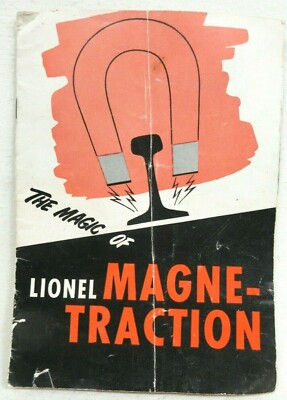
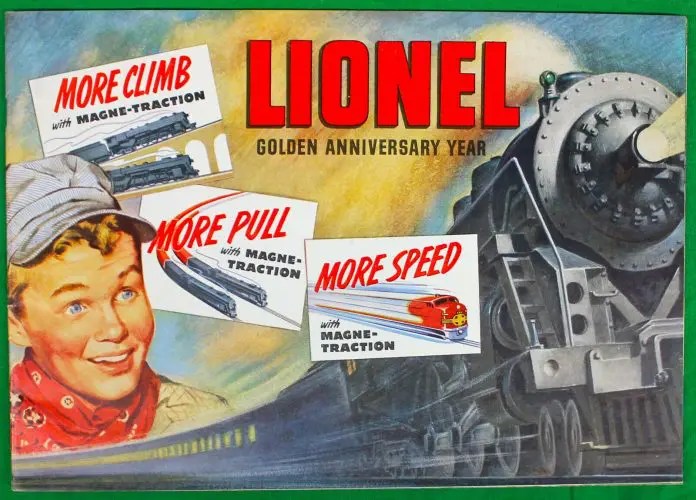
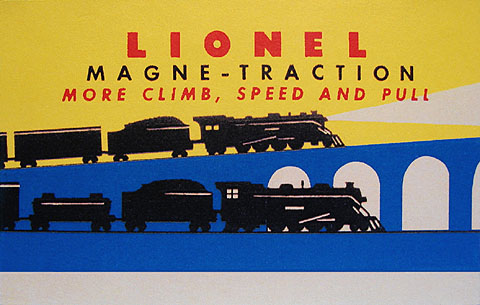
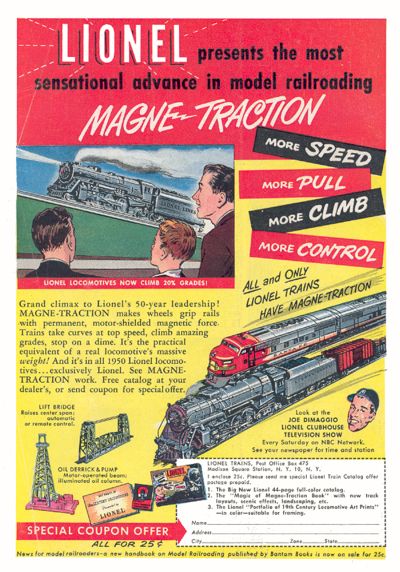
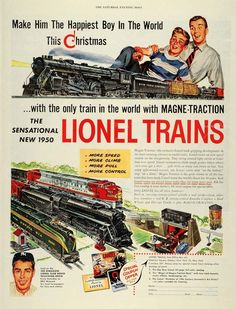
Some time ago I saw a Lionel poster that spelled it Magna-Traction, but now I can’t find the darn thing.
1 Like
Personally, if a traction tire wears out on one of my engines and the engine doesn’t miss it I don’t bother replacing it. Mind you, I’ve got a small layout (can’t run more than 15 freight cars) and no grades. And MagneTraction doesn’t help me, I run on nickle-silver track since my Chugger Barn’s not climate controlled and I don’t want corrosion issues. But it all works all right for me.
2 Likes
I guess what you’re saying is Gargraves stainless steel track attracts a magnet? If that’s so then most likely it’s only got enough chromium in the alloy to give it stainless non-corrosion properties and no more. Honestly it’s understandable if it makes it easier to work with. More than one machinist has told me that if you want to see a grown man reduced to tears of frustration watch a machinist trying to work with pure stainless steel, it’s a nightmare! 
2 Likes
I guess we’re supposed to put it in all CAPITAL LETTERS too
1 Like
It’s not all that difficult if you’ve read and understood The Art of Cutting Metals – "normal’ 304/308 (which is what I think you mean by ‘pure stainless steel’) work-hardens dramatically if you make the mistake of letting your tool dull, or you don’t establish and maintain a consistent feed rate from the initial cut. Not for the timid or those who learned by cutting brass or aluminum!
1 Like
I s’pose.
1 Like
This is of considerable interest to me, as someone who has indirect machining experience and considerable interest therein.
1 Like
This is the same Taylor who would later be known for ‘scientific management’.
Read carefully and critically, and note the implications of dissipating heat in the turnings as well as the lubricant. When you have a work-hardening but originally fairly soft material, your feed must be such that the depth of work-hardening is completely undercut (and the work-hardened material removed on the turnings) as you proceed. This is as you might suspect true of sawing or filing work-hardening stainless alloys, too.
1 Like