I grew up on a fishing resort. Somewhat similar to farm life I reckon as there was ALWAYS LOTS of W**K to be done. One difference between a resort and a farm is hospitality, you have to be nice!
International Falls was 35 miles away. Our basement and garage were full of things that you think you would need if anything went wrong and something always went wrong! [(-D]
If the thing you needed was not there, it wasn’t like you could stop what you were doing and run to town. Not Today!!! Not with guests running all over the place needing a fishing license, minnows, gas, fish cleaned, pizza or Whatever! [:-^]
You taped things back together good enough so to speak until the next time you went to town. Literally!
It would get to 40-50° below zero in the winter sometimes (Just see how fast you become an experienced furnace repair guy on a night like that), although you thought you bled all the water lines in the fall under each cabin perfectly[:(] Not even close as plumbing was extensive in the spring but some of those didn’t show up until your guests were there. Many-a-times we had those rubber things with the clamps on a pipe to Band-Aid it until the time it could be done right. Black tape wrapped tight worked for a while if you ran out of clamps. Just one example of the many.
So if someone said to me, That doesn’t look right Track Fiddler. I’d say “I know”, I haven’t been to town yet!
Nothing ever looked right anytime all the time. So if something doesn’t look completely right on your layout, don’t worry about it, that’s the real world! [:^)]
Are you aiming for absolute authenticity, or are you making a layout that is what you like but may not be accurate?
If you would like the look of some light coming from the windows, I’d say put it in. Who cares if it’s completely accurate? You will like it, and that’s the important thing.
The distributor was at the top of the elevator and if it got stuck or didn’t seat properly usually caused by spilled grain someone would have to go clear it. At busy times the loading could go on all night and if someone had to go up they would need light.
I may be wrong but I think the lights would all be turned on before operation started as a spark is most likely to occur when the switch is flipped. Flipping the switch before things get going means fewer combustibles floating around inside.
So have a light, it works for me.
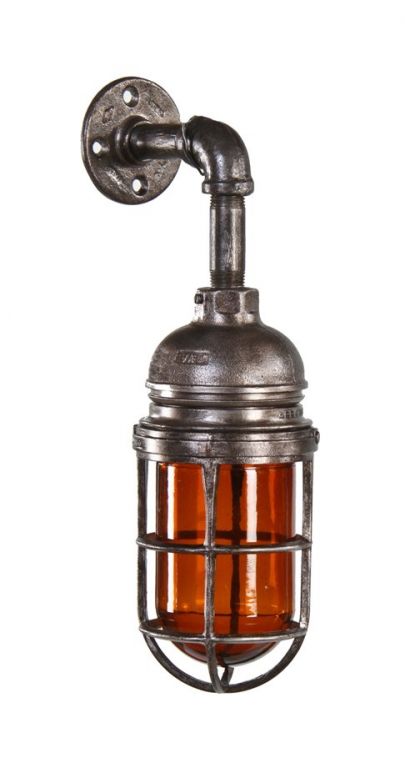
I just googled explosion-proof grain elevator light and got lots of images. Note the pipe, just as I remember.
When we built the CNG training center in Atlanta, the explosion proof light fixtures in the lab area looked almost exactyly like that. They were about $750.00 each, and looked like something from 1940.
I’ve always been a big fan of lights on layouts - they just seem to add a bit liveliness and dimension. It looks like you’ve already received some mixed replies about lights on grain elevators specifically. As some pointed out its seems logical that it woud hve some light but the argument about the potential for fire also seems sound. That said, I imagine that somewhere there is probably at least one grain elevator somewhere that’s lit up at night. And the ultimate answer is that if it looks right on your layout and in your scene then you should probably go for it. (You can always just not invite any grain farmers over to see the layout.)
Sometimes some forum members state things in absolute terms that may make the OPs feel as though they are wrong if they do things differently. We shouldn’t take those pronouncements to heart. It’s your railway. If you want lights in the grain elevator, then put lights in the grain elevator!
The OP asked about lighting because the roof was getting glued on.
The OP asked specifically about whether the upper level of the elevator (where the elevating stops and the grain is either delivered directly to the loading spout or to a storage bin) would normally be lit or not.
My posts were intended to explain why it would not be lit and that any rural and local grain elevator in operation in Western Canada (along a CN line) could not have been lit by electricity until after about 1950.
The Walthers model is specifically a rural, local elevator. Generic it may be but the prototype could not have been connected to electric power. After 1950 a rural Canadian grain elevator could have been lit electrically but would not have been for a number of very good reasons.
I will check with someone who would know having worked on a grain farm at harvest time in Western Canada (though the elevator would be on a CPR stub line) and whose uncle repaired these elevators for a living for over 50 years. Wish I could just ask him directly. Mind you that roof is now glued on so the OP made his decision. Then again, he’s no stranger to removing parts and re-installing them…
Sure, you can do whatever suits you on your railroad. But that wasn’t the question asked.
Decalling an uneven surface is very tricky. The decal does not lie down into the grooves or other surface irregularities very easily.
There are stronger decal softeners than Microsol. Tamiya makes a couple of levels of stronger softener for example.
When softening decals aggressively it’s very important not to move or even touch the decal until the softener has dried up.
Also, when placing your model on your layout note where the engine house is relative to the main elevator in that prototype picture. That little flat roofed building is the engine house. These buildings were separated from the grain handling parts of the structures for fire safety reasons. The belt drives from the engine house into the elevator lifting machinery ran under the truck delivery area floor.
Thanks Dave. I am still not very happy with my decals. They look too young for this building. I tried to sand it a little bit but the decals keep moving when I do this.
Thanks TF. I really like building kits. It’s the fourth kit I finished since I began in the hobby four months ago.
Thanks John for the link. Very interesting to know more about those grain elevators. Here in Québec, Canada we have the kind of circular one. The biggest are made of concrete but the smallest are near farms and I don’t know what they are made of.