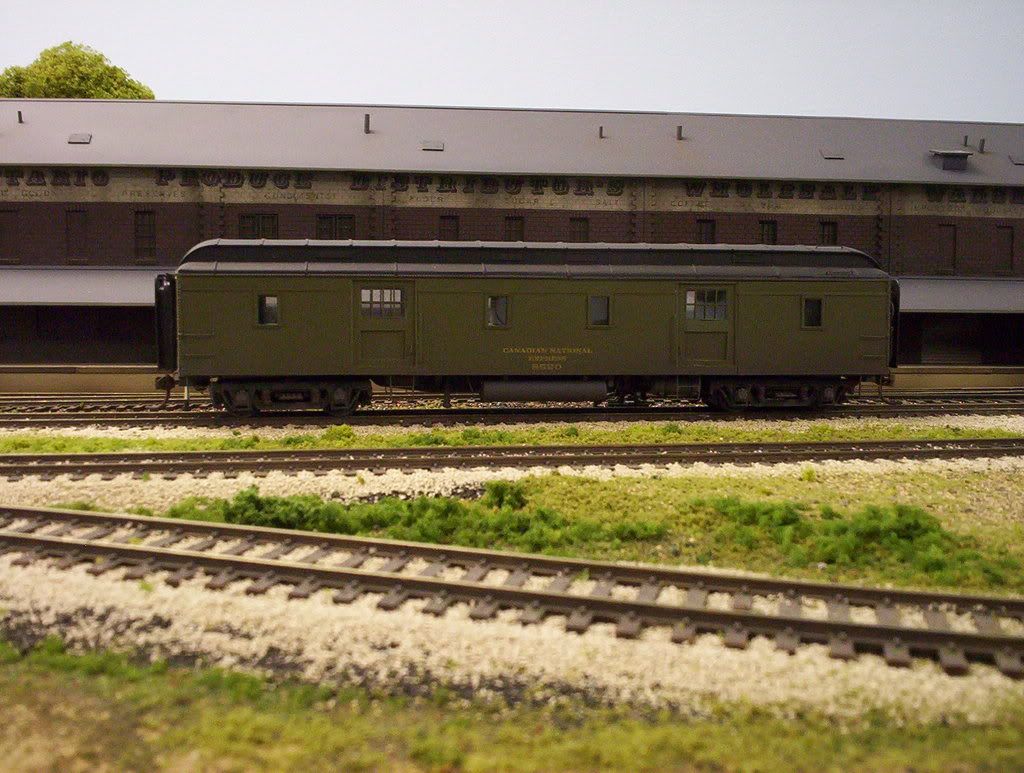
What are the correct IM metal wheels- size and part number-for Athearn HO heavyweight passenger cars? I am thinking of the ones that would be insulated on one side, in case I want to do some lighting of the cars. Also, any info on diaphragms? I heard that IHC interiors work well for these cars.
I don’t have an answer, but I’ll be checking in on this since I’m detailing some Athearn heavyweights and will eventually spring for some metal wheelsets. I just bought a couple of American Limited diaphragms (#9200) which the package says can be used on Athearn or Rivarossi cars “without minimum radius restrictions”-- maybe someone else on here has used these already for the same thing?
As an aside, I love the Athearn cars-- seem to me to be the perfect compressed size without looking too far out of place compared to longer passenger cars.
I used the American Beauty diaphrams on all my Athearn passenger cars and they look and work great. Also have some on a few F7 diesels. Not sure but I think I used Kadee or P2K metal wheels in 33" size.
I originally went with Intermountain wheel sets in my Athearn Streamlined cars. They are slightly sloppy, here are my findings:
The Athearn passenger axle measures 1.019” axle point to Axle point, Intermountain measures 1.002” and Kadee measures 1.006”. The diameter of a scale 36” intermountain measures .411”, the Kadee measures .411”, now this was my surprise the Athearn plastic wheel measures .412” but Athearn metal wheels measures .401”. According to my calculator a 36" wheel would be .4133" in HO scale.
I have changed out two cars with 4 wheel trucks to the Athearn ATH90504 metal wheel sets. I can’t see any operational difference between the longer Athearn axle and the Intermountain axle. I do have a warm and fuzzy feeling with the Athearn wheels because there is less slop. I plan to swap out the rest to the longer Athearn axle over time. The Intermountain wheels can be reused in freight trucks. The Athearn metal wheels have one wheel insolated so you can use the Athearn truck contact kit for power pickup. They have contact kits for both 4 and 6 wheel trucks.
Did you mean to write that the Athearn axle is 1 and 19 thousandths and the Intermountain and Kadee are 1 and 2 thousandths and 1 and 6 thousandths respectively? Because that’s a big difference.
The correct size of the wheels for passenger equipment is 36". I use Intermountain 36" wheels, #40051, on all of my passenger cars. The wheels are brass, and they are insulated.
Those measurements were taken with my digital caliper and I measured four axles of each manufacturer to make sure. The Athearn axles are 1975 vintage, Intermountain & Kadee are roughly 2008 vintage. All of my (9) Athearn Streamlined cars are 1975 vintage Blue Box Kits. All track very well, I added 3 oz. of weight to each car and use Kadee #119 Shelf Couplers to prevent accidental uncoupling.
All cars are illuminated with 2mm 1½ volt 40ma bulbs but not from Athearn axles. I made a lightning unit from a E7B dummy and use 2 pin micro connectors on #30 wire between cars. The B unit has a 4 volt Lithium 5000ma battery with a LM338 voltage regulator adjusted to 1.4 volts to supply all 10 cars (one Bachmann full dome kitbashed to a SP ¾ dome lounge car). I bought a 4 volt Lithium battery charging card to charge the Lithium battery in the E7B from the rails. It works very good on either DC or DCC. I use a micro DIP 5 volt relay in the E7B to turn on and off the 1.4 volt passenger car lightning, the relay is controlled from the DCC decoder in the E7A with Function 3.
The E7A is about a 2008 version Athearn SD40-2 frame with a Cary Body, plenty of pulling power even on my 3½% grades. Running at full load with lights off my Daylight E7A draws .913 amps going up my 3½% grades without any sign of over heating.