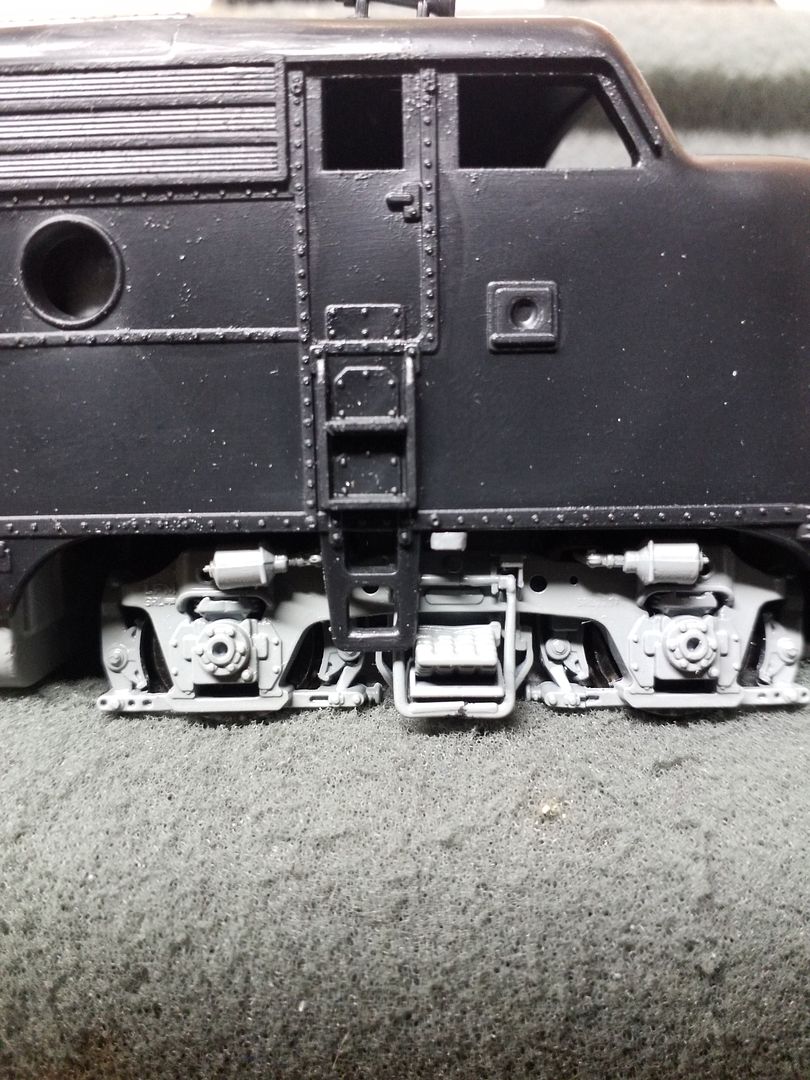
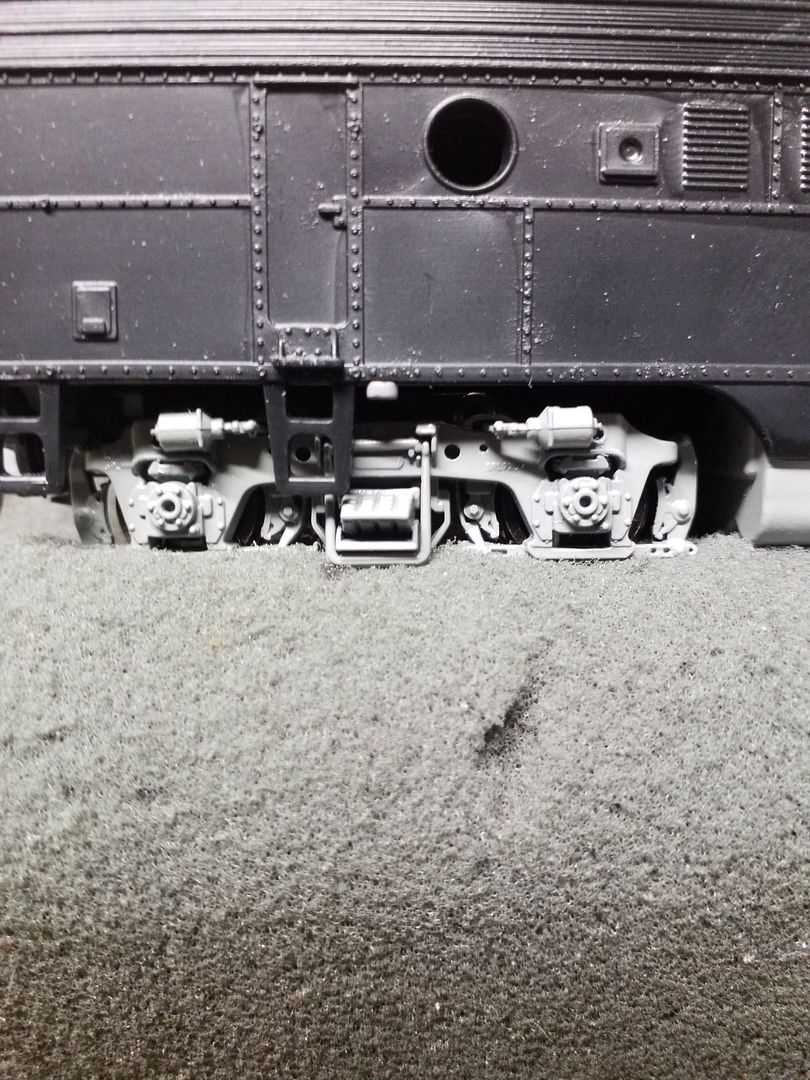
Thanks for posting the link. I was hoping that the version without the rear roof overhang would be produced (Phase II?).
But, with an undecorated shell, carefully filing and wet-sanding the sheetmetal overhang to a flat profile is not difficult.
Regarding windshields and nose. As a teen modeler, back in the day, I didn’t even pay attention to the nose, but yet noticed the huge windshields due to my constantly looking through magazines with prototype photos back then.
When I bought my first Atlas FP-7 I eventually noticed that the windshields had, as a friend pointed out, an “Eyes Squinting Shut” look, LOL![:P]. But I was a happy camper until, over the years, more accurate EMD covered wagon shells were produced. I really liked the Stewart shells.
I agree that no two prototype EMD Bulldog noses were exactly alike. But, imho, the windshields of the original HO Global shells definitely stand out.
I’m looking forward to the dual headlight version.
The rear roof overhang was present until very late in F unit production. If I recall only a few F7’s were built without it, and then all F9’s lacked the overhang
Only F7’s after October of 1952 lacked the rear roof overhang. All F7’s produced with 36" dynamic brake fans had the overhang. All F7’s built after 10/52 had 48" DB fans and lacked the overhang which is essentially an F9 body. A very few units built between June and October 52 had 48" DB fans and still had the overhang. F9 production began in Jan 54. So this model would not be correct without the overhang, it has a 36" DB fan.
Streamlining, possibly better airflow along the roofline of multiple unit lashups. And it provided a bit of a drip edge effect at the doors for units without diaphragms.
1) Drill and ream out the 36" dynamic brake fan, plug the hole with styrene and fill it with body filler.
2) Gently file and wet-sand the overhang to a flush contour.
SCL can be a “hoot” of a road to model as even two units from the same ancestry road (i.e: Atlantic Coast Line) can have noticeable differences between them (especially units that were wreck repaired or rebuilt).
The challenge for me, after the Scalecoat II black paint has cured, will be applying those long pesky yellow stripes! I’ve done stripes before, but for me it can be tedious, even when using fine line tape as a guide. I’ll make sure to be in a relaxed mood when it’s time for that stage.
I think I’ll be a happy camper as long as I can capture the basic, overall late 1960’s appearance.
However, whenever Highliner kits popped up on ebay, they’d go quickly. Ironically I think that it was some of my southeastern modeler friends that were among the bidders snatching them up! [:P]
Genesis & Intermountain SCL F’s were beautiful. I should be wearing a dunce cap for having procrastinated and foolilshly thinking “Ah no biggie…they sold out so we’ll see another run!”. But, as modelers point out to me “You know that if it’s Santa Fe or the other goodl ol’ boys from the west or north…no problem… you’ll get tired of seeing em’. But Southeastern? Well…we wish you the best, buddy!”
When an SCL version does pop up on ebay, as the bids continue climbing towards the $300 mark, my budget says “Don’t even think about it pal!”.
So I have to go for what I can get whether it is Athearn’s new units or older used “Stewart-Kays” that are (hopefully) in good condition. I’m not complaining as it is my own fault.
I learned my lesson, which is why I did not wait long after the SDP40F and the newly tooled Atlas U36B were produced.
On another discussion group, a question was brought up asking if this new tooling is from the molds used to produce the Highliner shells. The answer is that Athearn stated it’s new tooling.
In looking at the video, I would ask “Does it really matter?”. I’d like to think that, after seeing the excellent job that Athearn did with the SDP40F, that Athearn’s personnel have performed their research with the appropriate people (historians, society reps, etc) and produced a shell that, while not detailed on a genesis level, is dimensionally close to that of the Highliner shell.
As nostalgic as me and a number of modelers are, I don’t thiink that the Global F7 shell will be missed much at all.
Well…I do have a 30+ year old F7 shell that is used for airbrush testing Alclad metalizers [:P] .
The Highliner shell is a very complex set of tooling with a long list of separate parts and panels that allow virtually every different version and phase of F3 thru F9.
Other than using drawings of the Highliner as a starting point, there is no logic in building a one feature generic F7 from the Highliner tooling.
One nice thing about the new shell is it is going to have ‘dimples’ (or whatever Athearn is calling them) for drilling out holes for the handrails. Walthers “Diesel Dress-up” kit could be used to upgrade the old shell with handrails, but getting the holes drilled in the right place and perfectly in line could be tough.
I think that the modelers on the other forum (myself included) are basically hoping that, dimensionally, Athearn’s new F7’s contours and overall measuremetns will be close to that of the Highliners.
Well, since they are investing in new tooling it would only make sense to make it better. Just looking at the pictures it looks pretty good. But it will still be a one piece shell in only two versions - one headlight or two headlights.
They are removing the steam heat vents, relatively few F7’s had passenger steam boilers.
Actually looks like it will fit the old frame, but also have screw mounting on its new frame. If so, that is a smart move, especialy if they make the shell available separately.
Have you ever looked closely at an unassembled Highliner shell? It is a lot of parts.
Other high end brands have five and six different shells to cover the variations.
The new mounting methods are very interesting to me, the ability to easily de-skirt this model easily shoots it up to the top of my “things I am looking forward to” list. Hope to see if they run them in GN for their next run, this tooling looks very promising to me.
It will be interesting to see what Athearn cooks up to replace that old Globe based F7A. I don’t really have any warm feelings about them - they looked crude from my early days and as soon as Stewart began offering their F units, mine went bye bye.