I used colour-balanced fluorescents on a previous layout, and while the light provided good rendering of the colours, there wasn’t enough light for my tastes.
On my current layout, I use cool white fluorescents, with a couple of Daylight LEDs for in-fill in a couple of dark corners.
While the light doesn’t match real daylight, I based my choice on light quantity (lumens), and your eyes quickly adjust to accept it as “normal”.
The room is a somewhat oddly-shaped 560sq.ft., and part of the layout is doubledecked.
It’s lighted by 27 4’ double-tube, and two 8’ double-tube fixtures, along with two LEDs, although I’m considering replacing some of the 4’-ers with 8’-ers.
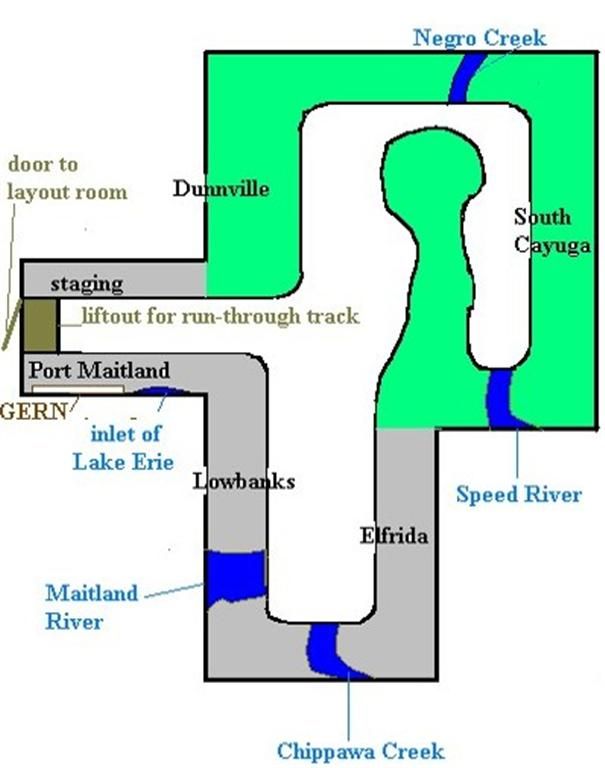
Here’s a not-quite-to-scale sketch of the room (the areas in grey are double-decked)…
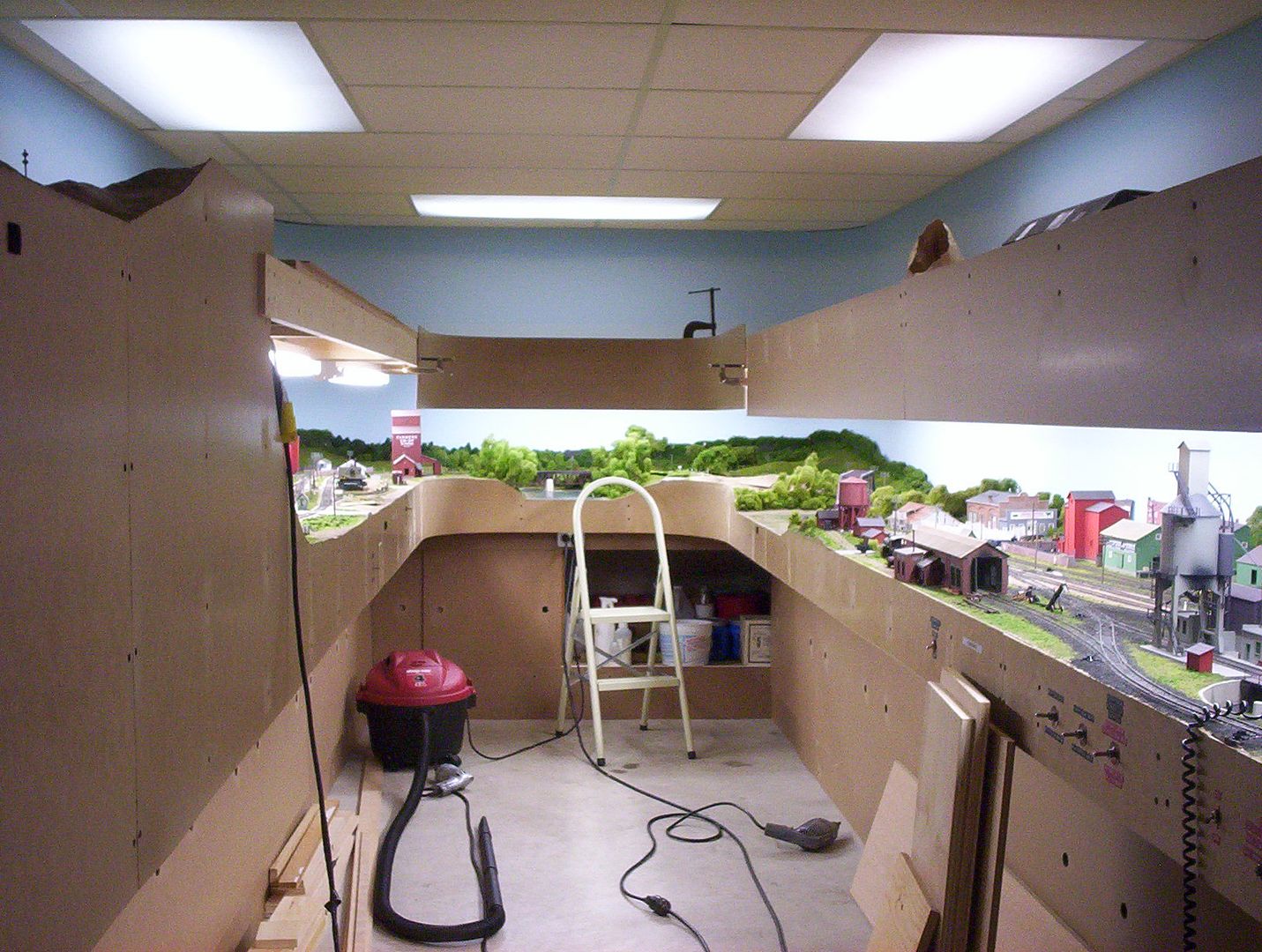
This is the Chippawa Creek aisle during construction of the upper level. The two 4’-ers in the foreground have since been replaced with 8’-ers, and the one at the far end will likely get the same treatment…
I bought LED replacement bulb for my dual tube 8’ fluorescent fixtures. The fluorescent were 5600K and the new LEDs are3200K. The LEDs are slightly directional and can be tweaked for fine tuning of light. I wasn’t aware of that when I bought them but that is a very nice feature. Fluorescent lighting will fade layout scenery, I had to renew my WS green flocking and redo rock staining twice over a 20 year period due to fading. LED lighting doesn’t fade the scenery.
The warm white LED replacement tubes are brighter than the cool white fluorescents and draw less power.
I use a pair of 4100K 9 watt LED floods to resemble moonlight for night running and night photography.
All in all I prefer the LED lighting over anything else I’ve tried. The 8’ LEDs replacements are available off Amazon, I bought 10 tubes (converted five dual tube fixtures) for $130 free S&H.
I’m using 4000 K LED panels. I selected that color temperature very scientifically - I looked at the little Home Despot light comparison doohickey, the one that shows differently color temperatures. Warm white seemed too yellow, and “daylight” seemed too blue. I bought a few Phillips LED tubes for ballasted fluorescent fixtures, and tried them. They looked about right, so I began purchasing 4000 K LED panels.
It doesn’t matter unless you have other sources of light. Your eyes will adapt to any of the color termperatures you mention. If there is an additional different colored light source, that will likely be irritating.
I’ve got one room where there’s both 5000K and 3000K. If only one of those is on, it looks like white light to me. When they are both on, I notice a dramatic difference.
I think I would pay more attention to the CRI rating. Color Rendition Index, I believe it’s called.
When both sets of lights are on, the areas lit by the 3000K look yellow. And the areas lit by the 5000K look blue. If only one set is on, that light looks white. Not yellow or blue.
Our brain tends to do “photo correction”. Until something is in view that makes it too difficult.
Sunlight is 3200° Kelvin and Moonlight is 4100° Kelvin. 3200°K is more red and 5000°K is approaching blue. To get a correct looking picture you have you compensate for the temperature. I use 3200°K for my garage/layout for day time photography and 4100°K for night time pictures. Cameras gave a temperature adjust setting to compensate for the different light. Normally with symbols like the Sun, Moon, an incandescent bulb or a Fluorescent symbol.
I’m sure a real photographer will jump in and explain it much better.
With a good quality digital SLR, there is a setting for white balance and light temperature. As long is the light is consistent and even over the scene, the camera can take care of the balance automatically. Actual light temperture is not so much of a factor.
.
I used to buy color balanced 35mm slide film back in the day, but I love digital photography.
Mel, is that a misprint in your post? I think you’ll find that sunlight is considered to be 5,000 to 6500 degrees, high noon sun about 5500 degrees. 3200 degrees is getting towards a 60 watt incadescent bulb which is usually around 2700 degrees.
Film couldn’t do the clever trick that our brains can do. It’s dumb, and just sees what’s there. So you could put filters on, to correct it. Or you could use the way-cool Kodachrome T40, that had the correction built in.
As for whether the two areas would photograph differently: They certainly would have with film. And I think they would with digital. The camera can auto-correct for a color cast (as can my Photoshop program). But neither have a way to know what to do with two different colors of light source.
And, again, the phrase is “consistent and even over the scene”. In my 3000/5000 room, it is not.
And that gets back to my assertion that the big no-no is mixing lighting colors. And your brain and/or digital camera will correct for it. And your film won’t. But film is gone. Although I still have some Ektar 25 in the freezer.
Yes, I screwed up. I was sitting on my brain again. Tungsten is 3200° and sunlight is 5000°. I did get moonlight right at 4100°. That’s what happens when you get old.