Does the EOT receiver in the cab and the voice comms transceiver share the the same antenna or use separate antennae. I ask because there is a fairly big difference in the freqs.
Good question, what kind of antennae do locomotives have, and where abouts are they located?
Sinclair seems to be a fairly popular model used on locomotives. And after trying to find the answer it leaves me with more questions.
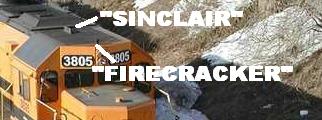
This pic of an SLR Geep has two antennae on the roof. The one on front is a “firecracker” type omni-directional antenna and the long one at the rear of the cab is a Sinclair type antenna, which looks like a ST series.
http://naphotos.nerail.org/showpic/?photo=20040330201729728.jpg&byrail%3A8%3ASt._Lawrence_&_Atlantic
Young man, your eyes must be much better than mine! The one in front - is that the “knob” above the headlight? And where is the rear one? Can you see any of these from the ground - about 20 feet away?
Mook
First Question:
Second question: Maybe, depends on where they are installed.
Third point. While not popular in the RR business, you still might see some “quarter wave spike” antennae, a thin wire about 18" tall, exactly like you may very well see on your local police and fire vehicles (which often are in the same basic band).
As for the EOT receiver, it would definitely have a different antenna. There may be a Sinclair-type antenna for the UHF band, but I’m not familiar with the line. Remember, too, that some EOTs are now two-way devices…
If I understand it correctly, the RRs use high VHFs (16x.xxxx) for their channelization. The receive only EOTs use high UHF (4xx.xxx) and two way use the UHF for receive and VHF for transmit, because they are not universal yet. The SInclair site shows most of it’s ST series like the one above in the VHF range, however many locos seem to have only one antenna. Which leads me to believe that the antennae are either a broader range omni for receive or they are using two antennae for the different functions.
Randy (and others in the loco maintenance field) - we need your help on this one!
A 457.9375 MHz quarter wave spike would only be 6.1 inches long, and darned hard to pick out casually, as the wire gauge would only be around 20 (about the same as a large sewing needle).
It would be possible to use the same VHF-Hi (160 MHz) antenna for both voice comms and the two-way EOT, but in my experience that’s not a likely approach unless they are using the same radio.
Transmitters tend to like antennae that are tuned to their freq/range, which would appear to rule out a broadband antenna. That’s based on my experience with radio. Technology changes…
I can only comment on what Conrail used to do. They used the larger Sinclair for the VHF voice radio and a small one for the UHF EOT.
As long as the antenna is attenuated for the frequency band, it can be multi-plexed or time shared between tranceivers and SAT / LOS., however, that’s a bit complex for a simple unsecure LOS VHF/UHF voice circuit. Or a UHF antenna can be used to receive VHF on harmonic frequencies, but sometime not real reliably.
The reason I’m asking is primarliy curiousity. Some locos, SP / ATSF notably, has complex multi antennae packages on the roofs with dedicated ground planes. CP Rail SD40-2Fs have four SInclairs on the roof, but I believe that one or more are for DPU control. Some roads have only a single Sinclair or omni (firecracker) visible, and UP and BNSF seem to be going to a universal dome type antenna (white GPS type).
Being a UHF freq, are there times when the EOT signal gets blocked or is shadowed?
No doubt, but I’ve picked up EOTs from a distance of several miles with a scanner. With a train length of a mile, LOS shouldn’t be a problem. Depending on length, composition, etc, a long tunnel may even help the signal. Shorter tunnels may have a negative effect, but don’t forget that the EOT only sends occasionally, so even a slightly long LOS might not be noticed.
Consider, too, that the EOT signal includes a specific ID, for which the receiver in the cab is set. Thus, if there are multiple EOTs armed and working (as in a yard situation, or even a meet), the interested engine will still only monitor its own EOT. Multiple EOTs walking on each other would probably fall into the same category as LOS in tunnels.
Sorry Tree…LOS…Line Of Sight. Which is another thing that kind of gets me, that UHF is used for EOTs. UHF is primarily a LOS frequency, which doesn’t bend as well as the lower VHF and HF freqs. This UHF transmitter is sitting at times obscured from the receiver be virtue of it’s physical location.
Ok guys - I got the picture and the names on the picture and understand now where the antennas are located, then you switched to Greek, and I was left at the station.
Anyway - Thanx Tree!
Mook
CSX uses the quarter wave spike antenna for the EOT radio on some if not all of their engines. I have replaced broken ones with a piece of a wire bucket handle. Some of the voice radios use the same type of antenna but they are not shared. There are some locations where contact with the EOT is lost almost always. The operator at Sandpatch had an EOT receiver on which he would dial in the code for each train so he could receive the information from the EOT on his end of the tunnel and relay it to the engine on the other end of the tunnel using his voice radio, which was much more powerful than the EOT transmitters. Crews are reluctant to start down the hill without knowing how much air pressure is on the rear of the train. I believe they installed a repeater or antenna system of some kind in the tunnel when the tower was closed.
Actually I was using LOS for loss of signal. My bad. While UHF (and actually VHF-Hi) are line-of-sight, one characteristic of UHF is that it bounces quite well off a number of things (buildings, trees, rocks). One thing it doesn’t do (and in this case it’s a desirable shortcoming) is carry long distances (ie, skip).
You know those little FRS radios that everyone is using for everthing from hunting to theme park visits? They are UHF. I can easily get better than mile out of mine, from inside a building, through a wall with steel siding. I would imagine the power output from an EOT is probably comparable, if not higher.
And one RR did/does use a VHF freq for their EOTs.
The correct term would be the antenna is “tuned” for the frequency band not attenuated. Attenuation is a reduction in signal or power level. Use of harmonics may be fun for HAM operators but it is not considered reliable enough to use in business and safety of life services.
The antenna on the front of the cab roof (firecracker) is a VHF Antenna Specialists ASP-16.
The antenna on the center cab roof is a UHF Sinclair ST321.
If you look at early production Norfolk Souther GE Dash9-44c locomotives you will see a pair of Firecracker antennas behind the cab, one is for the voice radio, the other is for the EOT, NS EOT’s, atleast in 1998 used the same 160 mhz frequency as the voice radio, just not the exact same freq. All class ones use two way EOT’s, FRA requirement. Additional antennas can be for DPU power, Remote control locomotives ect. The white dome is for GPS and satelite comm. Newer locos can have thier software and computers accessed by satelite by GE here where I live in Erie, PA.
Great topic, I love radios and scanners. There also seems to be a Sinclair on my back porch. hmmm, howd that get there [:D]
Adrianspeeder
I’ve noticed that lately roads have been less reluctant to use just the standard whips like everybody else uses, rather than the specific RR designed ones… Including the ones they use on RC units for control. Which makes sense, because from what I’ve been told, the RR designed ones… Top Hat, Firecracker, Sinclair, and so on… Apparently aren’t that great in many cases, as compared to just normal modern whips. The main reason they designed those the way they did, was survivability, not R&T ability.
As far as EOT, I believe there’s a small can type antenna as well. As you can see in these two pics… You have the firecracker for normal VHF voice on one, then the small can. And on the other, you have the “tophat” style for voice, and another can.
http://eje.railfan.net/temp2/sd38_roof01.jpg
http://eje.railfan.net/temp2/sd38_roof02.jpg
I would bet each style probably works below unit gain, but with the way RR systems are set up, they don;t have to worry about getting out for miles and miles. SF had the most creative antenna setups though I think.
Dave
-DPD Productions - Home of the TrainTenna RR Monitoring Antenna-
http://eje.railfan.net/dpdp/
Loved those “brake wheel” antenna setups…