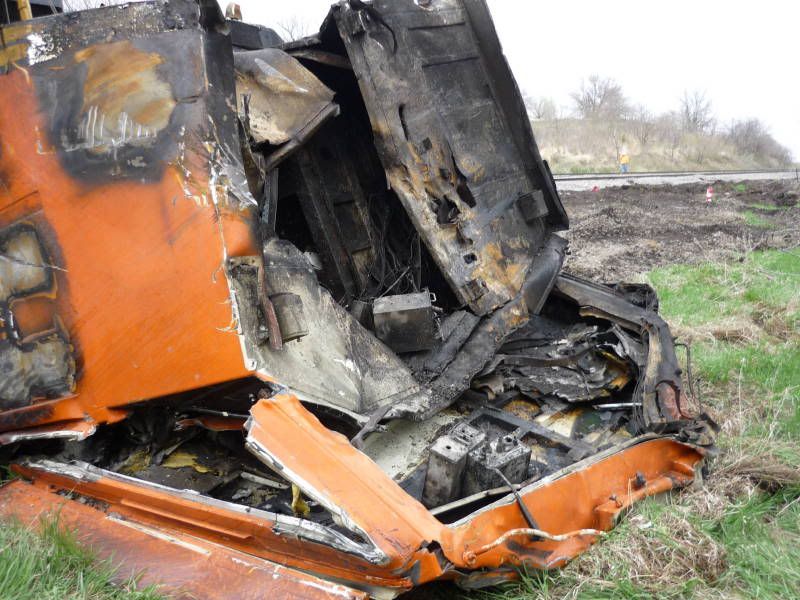
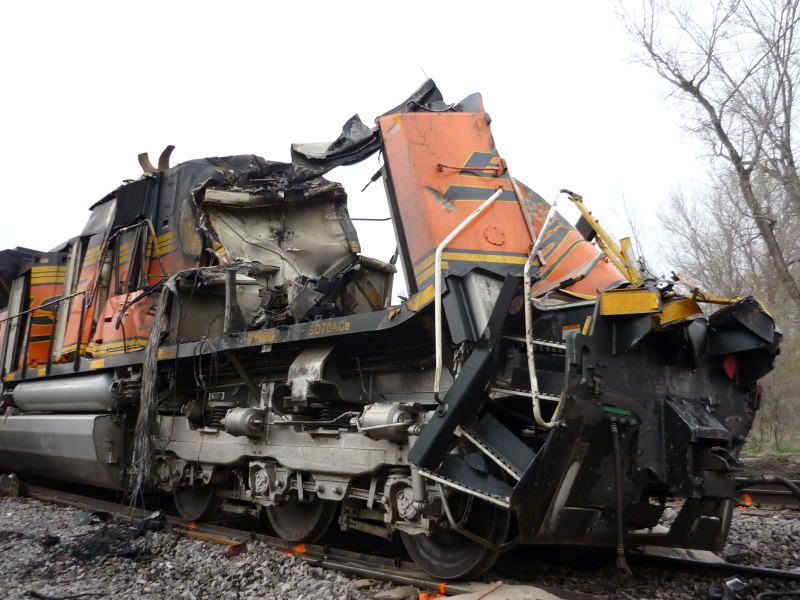
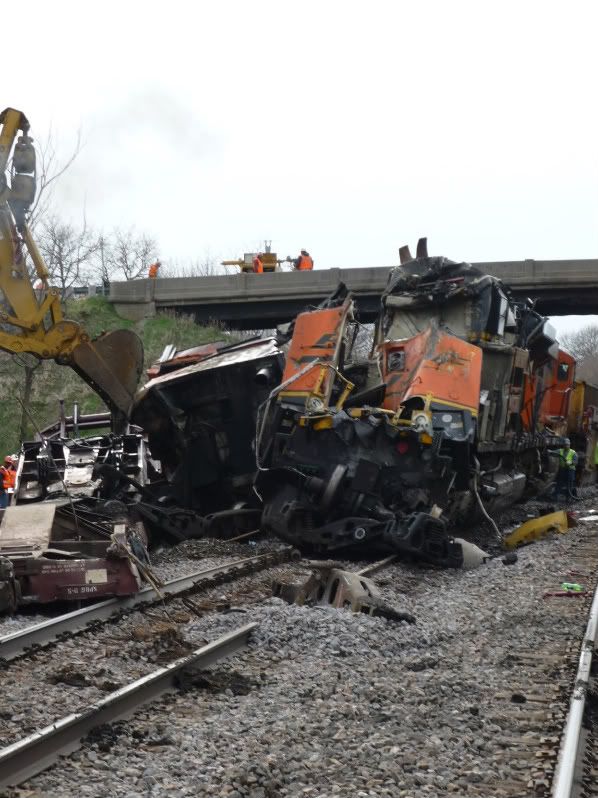
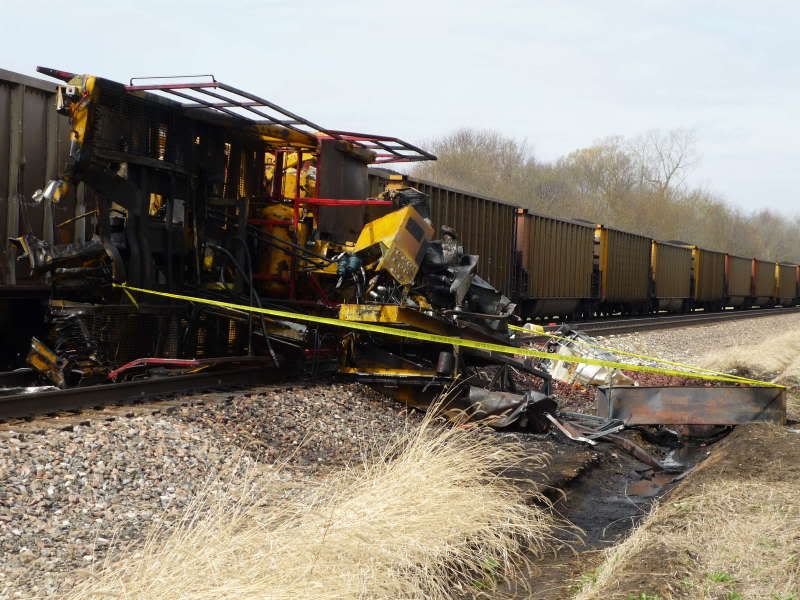
Jeff - So it was really a locomotive - locomotive collision, with the wide nose GE impacting the DP unit ? About what year was it ? (so I can look to see if it is in either the NTSB or FRA accident reports)
The ‘unworthy’ thought occurred to me that if a union representative proposed to a railroad management that the next order of locomotives have cabs with enhanced protection - such as the center post or ‘cage’ that I referenced above, the response might well be along the same lines as an SP trainmaster gave to an engineer who objected to the lack of protection with the first “cab-forward” type steam locomotives by saying he didn’t want a caboose in his lap someday: “Mister, you do your job right, and that’ll never happen to you”.
Well, fair enough - but even if a crew runs perfectly (and just like me driving on the highway [swg]), that’s no guarantee that some other guy out there isn’t going to screw up and do something that causes a collision. And aside from that, there are other impact incidents which can be caused by someone or something other than any train crew which would make such protection worthwhile, such as: shifted loads/ containers/ trailers; steel coil trucks at grade crossings; trees down; rockslides; runaways from industrial sidings; blind shoves or other bad moves in yards; construction equipment too close to the tracks; MOW equipment fouling the track; a derailment of another train on an adjoining track right in front of the locomotive, etc.
Thanks, Jeff - and not only for that, but for all of your other very informative and insightful comments on this and other threads here. [tup] (And now I know you read my post above, which I also intended . . . [swg] )
I’ve often thought the FRA was very kind to the railroad in placing primary blame on the crew and secondary blame on the defective brake equipment and not the other way around. The crew did everything right, except for not realizing the brake application wasn’t taking effect like it should have.
The fireman quit after this incident. The engineer was hurt enough that he hasn’t come back. The conductor came back and retired a couple of years ago. I see him at the Clinton Wal-mart from time to time. I worked with him a few times afterward. The location of the collision is now sometimes referred to as, “(engr’s name) Curve.”
I once rode an excursion on the Clinchfield RR, and they had just, a few days earlier, had a head-on collision of two freight trains inside of a tunnel. All of the wreckage had been pulled out of the tunnel and was piled up outside near each end. What an awful predicament that would be. There would be no way to jump and get away from the crush, and the tunnel would hold the trains in a straight line, so nothing could deflect. All the force of both trains would go right to the point of impact.
I jsut watched an interesting safety video yesterday, im sure some of you have heard of it. It is called “Mental Vacations” and I believe is from CSX. Now long story short the crew realized they couldn’t stop and were going to go head on with another train, so the fireman started to run out of the back of the engine to jump off, but realized he was going to get crushed. He then ran back into the cab and crouched behind the engineer, rode it out, and they all (4 man crew) survived. It was interesting because they hit at probably 20 mph and they just had scratches.
Sometimes jumping is the best option, but sometimes not. I read an account in the book Call the Big Hook where a fireman on a steam passenger train stepped off at about 70-80 mph and survived. The road forman of engines was standing behind the engineer coaching him to make better time, and the fireman told him they had better slow down because they would not make the next curve at that speed. The RFE told the fireman to mind his own business, so the fireman went down the ladder and stepped off. Now that is conviction!
The engine hit the curve, and the train leapt across the Arkansas River, killing the engineer and the RFE.
In general Locomotives are alot safer for crews than they ever were before. Just like modern passenger cars some level of crash worthiness is a major part of its design. Passenger cars are designed to be survivable for the occupants in a collision with a vehicle of similar weight at a reasonable speed.
While I am this loco/automobile analogy…
I witnessed an accident on the highway a few years ago where a guy(coworker) was killed.A 2x4 fell off a work truck, bounced off the road, and came through the windshield of, and was impaled itself into the guys face. His relatively new Grand Marquee could have easily and without much damage collided with that same piece of lumber standing on end, but coming though the windshield at 70-80 mph was deadly.
Note: I had an image that showed the damage to two locos that had been in a low speed head on. One was an older standard cab loco, the other a newer widecab. You could tell that the crew of the standard cab could have been killed or seriously injured and widecab crew would likely have been able to “drive her home”.
However the site I remember seeing this on(CSX-SUCKS.com) appears to be no longer with us.
From the “Analysis” section of the report, on page 6 of 7: “It was quickly discovered a one-way check valve within the number 8 pipe of the locomotive’s air brake system was defective. The defective valve allowed air to pass in the wrong direction when the main brake handle was placed in the suppression position. This allowed air pressure to drive the release control valve up in its cylinder and prevented air from reducing in the equalizing reservoir, thereby circumventing the full service brake application of the train’s air brakes.”
I agree, Jeff - with a trainee engineer/ Fireman In Training, that was like a simulator scenario happening in real-life. The defective valve - geez, those things seem complicated ! - is what disabled the brake system and created the crisis - not the crew’s actions - though maybe they should have reacted to that sooner. And I’m not sure what they could have done then anyway to stop the train quickly, with the brakes malfunctioning that way.
The report really doesn’t address the crashworthiness of the locomotive cabs, either.
About a two weeks after the Blairstown incident, I had a small stack train with an SD70m. It had a similar problem. The brake valve worked as it should in the service zone, but when going to the suppression position, it only reduced the equalizing reservoir by 6 to 8 lbs.
Normally in ATC territory, if I see a signal that will give me train control, I try to get under 40 mph if I’m running faster than that. I try to avoid having to make the heavy applications if I can. For about 3/4 of the way I’d been doing that. I never had to go to suppression. One time I finally didn’t get under 40, but I had about 12 lbs already set and was slowing down. I got train control and went to suppresion. Watching the eq res gauge I noticed it only dropped to about 70 lbs instead of 62 lbs where it should be. The brake pipe also only dropped to corespond to the eq res, but I had enough set that I was slowing to a stop anyway.
Once stopped and at a place where the locomotive brakes would hold the train, I released the train brakes and then made a series of applications and releases. That’s when I discovered what was going on. I found that I could go to the handle off position, bleed the brake pipe down to 62 lbs then move the valve back to suppression. I reported all this. They asked if I thought I could go on to the terminal safely (our other engines were facing the wrong way) and i said I could. (An emergency application would also work,and the procedure after Blairstown was all said and done is to use emergency in situations like this. I think that was where the FRA faulted the B-town crew, not dumping the air sooner.)
The B-town leader may have had more problems. It was said when the train came into Fremont, the engr overshot the crewchange spot by about 10 cars. At Boone, the next crewchange, they overshot by abo
I was wondering about that - thanks for confirming it.
Interesting story - how being a locomotive engineer can be/ is more than just getting on, pulling the throttle, and blowing the whistle. That sounds like quite a bit of diagnostic analysis and thinking you had to do there. Obviously you had a vested interest in finding out what was wrong so you could get home safely - but I suppose you could have just as well shrugged and said “I dunno - come get it !” until Hours of Service caught up with you. You do have have some training and lots of time and opportunities to use the air brake controls and to figure out how that “big pile of iron and pipes” works, but still - it takes some innate curiosity and mechanical savvy to be able to do that.
Well said - I can appreciate all of that. Thanks again for those insights.
After some thought - maybe so, particularly since so many trains now consist of them, often on the rear, too, because they are so light - at least until more crashworthy locomotive cabs are more prevalent. Not only would a ‘boxier’ car absorb more energy, it would be easier to see from a distance or if the end of a flatcar train is down in a hollow or obscured by brush, etc.
Rail trains are required to have a ‘buffer’ car - box or hopper, etc. - for much the same reason: to prevent a loose rail from sliding forward and puncturing and penetrating a cab in the event of a fast stop or wreck, etc. That type of a heavy small projectile is a difficult situation to design against, and I notice the the FRA didn’t even try with those crash impact tests that I linked to above - the closest they came was with the ‘offset shifted container load’ scenario. So the buffer car may be the most feasible alternative.
Either David P. Morgan or George W. Hilton once wrote - in the late 1960’s or 1970’s - to the effect that “a gasoline tank truck on a grade crossing is the ultimate incentive for an engineer to ‘big-hole’ the air brake to try to avoid a collision, even if it did result in a slack ‘run-in’ that derailed the train and scattered it all ove the landscape”. I can only think of a couple situations where a beefed-up cab would not be reasonably more effective in protecting the crew, and that is one of them (along with the related scenario of a propane or natural gas tank truck), unless all of the glass is of ballistic and fireproof quality; the other is the 1987 Amtrak Colonial collision at 125 MPH with 3 stopped ConRail locomotives, when the AEM-7 essentially disintegrated on impact. But both of those scenarios are rare eve
No kidding!? We got them from the Wisconsin Central around 2002 when we acquired their locomotive engineer training simulator. We had always assumed they were WC videos but of course they are a mix of Chessie, CSX and UP with a few WC thrown in. I am in the process of converting them to DVD.
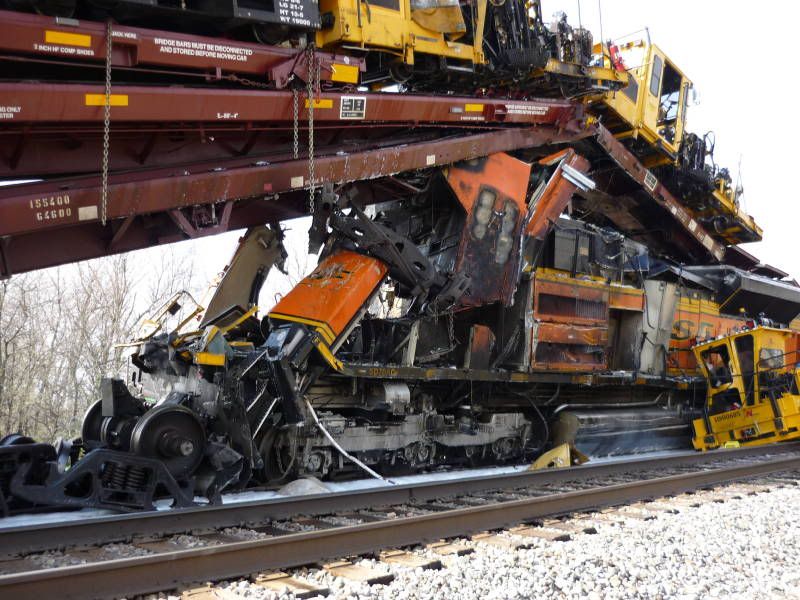
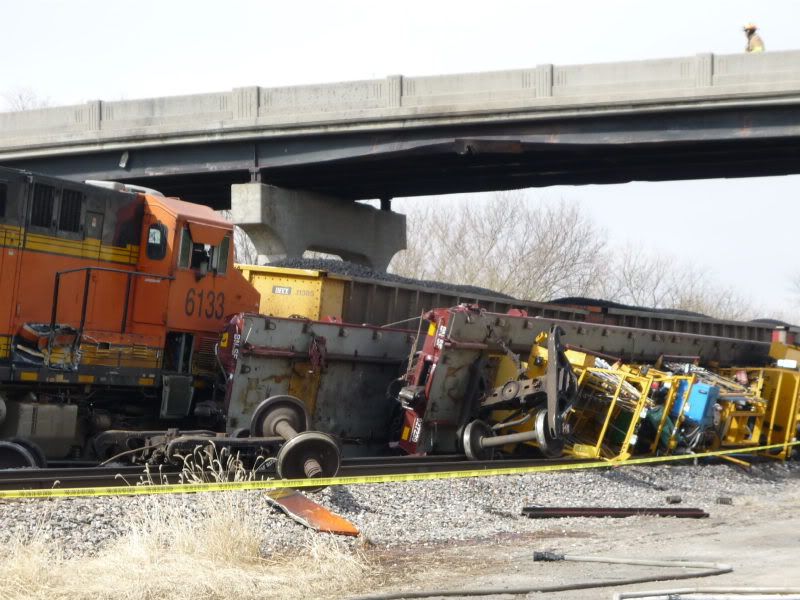
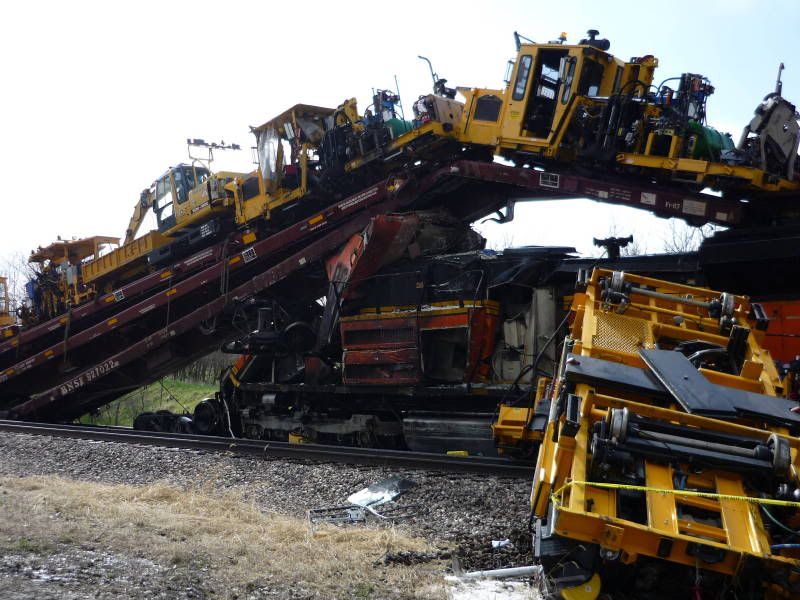
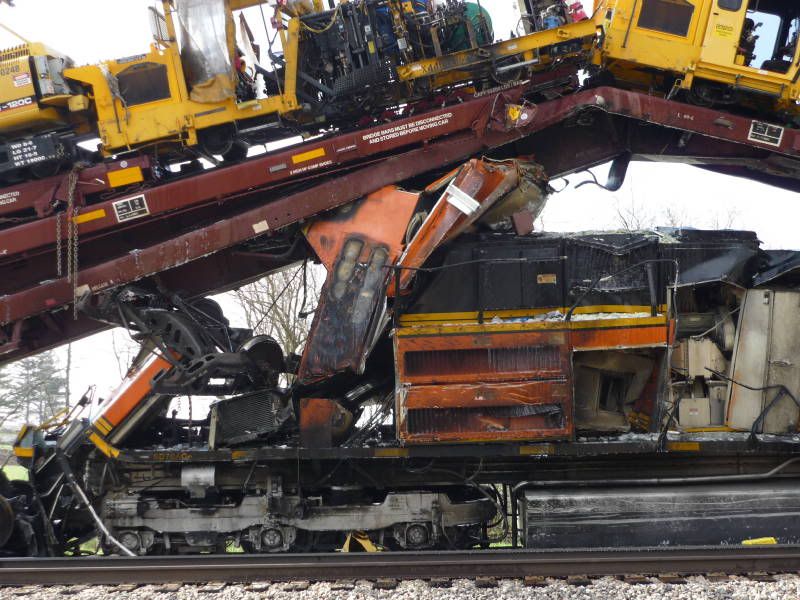
The collision post did what they were designed to do, they lifted the rear car up and over the cab, but as was pointed out, it was not the rear car, but one several deep from the rear end which ended up shearing the cab…note the “deck of cards” position of the remaining flat cars, that much mass/weight pushing on the cab and the collision post simply caused one of the cars to penetrate the cab.
Had these been any other type of car, say a box car or covered hopper, even a tank car, the post would have shoved the car either to the side or over the cab.
Note in several photos the post stayed put, but the frame just ahead of the nose bent back.
“+1” Thanks for posting those photos, ed - a lot of information there to digest, and potential answers and insights. [tup]
Kind of incredible how all of those flatcars stacked on top of each other, instead of diverting to one side or the other, etc. That defies the odds, IMHO - has anything like that ever happened before ?
Perhaps it’s because the point of impact of the collision likely occurred under the bridge in the background. In the 3rd photo up from the last, note how the nearest bridge beam has a good-sized buckle in it and is bent outwards, towards the camera. It’s going to have to be replaced, and that won’t be an easy or inexpensive repair, either.
But the real tragedy is the 2 lives lost. If the crew was asleep, that aspect won’t get a fraction of the attention that the air traffic controller dozing reports are. [sigh]