Answering your question, NO, likely no gain in capacity. The ME system might even make things worse.
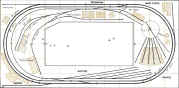
Assuming this is the plan 56 you’re refering to (Byron thumbnailed it above), if the yard tracks came off the ladder at a steeper angle, 16 degrees instead of 11, they would run into the edge of the benchwork sooner, making each one of the existing tracks shorter, thereby reducing capacity.
So while a shorter ladder might provide an extra track at the end, that track will be pretty short.
And the extra STORAGE CAPACITY you gain with the extra short track might be offset by the diminished storage capacity of each of the previous but now shorter tracks.
So to answer your question, no. the ME system will likely not benefit this specific plan.
Afterall, the point of a yard is to maximize storage capacity, not to maximize the number of storage tracks (which takes more turnouts and is generally more expensive)
Edit: I see that Paul said basically the same thing.
As you know, that’s not the same thing as replacing an existing ladder with the ME ladder tracks, which seems to be the academic discussion that has emerged in various threads about yard ladders.
In plan 56, the yard is short to accomodate the location of the crossover immediately left of the yard. My guess is that the curved yard drill track also serves as a departure track, and the designer wants to get the train over to the outside track ASAP (love 1950’s layout design!).
As it stands, the drill track is much much longer than the longest yard track. You generally want the drill track to be no longer than your longest cut of cars plus your locomotive(s).
The plan appears to want the operator to build a longer train right on the departure track by accumulating cuts of shorter cars from thr short yard tracks, then get the train to the outside. Certainly saves space (but the whole layout is nothing but components of a yard anyway, so the departure track could/should be along the north side of the layout).
I don’t know if they handlayed double curved turnouts in the 50s when this plan was designed, but if the plan built a crossover with Walthers #8 or #7.5 curved turnouts at the end of that curve (like MRs VIRGINIAN plan does), the plan could start the yard about a foot to the left and allow for an additional track, or longer yard tracks if it flipped the ladder and used the ME system.
Without getting out my micrometer, it looks like that would result in a better balance between the length of the drill track and yard tracks. But it would make the longest possible train shorter by a car or two.
I would put the A/D track on the north side of the layout where it belongs, IMO. If it was on the north side, there is a strong chance that the crossover in question could be eliminated all together.
The exact changes effected by using the ME system would need to be explored.
Clearly, using this ME system would require adapting the plan as drawn. Otherwise, why bother changing anything?
I have “discovered” the “trick” of changing the effective diverging track angle to include an extra siding but you need a particular shaped space to use it. It also takes up more space. You change the angle of the ladder track (series of turnouts) making it steeper than the frog angle would normally require. The desired siding spacing is then selected and the curved tracks connecting the diverging tracks to the tangents of the sidings are adjusted accordingly. Using the ME system achieves the same result by incorporating the start of those curves into the turnouts.
On the plan as drawn the ME system permits the entry to the yard to be moved to the left. Maybe one siding might have to be shorter but I doubt that. Maybe an extra siding could be included. As pointed out already, using just one curved turnout to create a single crossover instead of the double crossover and a conventionally laid out yard would utilize the blank space with longer yard sidings. You could do it with a LH and a RH turnout instead if you didn’t move the crossover quite as far to the left as a double curved turnout would allow.
Having just considered building one of these “feather track” yards myself using the ME system, I suggest adapting the plan and trying a conventionally laid out yard in place of the feather pattern. I’m pretty sure you’d get more yard capacity and a more useable yard. Just creating your longest siding as an extension of the mainline would allow assembly of the longest train possible using that space, for example.
Split the double crossover into one at the yard entry and the other at the yard exit and you create a passing siding doubling as a train assembly track. The exit crossover can be partway down
I have never been a fan of placing any track parallel to the benchwork edge. I just don’t like the way it looks.
If you have a free-flowing fascia, it would be fine. However, straight tracks running along a straight layout edge looks harsh to my eye.
Even 1or 2 degrees to the edge means the train either gets closer to or further away from the layout edge. This makes the trains look more like they are going somewhere.
My “yard” on my next layout, just four tracks, will be on a very large radius, about 200 inches. I saw a curved yard like that recently, and I loved the way it looked.
On my new layout most trackage will not run parallel to the benchwork, and I am considering some degree of curved and/or free flowing fascia for only the second time.
But in real life there are those times when your perspective is nearly perfectly perpendicular to the tracks, so “some” trackage parallel to the benchwork seems to work for me.
Maybe this is aided by the fact that almost all my scenes will be three feet deep or deeper. Only a few places with be “shelf like” at 1-2 feet deep.
My yard will be curved as well, with three straight sections joined by two curved sections of very large radius, 36" is the smallest. The yard will be parallel to the benchwork to allow easy access to the seven or eight yard tracks, caboose tracks, engine terminal, etc. The yard tracks will average about 23’ length to support 35-40 car trains. Counting t
It’s a yard. The tracks are supposed to be parallel to one another. The way the yard in that plan is as drawn is a huge space waster, to what end? Keeping the ayrd tracks from being parallel to the benchwork? How about making the yard parallel, and not having the main lines arrow straight down each side.
There’s no reason to have the main line parallel to the benchwork, even on narrow shelves. It can easily vary to avoid that perfectly straight line appearance. But a yard, unless it is being wrapped around a curve, in which case some pretty generous radii are needed for reliably coupling and uncoupling, is already one of the if not the widest part of the layout and angling it id goign to make one end have some reach issues. Or just randomly bumping out the fascia so the fascia in front of the yard isn;t straight - same issue. Extra width means a problem reaching to the back, unless it’s all on a penninsula accessible from both sides. And then there are two choices - main between the fascia and yard, making it harder to reach the yard, or yard in front of the main, making it easier to reach in to couple and uncouple in the yard, but harder to reach the main - which at that point is probably also just straight, with no turnouts, so low risk of derailment.
Agreed, the only prototype yard like that I ever saw was a 1970’s piggyback yard.
I have found that with my 1950’s equipment, and regular Kadee couplers, coupling on curves above 36" radius is not much of a problem.
I built a yard like my new design once before, it worked fine. The curves are not actually constant radius, the are two sprial easements back to back with the apex of the sharpest one reaching 36" radius. E