As most of us know, the last digit of a signal number is determined by the closest odd tenth of mile for outbound (away from MP 0) and the closest even tenth of a mile for inbound signals (of course, if two or more tracks are signaled in both directions, it is necessary to add another digit to distinguish the track the signal governs) so it is possible for a signal number to be almost two-tenths of a mile away from the actual distance.
When two or more roads have been merged, often a letter is added to the original number to distinguish which original road owned the track, as the SCL added an “A” for former ACL tracks and an “S” for former SAL tracks.
And, think of the work necessary if a newly formed (or enlarged) road should decide to renumber everything.
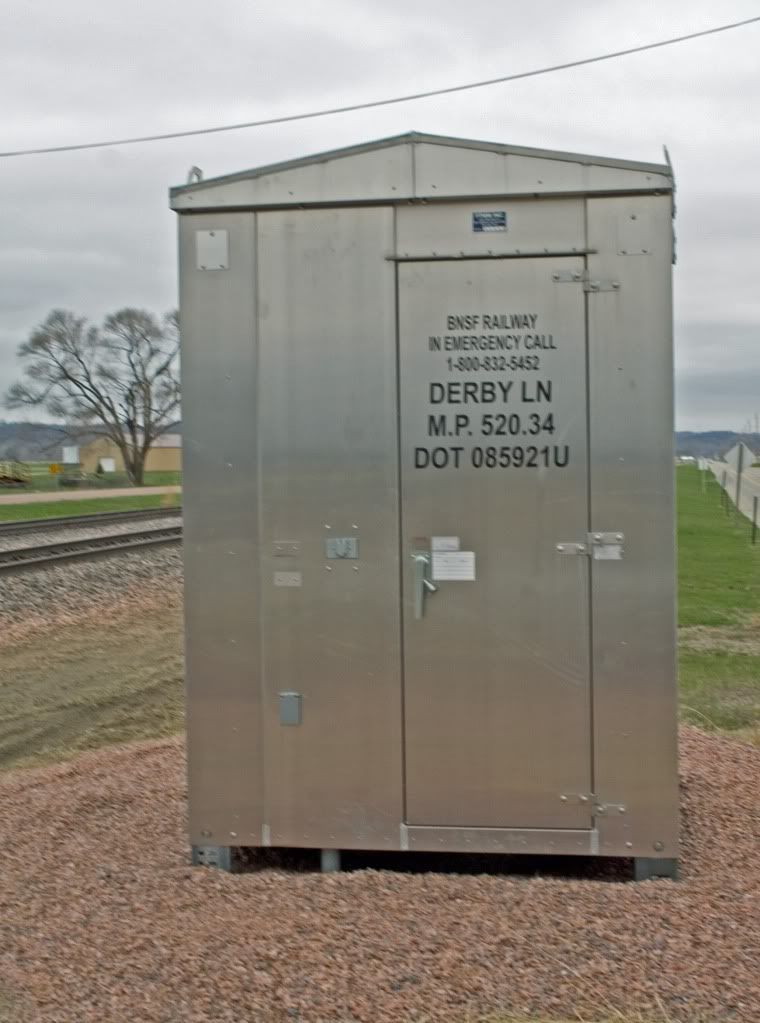
The BNSF includes both the street location and the mile post. This is a crossing that was changed from crossbucks to lights 3 or 4 years ago, so it should be current practice. Derby Lane is the street; 520 is the mile on the Milwaukee (from some point in Chicago?).
A couple months ago I was asked for the best term to use for them as part of a submission to a local government involving a NS line. I plowed through a bunch of documents, plans, esimates, and other correspondence and found no consistency at all - shed, shelter, box, bungalow, were all used, and maybe some others I can’t remember right now. It may be a matter of local usage. Bungalow isn’t quite right from a purely architectural perspective - the roof doesn’t overhang enough, and it really isn’t descriptive or intuitive. Also, in a world that increasingly places an emphasis on brevity, that’s the longest word and the one with the most syllables. It would be interesting to see what the AAR’s C&S Glossary or equivalent calls it.
“Bungalow” was a term used by our signal maintainers at the yard as well. I’m wondering whether the use of that term could be narrowed down to the type of structure that one walks into to check on relays, etc., and usually requires some sort of temperature control. I think the ones that you merely open up at the front were just “boxes” by us.
I thought a dog house was the structure on a tender that protected the headend brakeman from the weather–but since there no longer brakemen on the road, perhaps the dog houses have been set off by the tracks?[:)] Then, again, I have painted the windows on doghouses that were on the roof of one of the buildings at my college.
“Bungalow” may be a term found primarily in the Chicago area, especially if the structure resembles the 1920’s-era homes found in many parts of Chicago and older suburbs.
I’ve worked as a signalman and signal maintainer for two Class I’s, and today operate my own signal design practice. The terms house and bungalow are frequently interchanged, suggesting an enclosure that one can open up, step inside, and close the door behind oneself (the 3x4s and 4x4s common on the former WC may be the exception, though.) “Cabin” is another frequently used term, heard mostly by me from former CNW folks. A case usually suggests either a pole mounted or pier mounted enclosure with one or more doors that open, enabling access to the equipment but not providing enough room to work on with the door closed behind. Individual railroad design practices which type of enclosure (and what size) is used for a given crossing or signal application. Those of us who work on the equipment appreciate having a place to spread the circuit plans out, drop our tool bag on the floor, hang the meter from the rack, and otherwise have a dry place to duck in out of the rain/snow/hail.
MJE
M. J. “Mark” Engels
Railroad-Transit Signal Design Principal
ESCORRT LLC
Fond du Lac, Wisc. USA