While rules of thumb are useful, they should not be considered as a minimum standard for all situations, in my opinion. My layout has 22" radius curves, without S curves or slopes. I can operate 80’ Rivarossi passengers and 8-driver steamers (including some brass). All uncloupling ramps were installed on straight track. Trackwork is not perfect, but it is level all ways. I get very few derailments - most of them due to human error [*-)]. So I would say, consider all the variables before making decisions, including track plan, rolling stock manufacturer and type of operations.
You’ve sold me. I just ordered a set of American Limited diaphragms on ebay for 6 Athearn heavyweight cars. If these work out, I might redo my whole passenger fleet although it will get expensive. Diaphragms for 6 passenger cars cost almost $48 when tax and shipping are added. If it will alleviate the derailing problems I’m have with many of my passenger cars it will be money well spent.
One question. Do you have any full length Walthers lightweight passenger cars in your fleet and if so did you replace their diaphragms with the American Limited ones?
John, be sure to report back on how those American Limited diaphragms work out. I have often been tempted to follow Sheldon’s advice in this regard, but so far I have not acted for a variety of reasons.
One reason is cost. I have 11 passenger trains, each with 5 to 7 full size (85’) cars. So, I would be looking at over $500 to complete the conversion.
A second reason is that at this time I have my passenger trains fine tuned, so derailments are not a problem.
Another reason is that you need to remove the factory installed diaphragms and, as I understand it, once removed they cannot be re-installed. I am not prepared to take such a permanent step.
One other reason is that all of my passenger cars have various combinations of medium and long couplers to provide the necessary spacing to prevent snagging on curves. These couplers would likely all need to be replaced with short couplers for close coupling in order to benefit from the new diaphragms. I would be looking at buying over 120 new couplers. That just adds to the the overall cost of conversion.
Yes, once modified there is no going back. For me that is not an issue because I have never considered the “factory specification” anything special about any model train.
If that thought is about resale value - there you have it, I have never even considered the idea of “preserving resale value”. I think of that as something LIONEL collectors worry about.
But, my view comes from a place and time in the hobby when most rolling stock was kit built - and again, no plans to EVER sell.
Couplers - I actually use long shank couplers, Kadee #36, and set them back farther on the car floor to get the close coupling - so yes, that is another modification to the car - but the #36 has a very wide swing by virture of the torsio
Sheldon, I cannot refute anything that you have said in your reply, but I will offer these responses.
Yes, it is all about preserving resale value. Sooner or later, I wind up selling a lot locomotives and rolling stock (both passenger and freight) as I buy new stuff.
The problem for me goes back to Day One when I started out in HO scale. Without even realizing it, I went freelance, buying here and there without any thought to era or road name. Over time, I modified and even rebuilt my layout more than once, each time getting closer to settling on a Dearborn Station theme with Santa as the primary tenant and 5 owner roads (C&EI, Wabash, Erie, Monon and GTW).
Today, I have closely replicated the Dearborn Station them
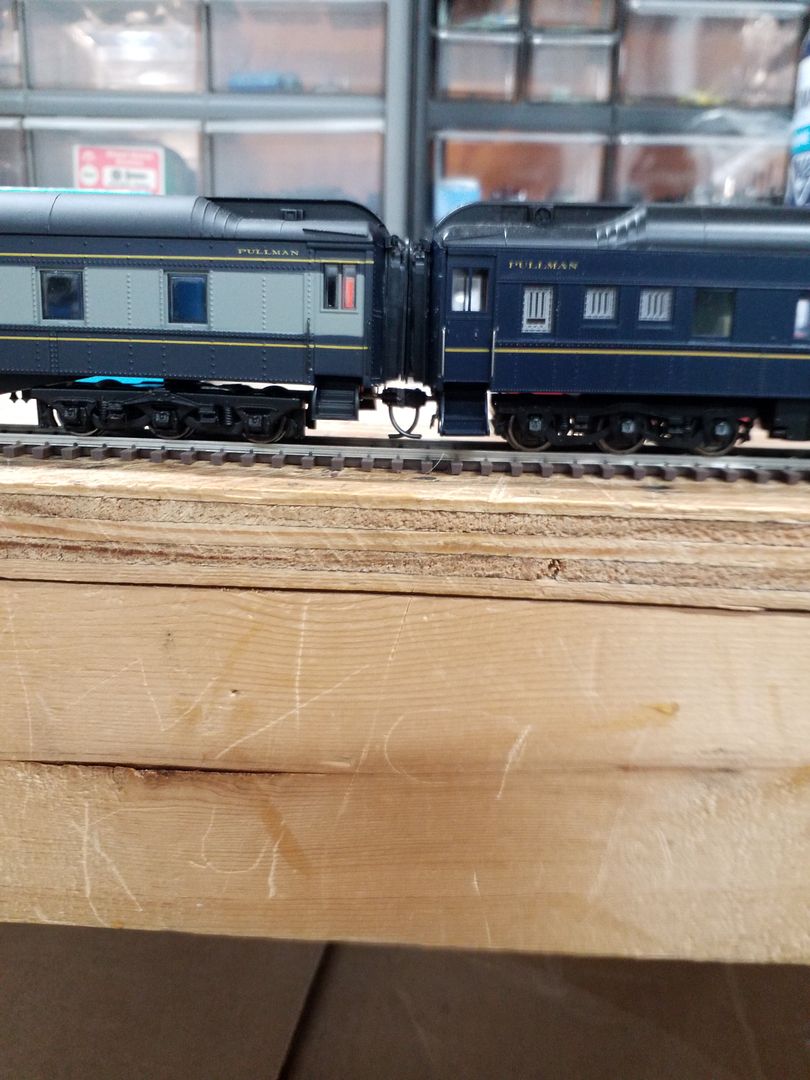
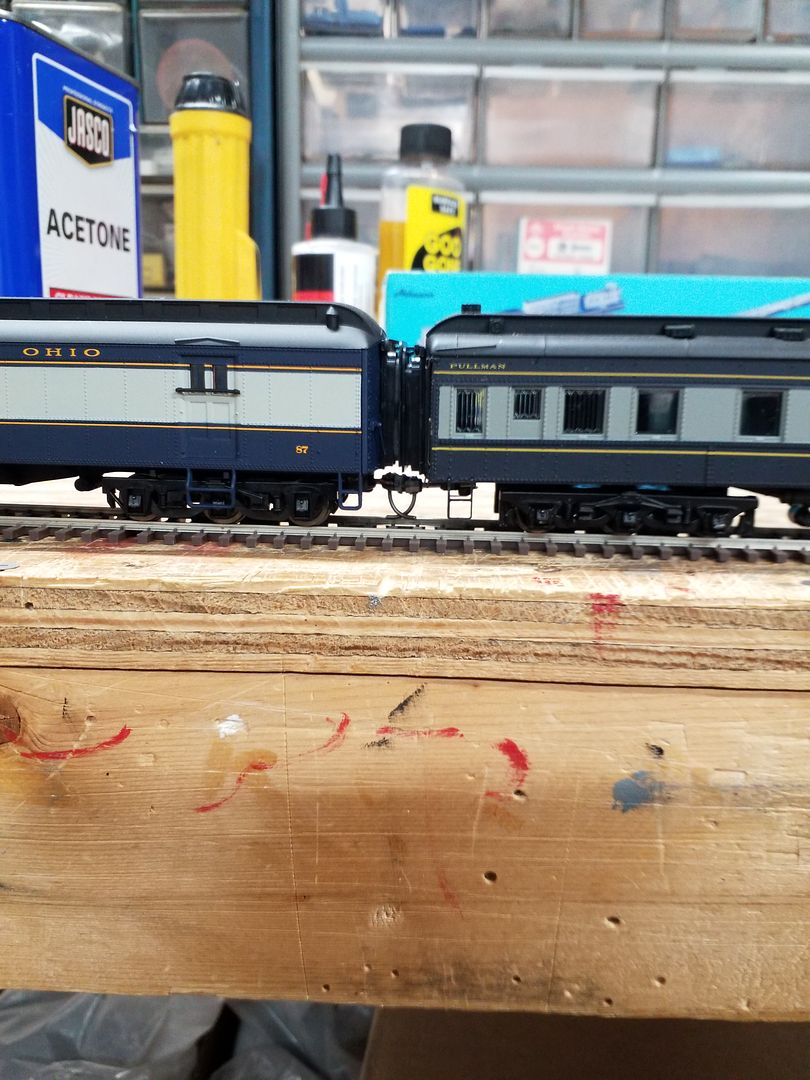
John, I’m going to answer your questions in reverse - ALL my passenger cars have American Limited diaphragms.
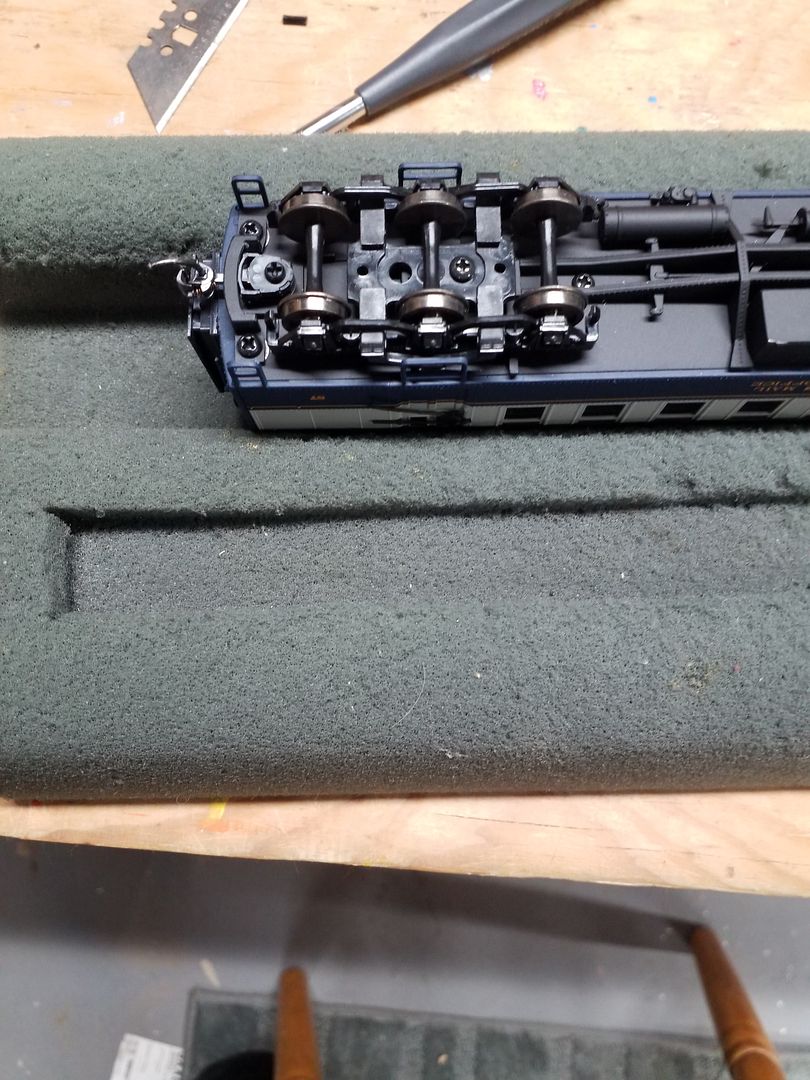
I only have one Walthers passenger car, a heavyweight RPO. BUT I do have full length heavyweight cars from Branchline and Bachmann which I have converted and they work great.
The rest of my passenger car fleet is mostly kit bashed, extra details added, Athearn (heavyweight and streamlined) and ConCor 72’ cars. Again, all with body mounted Kadee #36 couplers and American Limited diaphragms as in my pictures. The heavyweight in the picture is a Branchline car, coupled to a ConCor car, they work fine together. That is the whole point - one sy
Yes, once modified there is no going back. For me that is not an issue because I have never considered the “factory specification” anything special about any model train.
If that thought is about resale value - there you have it, I have never even considered the idea of “preserving resale value”. I think of that as something LIONEL collectors worry about.
But, my view comes from a place and time in the hobby when most rolling stock was kit built - and again, no plans to EVER sell.
Couplers - I actually use long shank couplers, Kadee #36, and set them back farther on the car floor to get the close coupling - so yes, that is another modification to the car - but the #36 has a very wide swing by virture of the torsion spring coupler box and that helps with passenger cars.
Call me fussy but I can’t even get my head around the idea of having a mix of short and long shank couplers to solve these problems. While I don’t change passenger consists a whole lot, I would never give up the flexiblity of coupling any car to any car in any order or direction desired. Yes, its a prototype operation thing.
Sheldon, I cannot refute anything that you have said in your reply, but I will offer these responses.
Yes, it is all about preserving resale value. Sooner or later, I wind up selling a lot locomotives and rolling stock (both passenger and freight) as I buy new stuff.
The problem for me goes back to Day One when I started out in HO scale. Without even realizing it, I went freelance, buying here and there without any thought to era or road name. Over time, I modified and even re
A few other thoughts about resale. Weathering for one. I am not one for real heavy weathering in most cases, but I do add some road grime to a lot of my rolling stock. And I do have the occasional “well used” car.
And as I have explained before, I replace the trucks on most of my rolling stock with sprung Kadee trucks reworked with Intermountain wheels - it is part of the long train formula.
While others might like that, again both my modifications, trucks and weathering work against the resale “idea”.
I think of model train money like “resturant” money…
Sheldon, we are good. I tried to word that last response to avoid any appearance of feeling defensive.
My problem has always been moving too fast and too big from when I first started into HO scale 18+ years ago. I failed to understand the hobby and I should have done more research while starting slow and small.
Lately, I find myself brooding over the size of my layout and the unwieldly roster of locomotives and rolling stock. As I mentioned in my last reply, I have decided to focus a lot more on a much reduced roster going forward.
A few more thoughts for John, and anyone interested.
Understand, I was heavily invested in Athearn and ConCor cars before Walthers (or Broadway, MTH, or anyone else) had all these somewhat more accurate cars on the market.
Additionally, the shorter cars, especially after they are close coupled with the diaphragms, are very graceful and realistic in their movement on my 36" and above curves, and their selectively compressed size means more cars in a similar length train for more “illusion” of size.
Most of my passenger trains are nine to twelve cars long, sometimes longer.
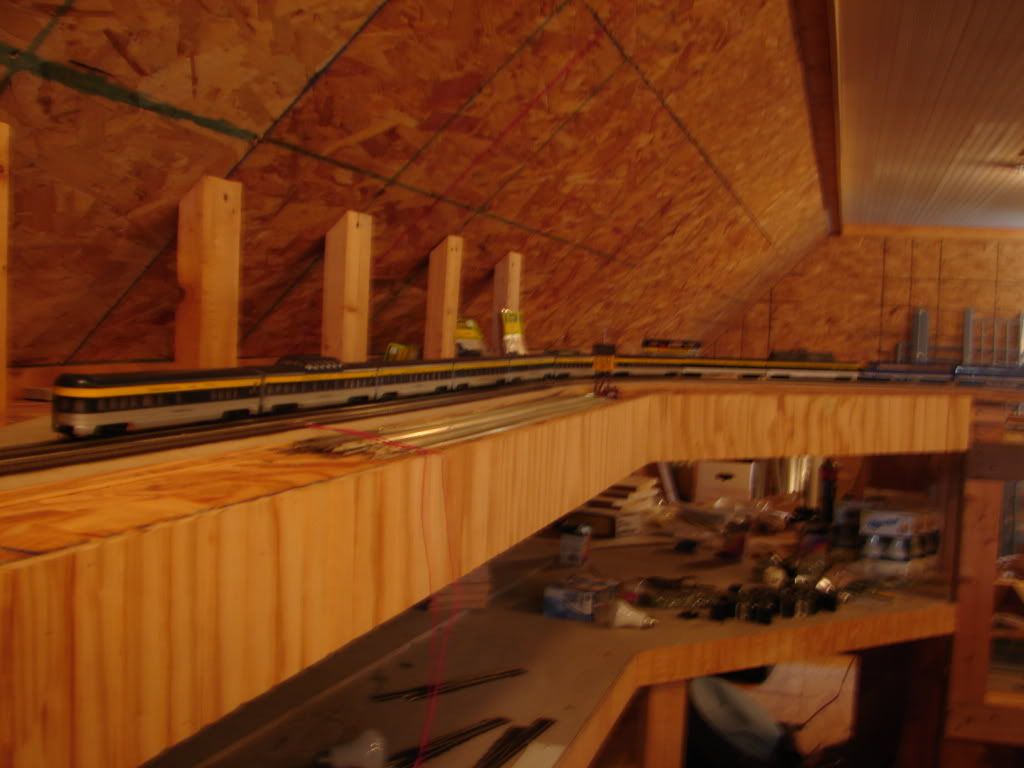
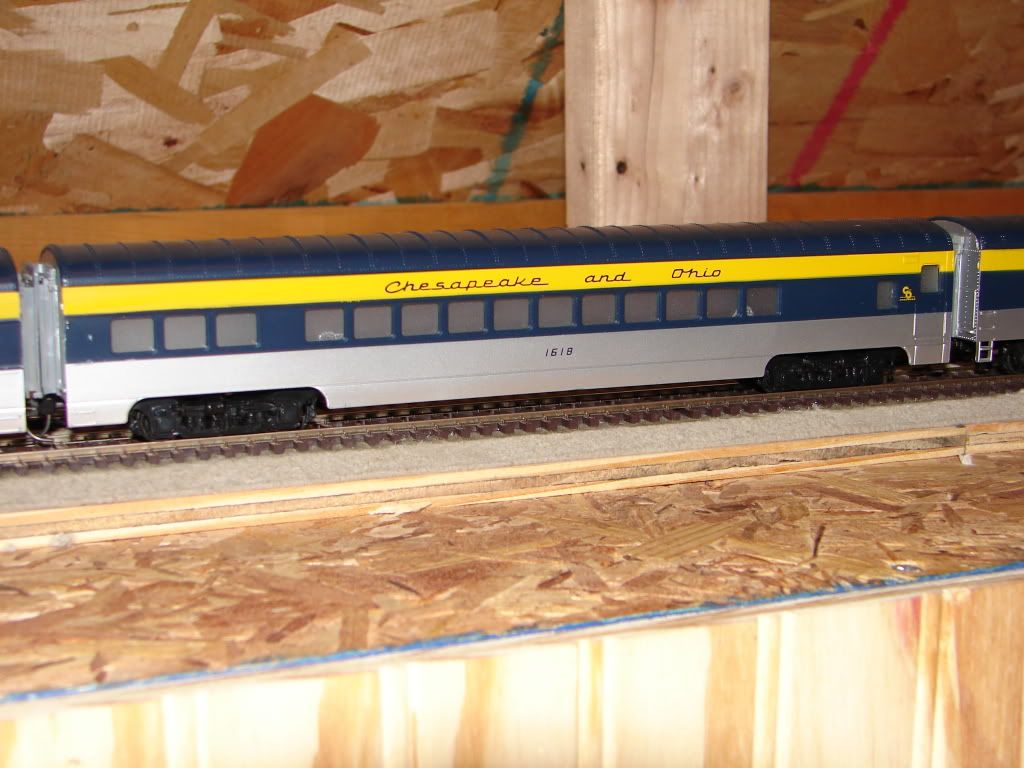
This is a really crappy picture, but hopefully it conveys some of what I am saying. It is my nine car C&O streamlined freelanced “George Washington”.
Here is a closeup of one car, again you can see the close coupling and diaphragms:
Many of my passenger cars are serious kit bash projects, and being a freelance modeler, all the ATLANTIC CENTRAL cars are serious painting projects.
That’s interesting. I have one set of Con-Cor cars. Back in 1991, Rivarossi and Con-Cor created a combined set for the 50th anniversary of the 1941 Empire State Express. Rivarossi supplied the streamlined Hudson and Con-Cor supplied the cars. Other than the baggage/express car, none of the cars made the cut for my current layout. I also acquired an MTH version of the Hudson which does see lots of action on my current layout. The Rivarossi version is a static scenic element on one of the garden tracks. Around the turntable.
I might give the Con-Cor cars a second look after seeing what you’ve done. They would need some serious upgrades, couplers, wheels, weight, and interiors just to name a few off the top of my head and of course the diaphragms. If I can get them to perform better than my Walthers cars, it will be worth the effort and expense.
I also have a small fleet of Branchline heavyweights which are decent performers. They don’t couple very closely but it appears that can be rectified with the new diaphragms and repositioning the coupler boxes and getting the longer shank.
I’ve never concerned myself too much with resale value. That’s something for my heirs and the executor of my estate to worry about. I don’t save the boxes except for the really high end stuff even though I know having something in the original box increases the value.
Last year I finally cleaned house and got rid of all the old equipment that I bought in the 1970s and 1980s that had been gathering dust for 25 years or more. My LHS buys and sells used equipment and I got $125 for the lot and I was happy with that because to me it was all just junk. The LHS resells old stuff rather cheaply so of course they aren’t going to pay much to get it. Usually a reseller will offer you about 1/3 of what he expects to resell it for so if he thinks it will sell for $30, you’ll get $10, $10 will go to his profit and another $10 to help pay his overhead. That seems reasonable to me.
Three different brands, all close coupled, all run well together.
I don’t have any ConCor 85’ cars, but it is my understanding that they have added metal wheels and weights. The newest 72’ cars I have, about 6-8 years old came with those improvements.
They still lack interiors or higher levels of exterior detail.
I’m a bit random on the detail thing, I don’t require every piece of rolling stock to be of the same/highest detail level.
I have never simply replaced stuff because new stuff came out, but I also have always been “selective” in what I bought.
Example, I bought a lot of Athearn cars knowing I would add details - I never bought AHM, Rivarossi, IHC or other cars that I felt had poor running qualities without having a specific plan to improve them.
I always felt those cars required too much “cutting up” to fix, where the Athearn and Concor 72’ cars where plan, allowing details to be added without cutting stuff off first.
I have converted some Rivarossi and they do require a lot of upgrades. Metal wheels, body mounted KDs, lots of weight, diaphragms and in some cases, interiors. I have converted several heavyweight RPOs in different roadnames because I like the design, a diner, and a couple of Pennsy coaches that I bought about 40 years ago at an estate sale and only recently found a use for them. I think they are worth the extra time and effort. They will look even better when I add the American Limited diaphragms.
One more question. What is the advantage of the long shank couplers over just using a #5 or #148 with the coupler box moved a little more forward?
However small the difference, the long shank coupler allows a wider coupler swing, especially with the type of coupler box used on the #36. And, just like a truck mounted coupler, it helps keep pulling forces closer to the track centers, reducing side forces.
On of the geometric effects is the as the curve gets sharper the distance between the cars does not shrink as much as with a shorter coupler. This guards against diaphragm binding.
All these little things add up to make operation more reliable.
Example, I bought a lot of Athearn cars knowing I would add details - I never bought AHM, Rivarossi, IHC or other cars that I felt had poor running qualities without having a specific plan to improve them.
I always felt those cars required too much “cutting up” to fix, where the Athearn and Concor 72’ cars where plan, allowing details to be added without cutting stuff off first.
Sheldon
I have converted some Rivarossi and they do require a lot of upgrades. Metal wheels, body mounted KDs, lots of weight, diaphragms and in some cases, interiors. I have converted several heavyweight RPOs in different roadnames because I like the design, a diner, and a couple of Pennsy coaches that I bought about 40 years ago at an estate sale and only recently found a use for them. I think they are worth the extra time and effort. They will look even better when I add the American Limited diaphragms.
One more question. What is the advantage of the long shank couplers over just using a #5 or #148 with the coupler box moved a little more forward?
However small the difference, the long shank coupler allows a wider coupler swing, especially with the type of coupler box used on the #36. And, just like a truck mounted coupler, it helps keep pulling forces closer to the track centers, reducing side forces.
I think 80 ft HO passenger cars from anyone will run well on 30 inch curves. If, like me, you have sharper curves, there are some things you can do. First clean and check all the wheels to remove any blobs of crud stuck to the treads. Check wheel gage. Then check the weight. I go with the NMRA recommendation of 1oz plus 1/2 oz per real inch of car length. And maybe a tad more. The weight helps keep the car on the track. Then check for good free swing on the trucks. File or Dremel away anthing that is interfering with truck swing. Then decide on body mount vs truck mount couplers. Truck mount will get the car around tighter curves than body mount. Body mount looks better, but I think a car standing on the rails looks better than one derailed. Longer couplers help. Doing all this gets my 80 ft IHC streamliners around 22 inch radius.
Consider the Athearn heavy weight passenger cars. They are a bit short, but coupled up with just short cars, no 80 footers, they look pretty good.
.jpg)