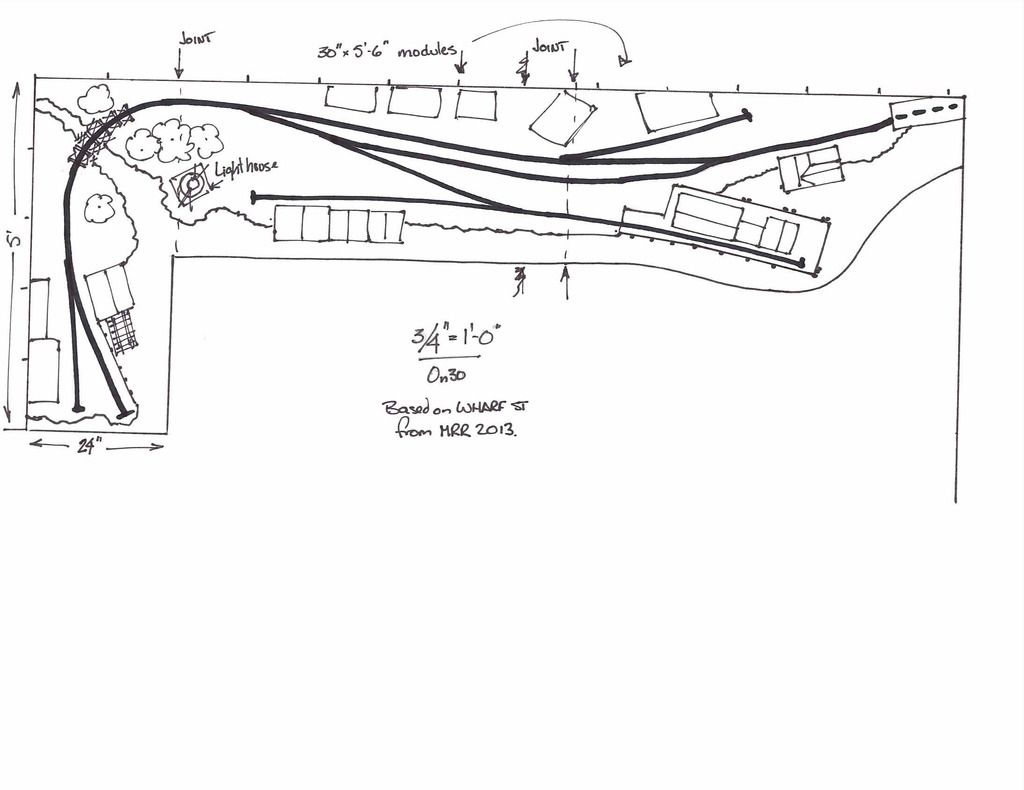
Any chance of fudging a bit on the top to bottom dimension of your drawing? The crude manipulation I did here shows the loop radius increased by 3",and the right side extended and narrowed to keep the aisle at 3’ wide. If you can live with a 2’6" entry,you could leave the right hand side as is. The red bar is just a suggestion of a place to join modules,being that there is only one track crossing the joint here(other joints may have to be repositioned accordingly).
With a minimum radius of 22" you are on the safe side for the Forney. The porter requires a much smaller radius and the 4-4-0 are happy with an 18" curve.
I very much like the plan and you should try to keep the big curve!
Thanks, Middleman! That’s some good advice. I’m not sure what you mean by “fudging the top to bottom dimension”. I gather that you “pulled” the loop down and to the right a bit to make the loop 25" diameter. The waterfront then was slimmed down to keep an aisleway. Are you suggesting lengthening the left side as well? Thanks again.
I have this on the bucket list, it was based on what can you do with a 4x8 sheet of plywood, the base was to be cut into 2 from a single sheet of ply but if I did it today I would just use 1x L framing.
Dave,I’m guilty of not looking closely enough at your plan. I looked at the 4’ side dimension of your “blob” on left and assumed it was a 4’x4’ square,but I see now that it’s 4’x5’. You could increase your radius by just extending the bottom of the left side another 6" toward the bottom of the page. This would leave the aisle unaffected,and you could keep the right side just as you have drawn it.
Whoops!
(I should add that I usually just throw track against the wall until enough sticks to call it a layout…so bear this in mind when reading my “advice”.)
Mike, Thanks again. My goal is to get enough of a layout design that I can divvy it up into modules that I can work on separately. I imagine that later modules might change as I get new ideas but I would like to get an overall plan as a starting point anyway. It gives me something to shoot for. I have zero experience with O scale I don’t want to end up with a design that will be unoperable (not that operations is the ultimate goal).
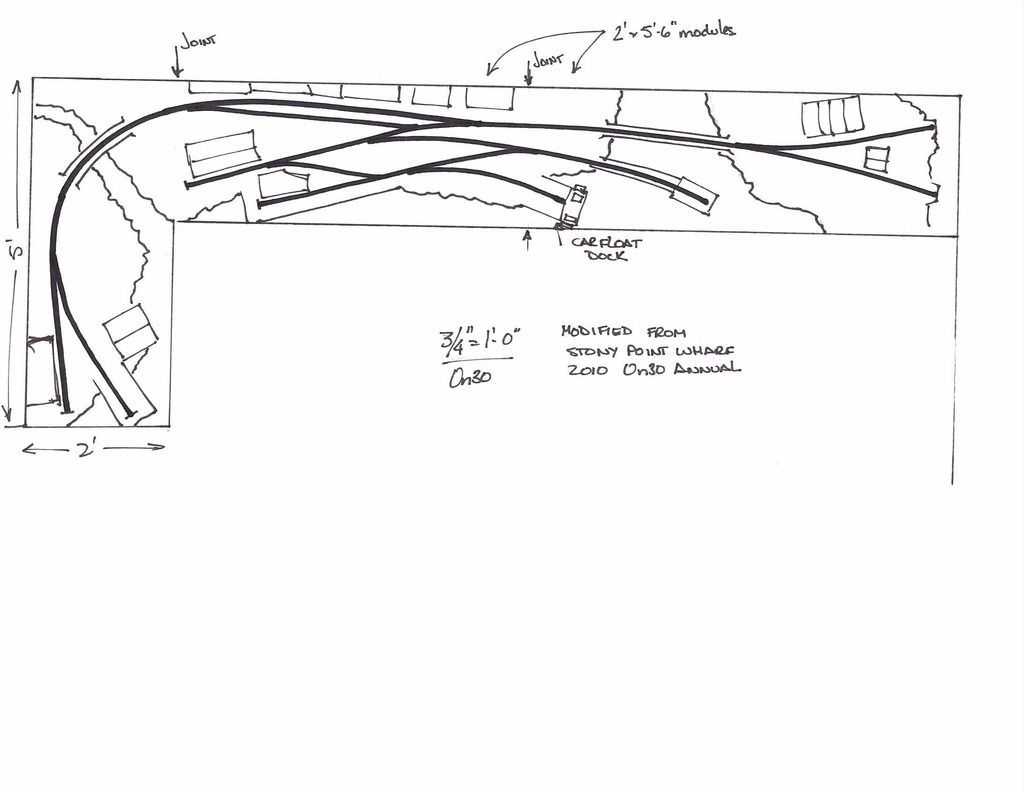
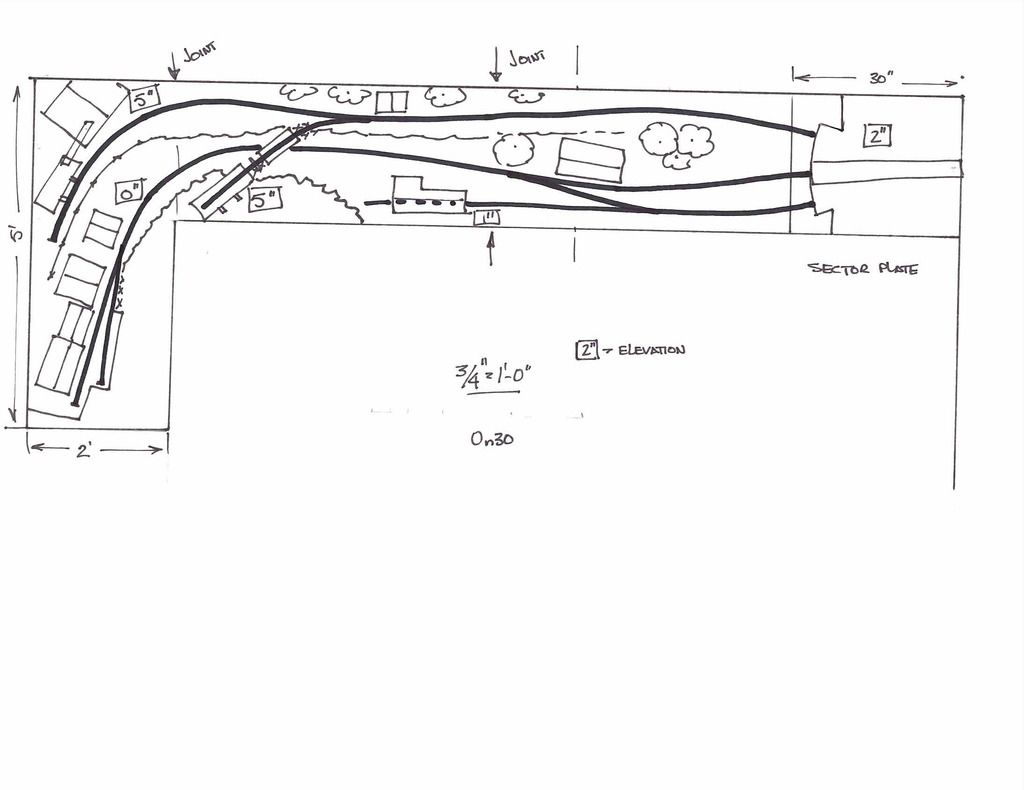
So after much agonizing and a bit of a hiatus with layout planning I thought I would try a point-to-point shelf layout and ditch the loop. I have three slightly different options and any comments would be appreciated. The room is a touch over 13’ long and I have a 5’ wall down the left side.
John, I have been trying to use existing area plans to block out space as best as I could. I have also been thinking about building some mock ups to make sure stuff will fit and will likely build some buildings before I even get around to laying track. Hopefully I won’t be too surprised!
So I did up a decision matrix to help me out and, as Ray had suggested, #1 came out ahead based on opportunities for scenery and operation. Looks like I have my marching orders. Next up will be a more detailed plan and perhaps a life-size layout on some paper.
This may be late in the process, but I have a comment on that track plan. I note how there is only one passing siding for run-arounds, and I think that this creates a large operational problem. The locomotive pulls the loads of ore out of the mine or tipple and has to run around them at that one passing siding to be able to place them on the wharf for unloading. That puts those heavy loaded ore cars on the down-side of the locomotive as it heads downgrade, inviting a break-away. If possible, can you add a crossover down at the waterfront to allow the locomotive to “escape” and move at that point to the uphill portion of the layout? Even if that was only long enough to allow the engine to escape, it would greatly add to your operations… and be more like what most prototypes did.
Perhaps you could “red-line” my drawing. I’m not sure I understand what you’re saying. My original plan (with the loop) had a mine, this one does not. In fact I hadn’t quite figured out all my industries (perhaps that’s a bad idea in itself). The layout is pretty much flat-ish, being coastline, so I don’t understand the “down slope”. I admittedly know nothing about operations so I do appreciate any insights. It is extremely unlikely that I will “operate” the train except to move cars around once in a while or maybe run an operation like MRR did with their On30 logging layout with the sector plate.
Okay, appears to be my error. I just re-read the whole sequence of messages and may be more clear now. My comment on the need for a crossover was based upon your “original” plan with the loop (which created the downgrade). Later in the series you offered up three different “shelf layout” options. When you subsequently said that you had selected “Option 1”, I thought that you had returned to that first alternative with the loop. You were selecting the first of the three “shelf” layouts, in which case my comment about the need for a crossover simply didn’t apply. Sorry for the confusion. I had a small - about 2’ by 7’ switching layout in HO when I lived in an apartment and still had plenty to work on and could spend time crafting those buildings. Enjoy
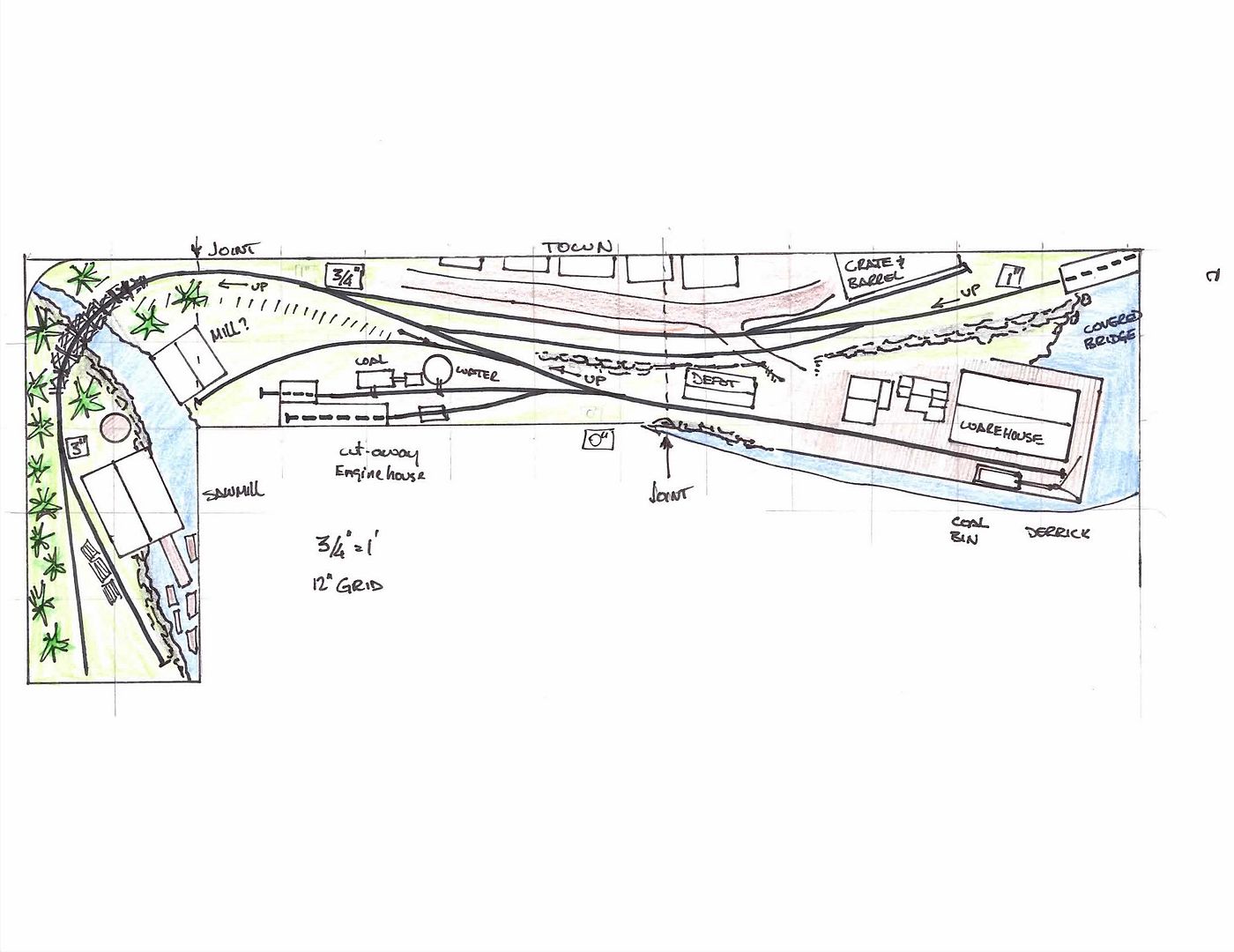
So this is my final (for now) layout design. I have decided to have the back of the layout rise from the wharf area to a few inches (3 by the time the track reaches the sawmill) to give the layout some more visual interest. I enlargened the wharf area based on the input I received that I might not be giving enough real estate for buildings. The engine house is partially cut away - that will give some visual interest and some protection for the trains near the board edge. The second (left-hand) track bypassing the sawmill can be a potential expansion if I manage to find more room and/or finish the first part (LOL).
In my world, logs float down to the sawmill where they are cut up and the sawn lumber shipped out by rail to destination or wharf, depending on final destination. Coal is barged in and off-loaded on the dock and can be furthered by ore car or truck to customers in the area. I stuck in what could be a water mill but I’m not sure if it might be a bit much and perhaps the layout might be less cluttered without it. The wharf will have some fishing or boat industries. The barrel and crate manufacturer will use local lumber and make shipping material for the local businesses.

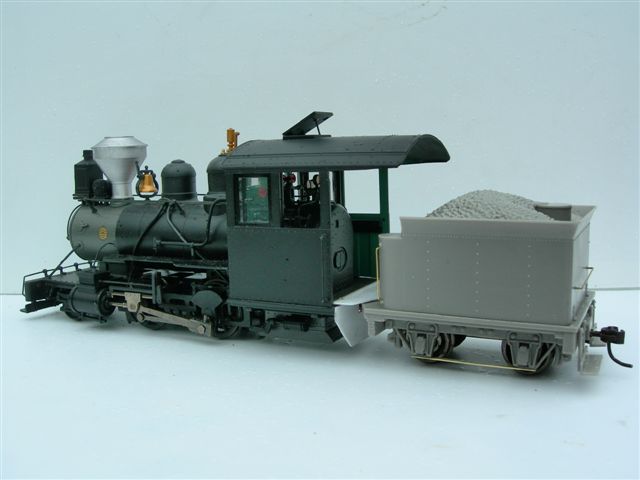
 I have this on the bucket list, it was based on what can you do with a 4x8 sheet of plywood, the base was to be cut into 2 from a single sheet of ply but if I did it today I would just use 1x L framing.