Fast Tracks work well for those with the patience and desire to build them, or who wish to purchase them from a custom builder. Note that they can be built shorter on the same jig – you would be looking for the dimensions labeled “Minimum Turnout Length” in the specifications. For example, the Fast Tracks On30 #5 template is the full “Default Turnout Length” of 13”. But the minimum length turnout built on that jig is 8.2” (close to the PECO On30 “Medium” 7.91").
Personally, I’m a big fan of the PECO On30 parts – a couple of clients have used these with good results in On30. Even though the ties may not quite match prototype dimensions, I think they look “right.” And the diverging curved length makes the turnouts quite space-efficient.
Since you will probably be using PECO flex track anyway, having the appearance match is a plus – but some don’t care for the look of the curved diverging leg on the turnout. Also, one is limited to the “Medium” and a similarly dimensioned wye with PECO On30 – at least for now.
I rather like your final version. If building myself I would make some changes;
*Install the tracks at each end in such a way that this “module” could be extended.
*Continue the sea level scenery from the wharf to the sawmill and put a generous infill curve where the sawmill is.
*Not really enough room for a sawmill as drawn. Need a place to stack sawn timber. Sawmills are not easy to model convincingly. I would look for a simpler industry there.
*Same applies to cutaway sheds. They have to be very well detailed otherwise they look rather silly. If you have the skills, great!
I am working on a sectional/modular On30 layout and something like yours might make a good module for me.
Hi Bill.Thanks for the input. I’ve been struggling with this layout. I mocked up some buildings and (like everyone said) they take up a lot of room. I don’t think I will ever have a room full of train and this module will certainly keep me entertained for years so ensuring it has an “in/out” route is not too important. I am thinking of going back to just a straight shelf layout (no curve, which just takes up a bunch of room). Yes, the sawmill is likely too small for a prototype operation but I was hoping would be enough space to represent - it could be a mine or something else, however.
Several years ago, a friend and I were railfanning the Arkansas and Missouri RR (specifically the former Frisco line from Fayettville to Ft Smith). We were well off the paved roads and happened to find a functioning sawmill. NOT one of the large lumber mills that ships multiple modern cars daily. This guy shipped a couple of flatbed 2 ton trucks “maybe” if he worked hard all day. Small, local saw mill that made fence posts, 6x6 corner posts and barn framing lumber.
That is exactly what your On30 would service back in the 1920s-early 1950s…don’t try to build an industry that ships 6 or 8 carloads daily, just try to make a 4 or 5 car train daily. The ferry, river boat would bring in a fair amount of freight and pick up some as well…maybe two cars daily? In the Ozarks, both wood and coal were used by regional steam back in those years, so that might effect your options for a coaling tower depending on what part of the world you plan to model. (I would keep it coal for the extra car loads.)
In your first version of this layout, you showed a track between the engine service area and the main line that curved down to a ?mill? along the river??? That would give you a place to move more freight in/out AND the lead track to that industry would make a good “team” or “house track” (as would the area between the depot and the warehouse at the landing dock).
Now don’t throw rocks at me…but…I would start with a perfectly flat sheet of plywood, perhaps 18 inches to as much as 24 inches wide and 10-14 feet long…perhaps in a spare bedroom or the garage or on top of the kitchen table one night a week. Put your basic track plan down and run trains…make buildings out of card stock or even small boxes just as “place takers” with the name of the future industry on the box…if you find you don’t like the switching activity, figure out what you can change.
I got more than 2 cents there! Thanks for the comments. I have indeed started making some buildings to use a planning tools and I have a couple of rolls of brown wrapping paper to plan on. I am in BC, Canada, so basements are de rigeur here. I think you nailed it on the head with what I want to achieve and I need to remind myself of that and not get too carried away.
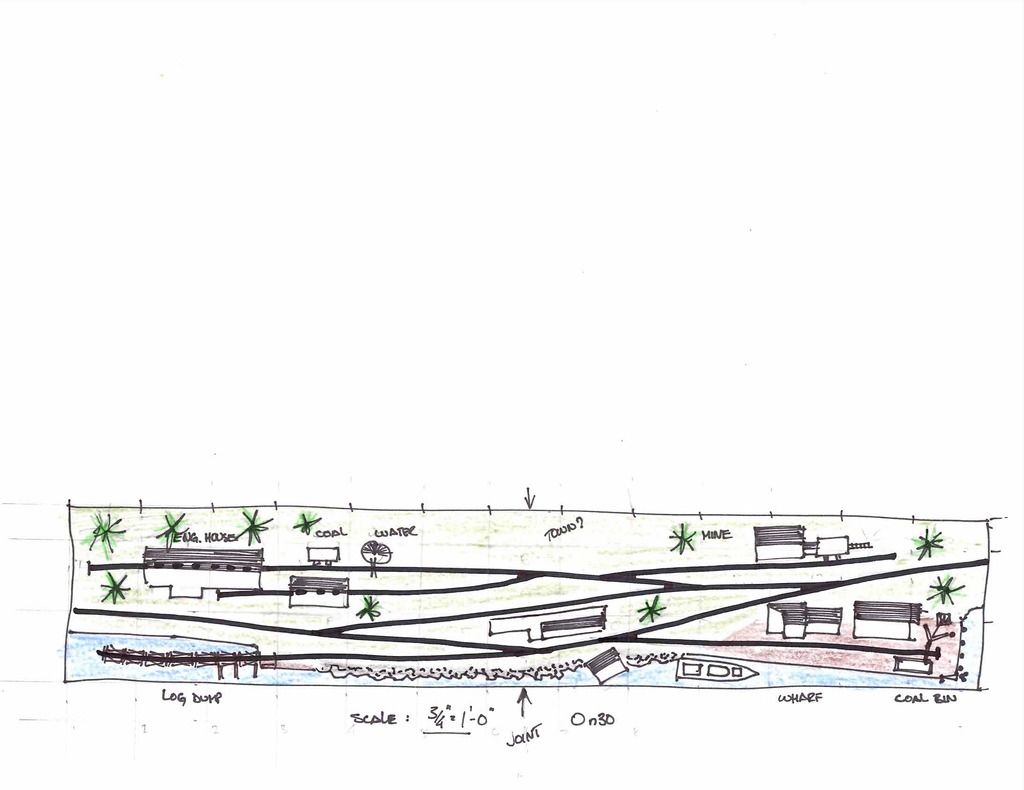
So I found a layout I liked, belonging to Terry Halmsey (did I get that right?) and duplicated that with some minor alterations. I will still draw this up in full scale to see what it looks like but this is where I’m going. Logs come from the “interior” and get dropped off at the log dump, they will eventually make their way back by barge as lumber. The empty space in the middle will have a few buildings to represent a town, edge of town, or something similar. The mine will ship out ore but I haven’t figured out how it will make its way onto the barge to go on its way. There is opportunity to have coal shipped in for the industries there. Warehouses on the wharf will have businesses devoted to shipping and handling. A small shack on the shore line can be seafood-related. The engine maintenance facility is just that. The layout will be broken into two halves 6 1/2 feet by 30 inches.
I decided to go to a 30" wide shelf and replace the log dump with a carfloat capable of taking three cars. That gives me some ability to introduce or remove cars from the layout to places “elsewhere”. It was suggested I try to leave more room after the turnouts to move trains around better and I am hoping that when I actually lay it out, I can do that. Otherwise, I think there is adequate room for buildings without squeezing it too much. Thoughts?