For Rio Grande freight cars, from what I understand Jim Eager provides significant assistance to manufacturers. For Rio Grande passenger cars, it’s Bob Webber.From what I understand, manufacturers find they can generally sell anything they can slap “Rio Grande” on the side of, within reason of course.
I can’t speak for Jim, but my own limited knowledge amounts to “more” of everything, autorack-wise. Jim studies traffic on the Rio Grande’s mainlines so has a somewhat eclectic look at things that includes not just home road cars, but the various streams of bridge route traffic that flowed across the Rio Grande’s lines. He’s probably got an extensive list of examples, while I’m just one to note that slightly more the virtually nothing in autoracks is a good idea.
Frankly, this is the sort of thing where a manufacturer probably already has a good idea of what will sell, certainly better than mine. With autoracks appearing in pool service, they get around more than typical rolling stock often does. I’m just here seconding Jim’s motion.[Y]
This is a list of Cars that match the Accurail Car, from Jim Eagers 7 part E-mail in the Modern Freight Cars List (MFCL) in Yahoo Groups. It might behoove a lot of you to join this group as it is a gold mine of information on current releases and data on freight cars from the 60’ s to the present.
Beginning in 1968 Para-Pac Type 6a racks were mounted on the new
flush-deck flats introduced that year. Accurail’s kit is based on
these later cars:
SP bilevel on 515412 (515400-515449) , an F-70-57 Bethlehem blt 1970
<http://www.railgoat .railfan. net/photos/ sp/sp515412_ brian_ehni. jpg>
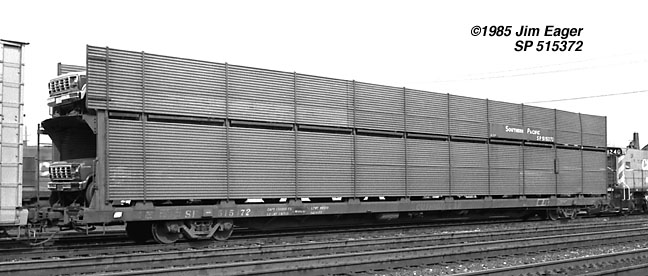
SP bilevel on 515372 (515350-515399) , an F-70-56 Bethlehem blt 1969
<http://www.railgoat .railfan. net/photos/ sp/sp515372_ jim_eager. jpg>
SSW bilevel on 84330 (84300-84399) , an F-70-67 ACF blt 8-73
Photo in Thompson’s SP Color Guide (V.1)
SSW 84349, same
Photo in Kinkaid’s SP Color Guide V.2
SSW 84302, same
Photo in the 12/01 Railmodel Journal
SSW trilevel on SSW 84808 (84784-84808) , a Bethlehem blt 2-69
Photo in the 4/00 Railmodel Journal
ATSF bilevel on ATSF 88721 (88706- 88736), an Ft-77 ACF flush-deck blt 1972
Photo in the 4/00 Railmodel Journal
B&O bilevel on TTBX 961863, a Bethlehem BSH11 blt 7-69
Photo in the 4/00 Railmodel Journal
B&O bilevel on TTBX 963017, a Bethlehem BSH11 blt 1970
Photo in Bossler’s B&O Color Guide
CN bilevel on CN 710610, an HSC flush-deck blt 1972
<
That sounds right from all my years on the Rio Grande Yahoo Groups email list. Jim Eager has been a big player in providing information to manufacturers and writing articles in some of the major MR mags, plus his Color Guide has been a big resource for me in identifying models vs prototype. I don’t have books for other RR"s and can’t afford to build up a library to do the same research on all of the myriad of road names which bridged between Denver, Pueblo CO and SLC/Ogden etc.
I haven’t done a “scientific study” of traffic in terms of taking time periods and actually documenting it on paper, but I’ve been studying the RR on an amature level to look for patterns, so that I can acquire models representative of typical traffic during mainly the 70’s and 80’s. I do have most of the major books published for the D&RGW during that time frame:
-Rio Grande Diesels: Vols 1,2 & 3 by Joseph Strapc
-Rio Grande In Color: Vols 1, 2, 3, 5 by Grenard, Sandrin, etc
-Rio Grande Trackside with Jim Ozment by James Sandrin
-Rio Grande: Ruler of the Rockies by RC Farewell
-Rio Grande Secret Places: Vol 2 by RC Farewell
-Rio Grande: Scenic Line
The RG Odyssey is my favorite video. I’ve heard there is a Machines of Iron video of the Moffat Line that’s pretty good.
Then there’s the great VHS tape my brother and I shot on Tennessee Pass in 1995. It was either lost in a fire or is buried in some stuff so I haven’t found it yet. If it’s really gone, that’s a personal tragedy. [:(]
What I like about RG Odyssey is it has quite a few scenes that you can see freight cars pretty well, well enough to identify them for modeling purposes. I’ve been able to identiy a number of Vertipacs including the Milwaukee, Southern Pacific and Frisco (yellow), as well as the Evergreen PC&F 50’ double plug door box car, the Southern Pacific 40 modernized box car (Hi-Tech, hurry up!!!). I’ll see if I can find the Machines of Iron DVD - I just like to get feedback since my Denver & Rio Grande Western VHS tape by Pentrex seems to focus so much on the diesels that you are constantly disappointed by the lack of visible freight cars. On that VHS video, I’m constantly freezing the action as the camera pans just … barely … past the last power unit before the scene cuts away. Its maddening. At least Emery Gulash scenes shot in 16mm film show much more vewable freight traffic.
Back on topic:
There are a number of auto racks in some of the scenes but being that the road names are often hard to see, even on a DVD which is upscaled on my 46" 1080P HDTV, the film is still pretty grainy and hard to see but I’ll try to re-review when I get a chance and see what I can gleen.
This rack is on a Pullman-Standard 85’ flatcar - actually similar to Athearn’s 85’ piggyback flacar (same basic car, plus a rack). The rack is either Portec or Paragon; I think an early Paragon:
The name of the pool company was Trailer Train, not Truck-Train. Trailer Train is today known as TTX Inc.
In those days, the Canadian railways were not members of Trailer Train, so CN and CP owned all their own flatcars. Lots of American roads also definately owned some of their own flatcars. ATSF, SP, SSW, GTW, SOO, L&N, FEC, DTI, CGW, NW, MON, etc. are just a few I’ve seen photos of. (c1960s/1970s time frame)
Merchant’s Despatch (MDAX) and North American (NIFX) also owned and leased autorack flatcars in the 1960s and 1970s.
Agree’d, it may hvae been Truck-Train way back, not sure. I’ll have to go back to really good article on the history of the Trailer Train corp to see about that, but mostly from the 60’s onward, certainly the time frame I’m interested in, it was Trailer Train or later TTX.
Sorry for bringing up an old topic, but Athearn just announced new bi - level auto racks at the NTS 2014 Cleveland show. They look great, but I haven’t compared them to prototype photos. I believe they will be available in early (January)2015.
Didn’t each railroad build their own racks and put them on 'standard, flatcars? I guess check your railroad and see what they did (and maybe it differs depending on the era?). I have several Accurail models and, for me, are close enough…and can usually be had for $5-$15 at train shows (I think the Athearn cars Will be closer to the $50 mark).
As info, here is a photo I took in the early 1970’s at the loading ramp at Chevy truck assembly plant in Flint MI.
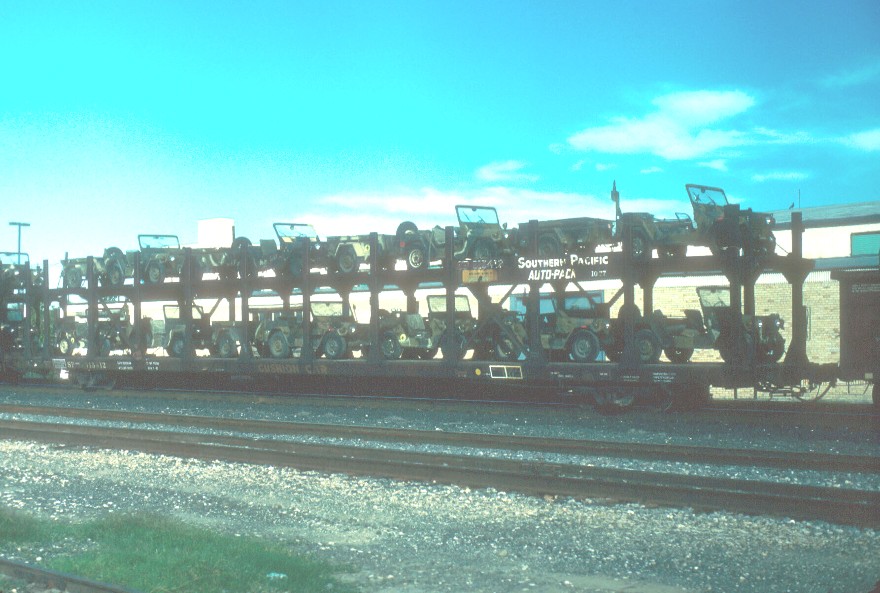
Bi-levels were used for pick up trucks, suburban wagons, and Blazers.
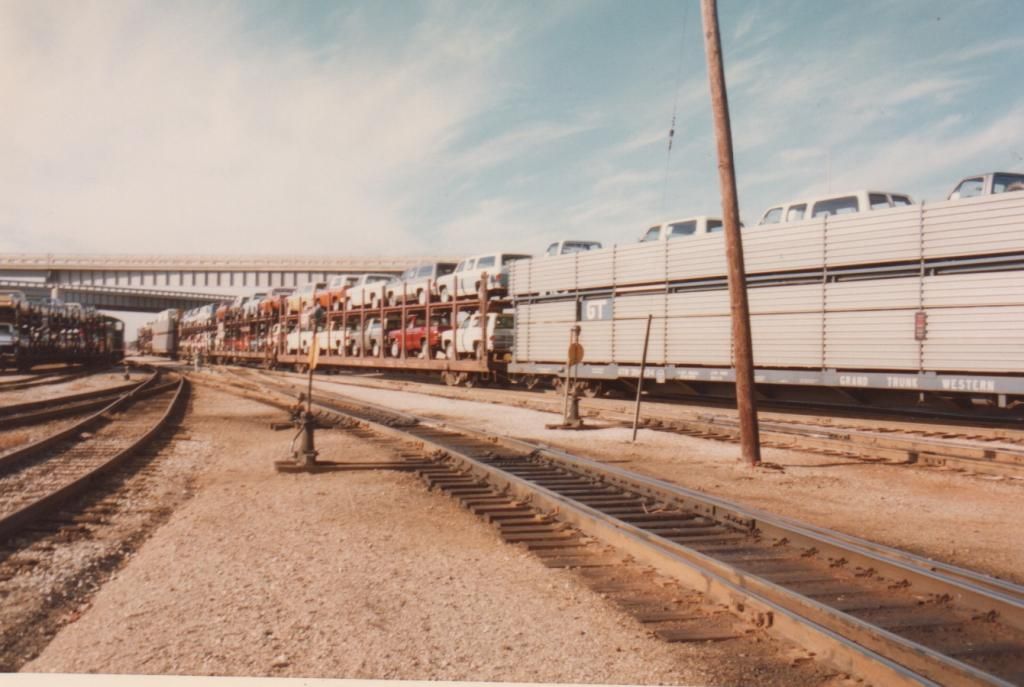
In the eary 1970’s railroads were applying side shields to the auto racks.
By the mid 1970’s designs for fully enclosed racks with roofs and end doors were developed. It took maybe 10 years or so to convert the entire fleet to fully enclosed cars. So, you could see all three types together in the late 1970’s.
Also, the railroads and General Motors experimented with unique designs in the 1970’s Stack Paks were used to haul Cadilacs inside special containers loaded on 89’ flat cars. Verta Paks were designed to haul Chevy Vega compact cars in vertical position, nose down.
That’s a great pic, Garry. Thanks for sharing it. It’s a reminder for those of us old enough, but a good illustration of just how colorful and interesting seeing the new vehicles on their way to wherever used to be. It was good advertising for the auto companies, too. People could see the new models on their way to the dealer.
I’m not a modern/contemporary era modeller (I cutoff in the mid-70s and that’s often too modern for my tastes) and this is one of the big reasons. Those enclosed racks prevent damage, but they also prevent a vital piece of “eye candy” that I see as essential to what I like to model in railroading.