on a shelf you can effectively model a large industry in a space as narrow as 8 inches a reach of 36 to the back of the layout is asking for your scenery modeling to get wrecked by people reaching in to uncouple cars and rerail the occasional errant piece of equipment. it also causes the model building budget to expand from having to use more structures and scenery materials to complete the scene
makes sense. i am sure 24 inches will do as it wil max layout an max ailes size as well
hi
about the same idea; a cassette could be added to the track at the very left; facing your wife’s space.
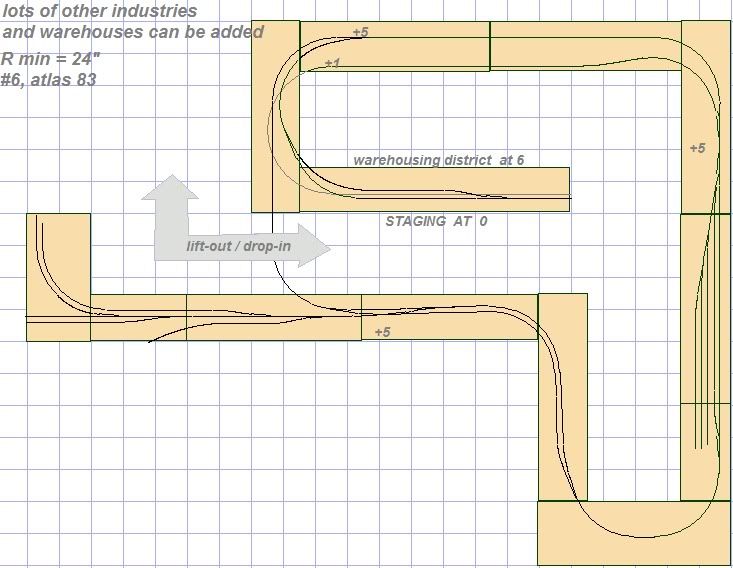
paul
when you say cassette do you mean http://www.bandrmodelrailways.co.uk/Accessories.html something like this? that would work well in the place of a round house… I do like round houses and turntables i also like the idea of the whole engine yard but from what i see it takes a tonne of space.
ok i am in the middle of drawing out a track plan the old fashioned way (paper and pencil) As soon as i have a first draft i will scan and post it .
Welcome to the Forum. Is the room 10’x15’(or what are the dimensions)? Around the room layouts with wide peninsulas, are preferable to a 4’x8’set in the middle of the room,(especially for HO layouts, where the minimum radius curves should be 24 inches,if you plan on passenger trains. I was fortunate to be able to build a two stall garage, with a loft with an inside stairway to my 23’x23’around the room layout. I am using a Digtrax Super Chief, but you probably could get by with a Digitrax Zepher. I use a tethered 4 district set-up, with manual controls,(but go for wireless radio control,if you can afford it). The 4 districts are controlled by four operators,(that each,also, control 24 electrically controlled turnouts). I just purchased the Track Layer version of “TrainPlayer.com” It includes the 101 layouts, with the ability to draw your own layout, and then place locos of any era and cars on the layouts, to run on the computer screen as an “Armchair Model Railroader”. It’s terrific, (especially in chilly Michigan, with an unheated garage loft layout. Post a photo of your proposed layout, and the room. Bob Hahn
ok here is the first draft of the plan.
blue represents the walls or backdrops and the pink access to veiwing operatin ect. black ar the tracks and the dotted line is track underneathe the main layout.
I stated with a beautiful inustrial switching layout found on this site and went from there.
Its the Progressive rail Airlake industrial park layout.
i also found that if i put a 1 foot by 15 foot shelf on the otherside of the wall i could hide stagging tracks that dont need to be sceniced. i square on the graph paper equals 6 inches on the layout.
the benchwork will prolly start at about the 48 inch high range.
questions, comments and advice always welcome.
Antagonist
PS. the space with writting and no track plan was left like that for an engine terminal and servicing area

hi antag,
i hope this is not a serious attempt. Drawing freehand is fooling yourself in a major way; unless you have gained much more experience.
- switch angles are unbelievable.
2)spacing is way to less at several places
3)the aisles are way to narrow
4)grades are way to steep and often impossible.
I could make this list much longer … .
Track Planning For Realistic Operation by the late John Armstrong would be a wise investment. Reading through Lance Mindheim’s How To Design A Small Switching Layout would be an idea too.
Paul
Antag - I second the recommendation to get e.g. Lance Mindheim’s “How to Design a Small Switching Layout”, which will teach you about some rules of the thumb for designing small layouts and some tricks to make a simple track plan be interesting switching.
And John Armstrong’s “Track Planning for Realistic Operations” will teach you more about how real railroads work and some standard tricks of the model railroading trade - like yard ladders, curve radii, inclines etc. Considered by many the bible of track planning.
Quick recap of some important factors in a H0 scale design:
-
Distance track center to track center between two neighboring tracks : straights - 2", curves - 2 1/8" or 2 1/4" (at least if you are going to run longer rolling stock).
-
Turnouts - sharpest turnout there is is a #4, #6 is usually a better choice for most applications
. Quick rule of thumb when drawing turnouts - to get 2" to the side (center distance between two parallel tracks), for a #4 turnout you need to move 8" (4x2") forward. For a #6 turnout, you need to move 12" (6x2") forward.
Yard ladders eat space surprisingly fast. To branch out to four tracks using a straight unmodified ladder of #6 turnouts, you need about four feet of length for the ladder.
- Length of equipment - HO scale is 1:87.1.
Take length of real railroad car or object - say e.g. 60 feet - convert to inches - 60 x 12 = 720 inches, divide by 87.1 to see model length: 8.2". If you need room for five such cars, you need a piece of track that is 8.2 x 5 = 41" long.
What type of cars and what length of trains you are designing for is an important design consideration. Pick an era you want to model, pick cars, and calculate how long your cars and your
Thanks guys i will look into those two books.
I also didnt plan on trying to build the track straight from this plan. another reason for not putting in the engine yard tracks as i have no idea which building models i will use for eg.
there are a few models of coaling tower and depending on the one i choose the tracks to it under it and around it will be much different then the next one.
have faith all im not a fool and this is not my first layout just my first layout that will be built for operation for more than just myself. i previously had a 8x8x5 “U” shaped N scale layout in my spare room in my old apartment.
as for the plan i drew i used templates made by woodland scenics that comes with there mod u rail system for the most part until i cam to the realization i will make a tonne of changes before i am completly satisfied to build the layout i will free hand the rest of the drawing
.
i was thinking 22" min radius
min No4 turnout No6 where the space allowes
max 2% grade
and the track underneath the layout is for a longer mainline run just about a twice around mainline.
again thanks guys.
And remmember i am always open to comment, suggestions and new ideas.
antagonist
was looking over my space and my plan today and got to thinking. do i need double track mainline if there will be more then one operater
my first answer o myself was yes, but then i thought no because it would make switching intersting then i rethought and said yes cos when there is 4 operators it will get jammed and frustrating. what are your thoughts guys?
hi,
as usual there is no straight answer. It depends on what you want the operators to do.
in your first entry you talked about a switching pike. One of the nicest design is by Russel Schoof, the Free Haven Terminal (FHT). One operator brings in trains from staging to a classification yard and back and functions as a superintendent. The second is switching these trains into different locals (classification); while two other operators are switching the various parts of Russel’s dock sides. The plan is described in 48 Top-notch Track Plans.
If operating is running trains over a mainline, we have a totally different form of operation. The NKP by Tony Koester is a great example of railroading in the dark; dispatching trains over a single track mainline, in a time no CTC or electronic devises were used.
A good plan should start by you, being very specific about what you want. You have ample space…, a version of the FHT would be a good choice, operationally the designs by Chris and me were about the same.
Paul
well operation to me is not just main line running but i do need a continues main for my wife she like watching the trains just go around the layout. In myminds eye i would like 4 seperate operating “spaces” so really not much movement on the part of the operators. buy this i mean i dont want to be shunting cars into some industies and have My buddy Lee trying to squeeze buy me in a 24" isle way.
considering we are both on the heavy side. I will add that book to my list of must reads
Hey everyone just a question befor ei begin layout design 2.0
how close to the edge would you pu a main line?
I know that it will need at least enought room for track bed and such but should there be an inch or more or less?
thanks
I would start by definining what you are trying to achieve. The question about where to put the mainline comes way, way, way down the list of design decisions.
A good place for a mainline could e.g. be about 1/3rd of the way in from the fascia, allowing both foregound and background scenes around the mainline - with the mainline running through the area, instead of in front of the area.
Or 2/3rds of the way in from the fascia towards the backdrop, if you want more focus on the foreground - e.g. a yard pof some kind or some industries or whatever.
It really depends on what you are trying to model.
Concentrating on how far you can push the boundaries to cram in as much track as at all possible will not necessarily give you a layout that will be interesting to look at or to run trains in.
Smile,
Stein
All i am trying to figure out is im trying to max layout space and at the same time max isle aspce so at some points in the main line like where there is no industrys to worrie about if i drop shelf size own to minimum space need to model track road bed maybe some space along the right of way maybe i could drop the self to 8 inches or so but in doing that on a curve i have decided a mi of 22" radius it may come close to the edge for a bit before i can gradually back away from the edge.
hi
you seem completely unable to listen or read;
You should begin by telling the kind of trains and operation you want. A passenger train with 90 feet long coaches or a modern freight with 90 feet long auto-racks need a 30" minimum radius; 36" or 40" would be better. If you want mainline running the emphasis will be on a long mainline. Or do you want yard switching (classification) or picking up and setting out cars from and to industries(way or local freight). Is your main a high-speed thorough fair or a laid back branch?
It is about taking coherent decisions, your 22" radius expels modern freight and passenger traffic; large engines as well.
The maximum layout space is the room you are using; you can’t enlarge it. The room-space you have must be divided in man en train space; Chris and Paul (me) gave you the same footprint; better is not possible. Unless you want to squeeze aisle-width a lot.
Wish you good luck, did you ever thought about N-scale?
paul
“you seem completely unable to listen or read”
Seems i able to say this about you as in my first post i said 1941-1960 would be my era.
Second I also said i was mainly interested in frieght from this era, maybe i might run passenger service, but again not that important to me.
“It is about taking coherent decisions, your 22” radius expels modern freight and passenger traffic; large engines as well."
Again i never mentioned modern anything.
I had n scale i want HO and will min/max to get what i want.
I have a drawing in which i think will work well with some tweeking and i heeded your advice as well as Chriss about the books and have ordered them and will read them because i can read. and refine it. I asked a simple question about personal opinions regarding distance from the shelf edge.
If you wish to post something about that i will consider it.
Again for those you didnt read the first time.
I have always been a fan of steam, and of early diesel so naturally I will be modeling somewhere between 1941 -1960.
I need a full loop as well as staging and classification yard.
industries to service with frieght cars.
maybe an engine yard no round house as i know they take up way more space then i can afford.
Suggestion intelligent comments and constructive critisism always welcome.
Antagonist
You are already thinking of local transit in your layout space – Consider adding passenger operations – Lending a feeling of a much larger world beyond your layout. People Transportation is also an industry – Especially so in the 1940s-1950s – Conducive to continuous-running plan design.
You do have space for a passenger/junction union terminal – See the Walther’s Cornerstone Union Station for inspiration. Plus, passenger operations adds operations coordination with freight operations for timetables.
See the recent forum thread Passenger Trains Layout in Jan. MRR for different ideas.
Also think about the following Information Station PDF-downloads…
Modeling Realistic Passenger Train Operations – Kalmbach PDF (various authors).
Freight Yards by John Armstrong – Kalmbach PDF (note yard design emphasis).
Frank Ellison was a master at freight operations & freight layout design over 60 years ago, and his Delta Lines articles are timeless, while also fitting into the era you are modeling…
The Art of Model Railroading by Frank Ellison – (complimentary PDF).
Realistic Freight Operations by Frank Ellison – Kalmbach PDF.
P.S.: 2-track mainlines, if feasible, does allow for enhanced operations and in both directions for “train meets” – Perh
thank you i will take a look.