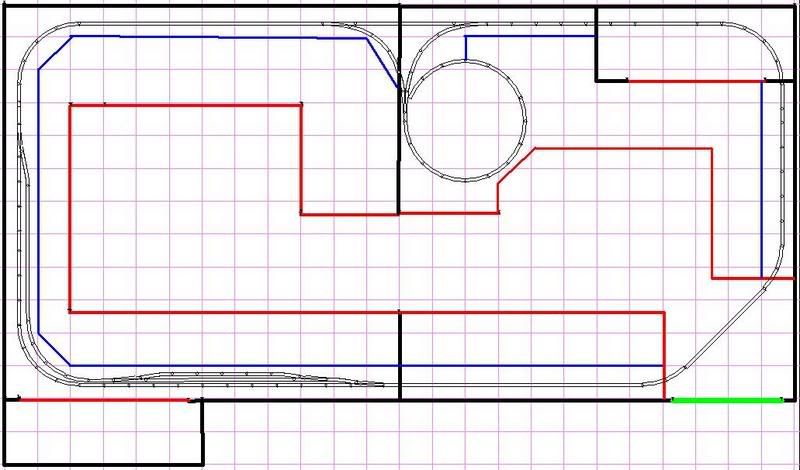
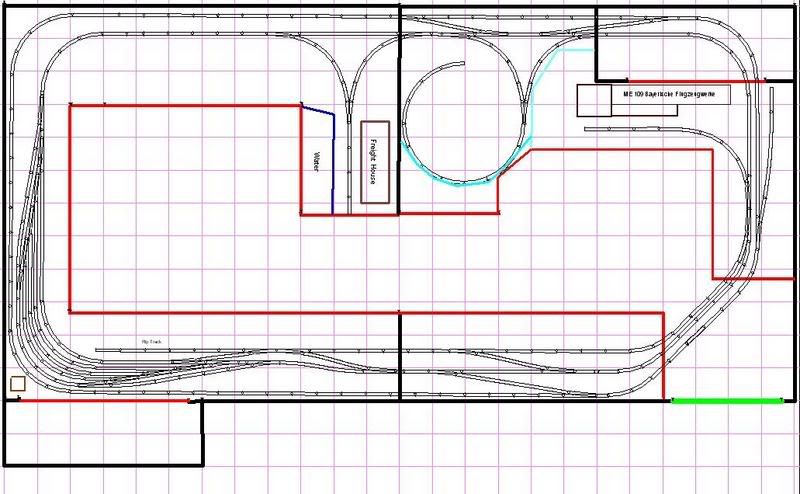
Here is try number 2. I have a theme and a plan on what I want to do. Again any thoughts are welcome.
Thanks
Schom
Here is try number 2. I have a theme and a plan on what I want to do. Again any thoughts are welcome.
Thanks
Schom
Please share the theme and your objectives. That gives the plan a context for evaluation. Without that kind of information only you know whether the plan comes close to meeting your goals. If I make recommendations without knowing your theme and goals (givens and druthers), the suggestions will be based on my preferences instead of yours.
Fred W
I am modeling 1943-1945. War industry and troop transportation. The pier is a embarkation point for material and men to go over seas. The room to the right on the lower level are industrial areas on the East coast. The room on the right is a freight classification yard connected to the Brooklyn ship yard in New York City.
The upper level is the Midwest with a passenger station and some war materials out of Chicago. I model the NYC and want to put passenger stations that would be serviced with the run from Chicago to NYC.
I know that this is very basic but I am looking for opinions on my track plan for some basic switching and material movement.
Schom,
I assume you’re working in HO scale and each square on your grid is 12 inches. It appears your layout consists of two bedrooms you’ve connected.
Your helix has what appears to be about a 22 inch radius. Assuming 3.5 inches of rise per loop, you’ll have a 2.5% grade. This is a little steep, but not too bad. If you can open the radius to 28 inches, you’ll get to a more reasonable 2% grade.
The trackwork behind the helix will be a bear to access. Having turnouts in that difficult to access area only compounds the issue.
It appears your operating scheme will have trains starting on the lower level, going up the helix, taking a spin around the upper level, and coming back down to the lower level, double track your helix. Then trains going up will not interfere with trains going down and vice versa. When thinking about the linear mainlines real railroads have, in your modeling, you would not want to have trains that are supposed to be miles apart in the “real” world be needing the same track on your model. Also, I’m not sure if you intend to treat the two loops around your lower level as double track or as two seperate mainlines. If you wish to treat them as seperate mainlines, you may wish to redo your turnouts at the bottom of the helix and add some grade seperations some you do not have trains sharing the same track when they’re supposed to be miles apart in the “real” world.
Add staging. Unless you’re modeling a shortline or have 2400 square feet to model an entire railroad, trains from other parts of your freelanced railroad need some place on your layout to come from and go to. I recommend extending your helix down to a lower staging level.
I don’t know what you’re restrictions are with track passing through the walls, but your yard could be extended along the lower wall. It seems the other track you have in that spot is
If Eric is correct and you are going to be using 22r curves in your helix, you may have some problems with your passenger trains. I also model late steam / early diesel. I run branchline Pullman coaches and I’ve got to tell you, they don’t like 22r curves. These coaches run just fine on my club layout, but the minimum curve there is 30 inches. I like how you took some of your track out of this new revision of your plan. Looks like you now have some room for other things besides “just track” but your curves still seem a little tight. Without really knowing what scale (HO, N ???) or what each square equals, it’s kind of hard to know what radius each turn is going to be.
HO Scale and each square is 12 inch
You’ve got some mighty long reaches to correct derailments with no popouts.