To my knowledge, the purpose of the tell-tale was indeed to warn brakemen. I can’t see how this could be considered “cruel”, as I, for one, would rather be hit by a rope than be hit by the top of a tunnel portal or some other structure! If you ask me, it would be moreso cruel if they didn’t have a telltale.
I haven’t seen any roadway telltales, but it wouldn’t surprise me if they served a similar purpose–to warn you that your vehicle is too tall.
1 Like
Many telltales used chains to knock anything or anybody off of the roofs of cars. Brakemen likely would know their territory well and would be clear before the train got to the telltale. Exceptions would be Bugs Bunny vs Yosemite Sam and Shack vs A number one type situations.
1 Like
My hypothesis (fantasy novel) is as follows:
(1) Before the air brakes were introduced, the hand brakes of some of the cars in the train were half-applied by brakemen just before descending a long grade such as the Saluda.
(2) If the hand brake handles were located on both sides of the freight cars, the brakemen would not be able to cross the train, so a roofwalk was installed on the center of the roof as a passage for them to operate the handles efficiently.
(3) When the air brakes were introduced, the hand brakes were replaced by retainer valves installed nearby, and the roofwalks continued to be used.
(4) When dynamic brakes were introduced to diesel locomotives, the number of retainer valves that were operated decreased.
(5) After the Transition era passed and the 1960s came, diesel locomotives with dynamic brakes became widespread, and there were almost no retainer valves that were operated. So the decision was made to abolish the roofwalks in 1966.
(6) The retainer valve is now located under the floor, and a crossover platform and handrails are required above the couplers at the ends of the cars to allow for movement between the left and right sides of the train.
I posted the above plot in a thread in March 2021, but no one agreed with it. This time, my purpose in arguing that brakemen would not use the roof walk while the train is moving was to reinforce this hypothesis.
Everyone’s arguments were easy for anyone to agree with, but it was disappointing that you did not provide any evidence to back them up.
It seems that I was unable to find anyone to agree with me this time either, so I will wait a while and challenge again from a different angle. If I could find the minutes of the meeting that led to the decision in 1966, that would solve the issue.
1 Like
I thought they used ropes and their purpose wasn’t to knock people off, but to serve as a final warning to hit the deck.
4 Likes
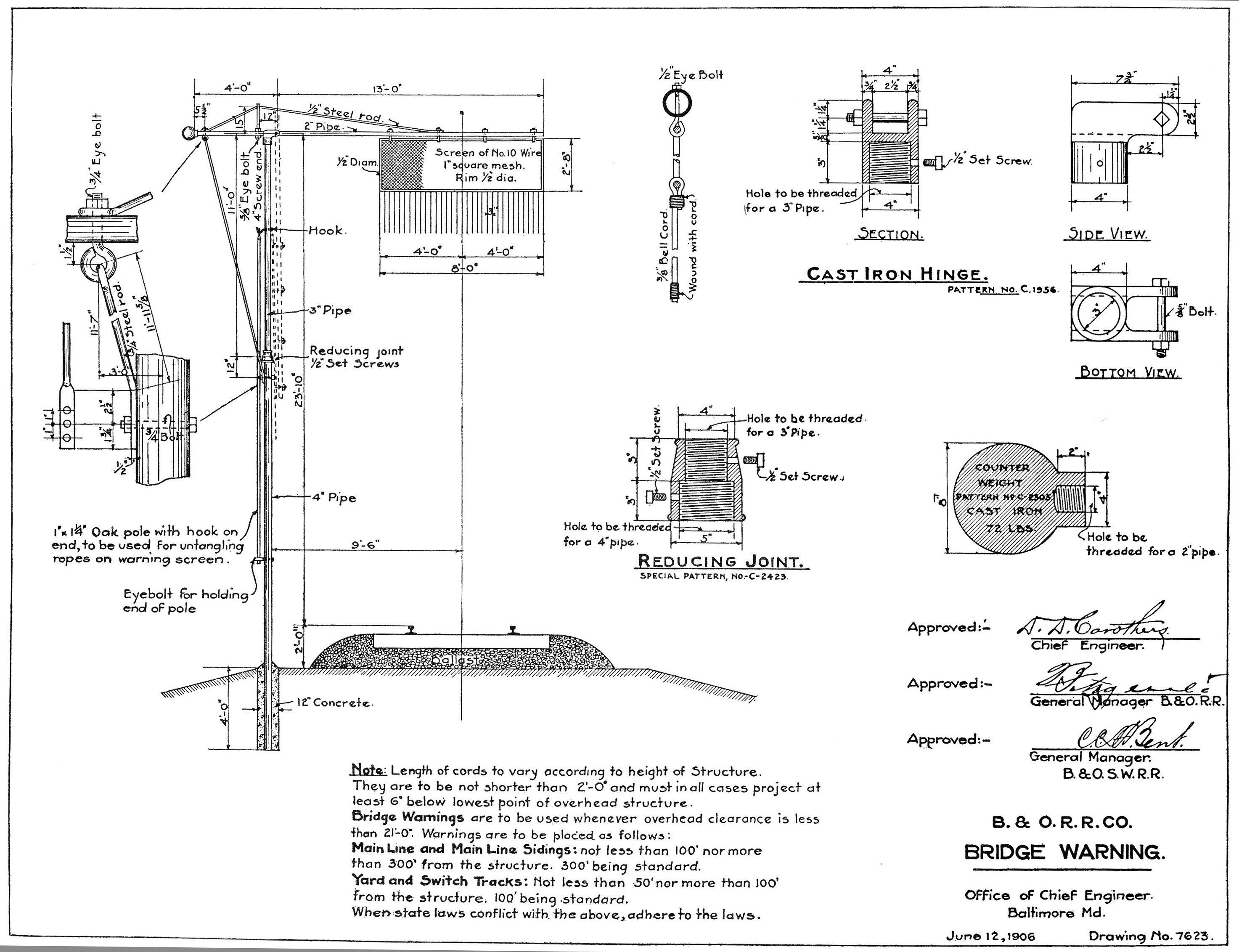 Telltale B&O Bridge Warning by Edmund, on Flickr
I recall reading some of my dad’s railroad books as a youngster. One in particular was called Down Brakes (1961) by Robert B. Shaw; A history of Railroad Accidents, Safety Precautions and Operating Practices in the United States, and it chronicles many of the hazards of railroading over the years. A worthwhile read.
Regards, Ed
1 Like
That was my understanding too!
1 Like
If one searches for brakemen on top of freight cars, pictures are available on the internet. Most actual photos are of brakemen passing signals. For the pre airbrake era, only drawings from publications are available. That and anecdotal information from contemporaries of the era is all there is.
I’ve not searched for it, but there is a case of a brakeman who tightened the hand brake on a car that the wheels slid and caused flat spots. The railroad docked his pay for a new wheel set. The railroad then had the flat wheel trued up in the shop and put them back into use. The brakeman found out, and sued them for using “his” wheel set. He won and the railroad had to pay him rent for using the wheels.
Jeff
4 Likes
Never heard that one.
1 Like
Hand brakes have NEVER been replaced by Retainer Valves. Hand brakes are still on every freight car today.
Functional Dynamic Braking has minimized the use of Retainer Valves in as much as Dynamic Braking has also reduced the reliance on air brakes to control trains in graded territory. There are TTSI in effect on some territories that specify the use of Retainers on trains when the Dynamic Braking on the locomotive consist is known to be defective.
2 Likes
A better way to put it was that ‘down braking’ was replaced by having valves that maintained a continuous 15-pound pre-set on the air brakes, so the power brakes and car foundations connected to them did the work of 'turning all those brakewheels" (and then un-turning them) with more repeatable precision of braking effort.
Engine men would then further control the train with additional ‘sets’ as needed, but I believe any ‘release and recharge’ with retainers set, which would otherwise pose the risk of a runaway if mistimed, would still leave the 15# set actuated.
Retainers, even in the days of steam, weren’t needed everywhere. Outside of long, heavy down grades they wouldn’t be needed. The air brake was the mechanism that operated the brakes on individual cars. The retainer was added for safety.
Retainers hold, or “retain,” air pressure in the car’s brake cylinder. They have a direct release position, which is the normal position. It would compare to the “off” position. It lets air out of the cylinder when the air brake is released.
There’s a slow direct release position. It allows air out of the brake cylinder until exhausted, but at a slower rate than direct release.
Then there are two, some may have a third position, that retain air pressure until manually released, either setting the retainer to release or bleeding the cylinder. I forget off hand what pressure values are with each position, they are labeled high and low on the valve.
When engaged, they work after the air brake is first set. All of the “on” positions are to allow the automatic brake to be released and the auxiliary reservoirs, that supply air to the brake cylinders, to be recharged without letting the train get out of control. Once the retainers are set in the desired position, they don’t do anything until a brake application is made, putting air into the brake cylinder.
Why would an engineer release the brakes going down hill in the first place? One reason is grades are seldom a constant value. An initial set might be good at one spot, then the grade lessens and it’s too much braking effort. Then you either release the brakes or pull the train until the grade steepens again.
Another reason is that until around the late 40s or 50s, locomotive brake valves didn’t have pressure maintaining ability. With that ability, when the engineer sets the brake by reducing the brake pipe, say from 90psi to 80psi, the brake valve will maintain that 80psi, compensating for any leaks in the brake pipe. Without the maintaining feature, that initial change to 80psi can drop through leakage in the brake pipe. As the pressure in the brake pipe drops, the brakes start seting up harder, increasing the braking force. Again, you either release or start dragging the train.
The longer the train, the longer it can take to recharge the brake system. Setting and releasing too quickly will deplete the auxiliary reservoirs to where there isn’t enough pressure to operate the car brakes effectively. It’s called “pis-ing away your air.” (Another safety measure was the addition of a separate emergency reservoir on a car that has pressure separate from the auxiliary reservoir. So, in theory, you have some braking capability in reserve.) The retainers gave time without having to completely lose any braking effort.
Jeff
3 Likes
Of course. There are no air brakes when a car is disconnected from a locomotive and parked. 
1 Like
Nice explanation of the use of retainers. A 1968 (August??) issue of MR had an ABC’s of Railroading article on air brakes, which included the operation and use of retainers.
IIRC, the DRG&W had dual straight air and automatic air on the narrow gauge freights and a few standard gauge freight cars. The idea was that normal breaking would be done with straight air as braking effort could be incrementally decreased as well as increased, with the automatic brakes providing a backup.
2 Likes
As did the DM&IR ore cars:
 Straight Air and Steaming Taconite by CN Southwell, on Flickr
Straight Air and Steaming Taconite
The Orinoco Retainer System, otherwise known as “Straight Air” is a separate air brake system installed and used on the DM&IR’s ore trains in conjunction with the Automatic and Dynamic Brakes. It’s incredibly useful as it can be regulated like the independent, wherein you can put a little on and take a little off as necessary.
Click the image to see more of the photo caption.
The additional hose can be seen here:
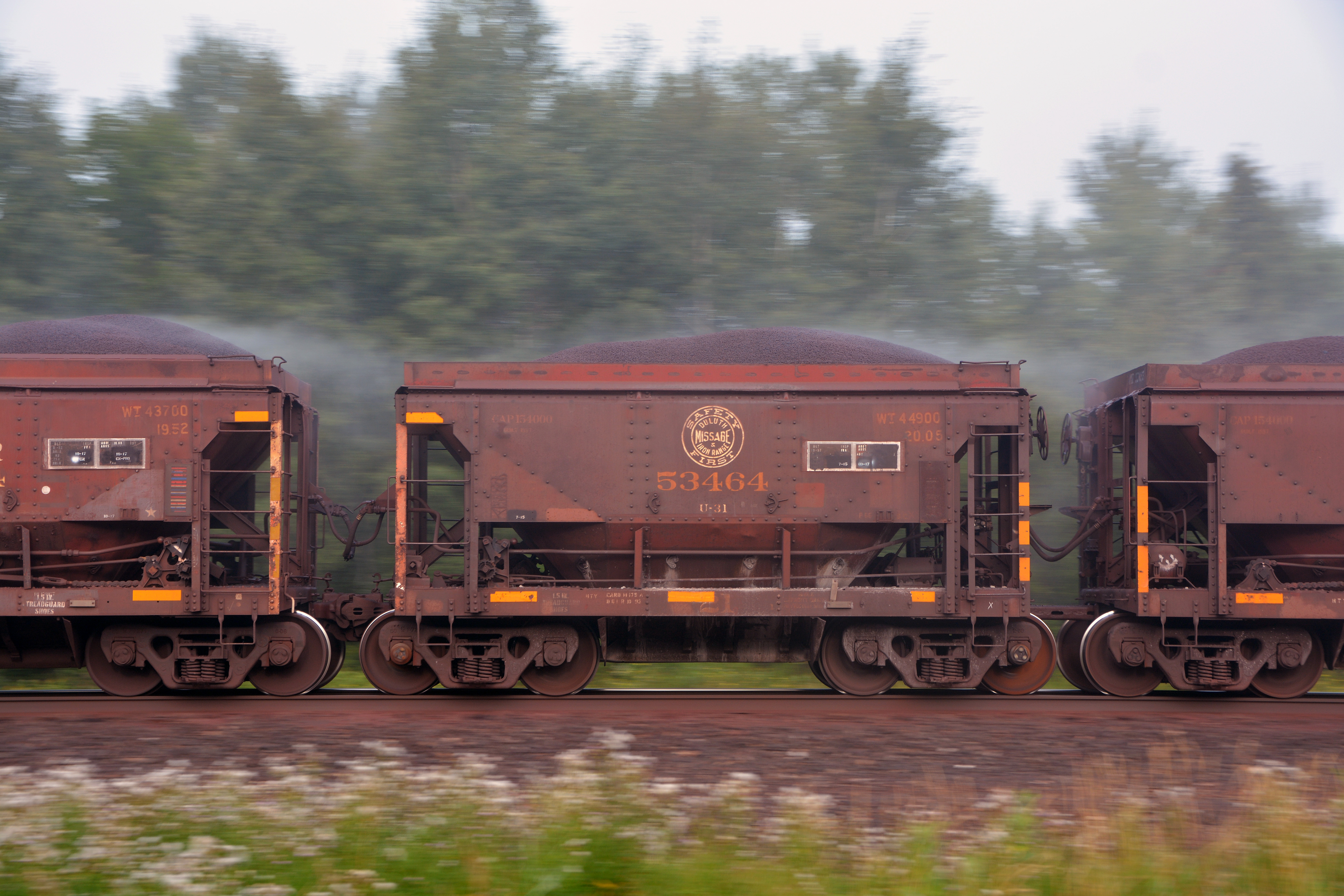 A pretty Jennie by CN Southwell, on Flickr
Regards, Ed
4 Likes
Note in the above DM&IR photo that the center car is coupled to the left car, but the car on the right side is draw-bared to the center car. IIRC ore cars have draw bars in 4 car sets.
2 Likes
2 Likes
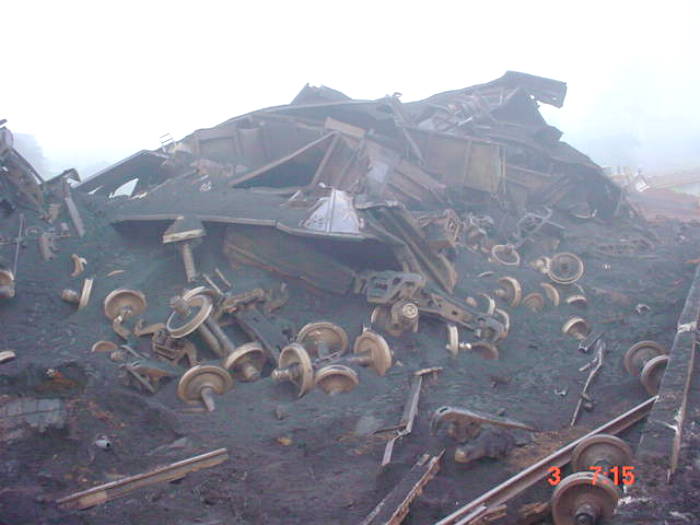
That’s an even bigger mess than my train room!
1 Like