Pittsburgh had to build a new garage at its South Hills Station and I have been trying to argue for a extention of the extension of the Rapid to I-480…We have to think about the fact that a good many people drive to the light rail-commuter station when we plan new lines and that a light rail-Freeway Interchange may be needed as improvments to roads leading to the light rail terminals…Parking had been a huge issue on MARC Trains as again there is never enough and few people live on a main bus route----Most people live in Subdivsions miles away from the main road
Utah’s FrontRunner has been in service for just about 1 week and already ridership is 120% of expectations. If planners don’t expect much then they don’t plan for much parking.
dd
If I were a rail-transit planner, I’d do my best to pre-clear permits and zoning to allow the flat parking lot to become a multi-storey.
Better yet, if the transit agency has the money, even a “Greenfield” line extension is better than none. Currently Metra operates the UP west line thru Geneva to Elburn, and I believe it’s the MILW-west line that runs thru Elgin to Big Timber.
The ideal, of course, would be to have circulator buses running to the station during peak hours. There’s a lot of that done in the suburbs and subdivisions of Toronto, where the bus schedules mesh with those of the GO trains and the feeder routes come right up many of the culs-de-sac during rush times. But would American city/county dichotomy politics louse up such coordination?
Park a string of tri-leval Auto-Racks next to the station as a Temporary Portible Garage
PACE (RTA’s bus division) does operate rush-hour only feeder buses at several stations, mostly in DuPage County and some north and northwest suburbs. A fair number of other such routes have been discontinued for lack of ridership.
Right, but “never say never” to the routes that were tried in the past and abandoned. Metra is getting more riders because of the rising price of gasoline, and extra people who ordinarily would have driven to work, or straight to the train station, might be lured by the prospect of a work day without having to drive the car at all.
I have limited experience with PACE but I have been impressed on the few rides I took at how well the buses kept to schedule. Of course, the CTA is quite an “object lesson” by comparison! - a.s.
The PATCO Hi-Speed Line has some BIG park and ride lots - all flat. The downside is that at some, the furthest space is more than 1/3 mile from the station. More like park-walk-and ride lots!
Parking lots are often shortchanged by transit agencies not because the agencies are dumb, penurious, or shortsighted, but because they’re a non-critical path item where economies can be found without causing the project to come up incomplete with the money all spent. It’s not possible to buy less catenary, track, right-of-way, street relocation, or utility relocation, and still open the railroad. But it is possible to buy half as much parking lot as you’d like to have, and hope that after the railroad opens the taxpayers will agree to fund an expansion.
It’s not pretty but it’s reality.
RWM
RWM: Right again. Opened a park ride in a Atlanta suburb location (Cummings). 2nd day lot full and additional buses had to be added and scheduled ones left ahead of schedule full SRO.
They key here again is that MARC and VRE has found out in places like Germantown and Gathersburg that the Real Estate gets preety valuble next to the train station and that condos and retail next to the tracks could bring in more revenue.------
The problem with Feeder Buses is that you have the labor costs of the drivers which at 40,000.00s a driver and 80,000 for mini-bus or used bus could add up…
My solution would to have eletronic rideshare boards on the trains or have stationmasters help cornidate a rideshare board like the ones you see at colleges
I keep thinking of an article I read about five years ago about a women who had to get to her VRE station parking lot before 5:00 a.m. or she wouldn’t have a place to park. The train was due close to an hour and a half later.
Ironically, she would probably appear to be a “satisfied customer” according to ticket sales if she always uses a monthly pass.
Many people disagree with me, but I think it’s crazy for people to have to stay up all night for Stevie Nicks tickets or waste part of the early morning just to find a place in the lot. One solution would be to institute a charge to park or raise the price if VRE already charges. Another would be a lottery, but that could easily be subject to fraud.
charge for parking?$$$$$?
Obviously you’ve never visited Chicago!
Al:
You and I don’t disagree often, but you struck a nerve this time.
The cost of parking in center city is one of the major draws that the Lynx light rail has.
When people are interviewed by the press at the light rail station they quote the cost of gasoline and the cost of parking vs the cost of the light rail. They seldom mention the inconvenience of fighting rush hour traffic.
I believe charging for parking at the park and ride lots would be counterproductive unless the goal is to get fewer people to use mass transit.
We, too, are finding that the planners underestimated the parking need.
The following is not a plan or advocacy, just a thought:
A large part of the cost of transportation systems is the cost of selling, the fare evidence, verifying and enforcing the payment of the fare, collecting, protecting, and accounting for the collected fares, etc. I often wonder what the difference in cost per rider would be if a tax on city parking spaces was implimented and used to fund a totally free extensive mass transit system.
Portland Maine just spent 30,000,000 on a parking garage…15-40,000,000 is a typical for a garage…Now also os the fact that that land is off the tax rolls in a city whose University and Port and Hospital take up what basicaly is a landlocked island and they have some problems
Austin Texas bus system did something like that in the mid 1980’s. The bean counters figured it was cheaper not to charge than it was to buy the newfangled fare boxes that could handle bills and coins, as well as collecting, protecting, accounting etc… you mention.
I forget how long that free system lasted, but it was more than a year. I’m assuming the bean counters took another look, or maybe increased fare increased then amount of payment with paper money, which probably is cheaper to handle than coins.
I didn’t expect it to be cheaper, just not as much more expensive as one might think.
The loss of the fare revenue would be partially offset by the money saved by not having to administer the collecting of the fare.
I see your point and believe your facts. We seem in this thread to have exhausted what’s possible in transit parking. I’ve seen those multi-acred PATCO parking lots. But if you’re someone like me who can’t stand for long, I could handle the walk but not standing on a train. VRE must be tremendously effective if it has people literally standing in the aisles!
Yes, it was dumb of me to insert a disincentive of higher parking cost at the suburban end of the commuter rail system. Me, I won’t drive into D.C. on a bet.
Al:
I wouldn’t use the term “dumb”. It’s should be more like “Gosh, I didn’t think of that”.
For those who can’t stand for long or walk long distances, that is what handicap parking spots are for.
The Lynx has one 4 level parking deck, the rest are flat lots. The deck is large enough, but only just. If ridership increases much it won’t be. The Arrowood Road lot is way too small. They are evaluating possible remedies. One of the thoughts is better bus service feeding the rail stop. The light rail pass or ticket is good on the bus, too, and the fare is the same no matter how far you travel. The stops close to city center don’t have any parking at all. Condos and mixed use buildings are popping up near all the stops advertising that they are at, or within walking distance, of the light rail.
Unexpected is the fact that there is a shopping center right across the street from that last stop and a lot of people are taking the train to and from the shopping center. I don’t know from where. I often sit in one of the restaurants there and watch all the people walking across what is a very busy street that is 6 lanes wide there, carrying bags of stuff headed for the train.
Before they built it, and even during the construction, I was not opposed, but I was skeptical. I, however, am now convinced and looking forward to the planned expansion. In fact, I think the plan was too conservative. It should go farther in both directions.
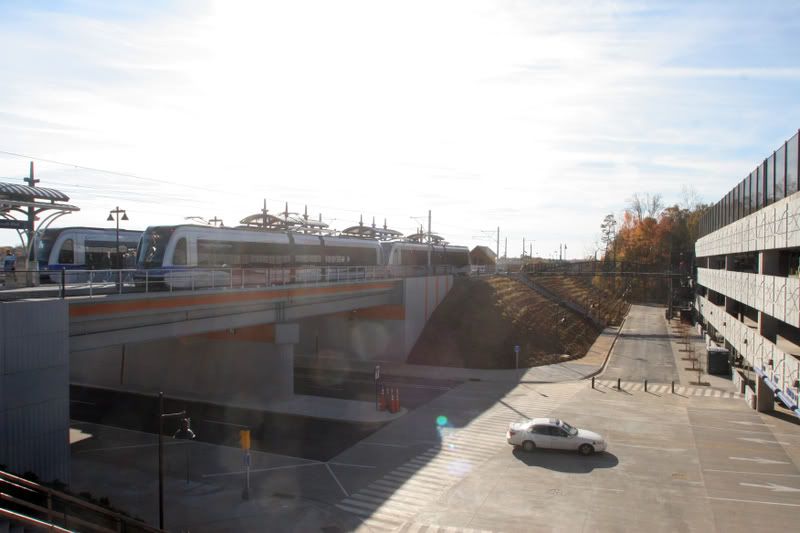
Note the parking deck on the right.
any thoughts on bus service feeding parking lots? For example, Septa Cornwells Heights RR station got a major parking lot expansion, but most of the expansion was gerrymandered so that it’s not much different from having 1 small lot next to the station platform and a completely separate large lot connected via a driveway. Septa provides small buses-large vans to shuttle from station to the expansion lot. Meanwhile there’s no public transit service from the gigantic Franklin Mills shopping mall, which looks to be not much more than 2 or 3 times further from the station than the farthest parking spot. http://www.mapquest.com/
/maps/station+ave+and+railroad+ave+bensalem+pa/
woodhaven+rd+and+millbrook+rd+philadelphia+pa/ says 1.41 mi
Similarly just a bit north on the Amtrak Philly-NYC main, NJ transit Hamilton station 9:30am on a weekday I saw quite a few people, I’m guessing about 50 in the half hour I was hanging out at the platform, walking from underneath the Sloan Ave overpass. I asked one of them if that was the closest parking spot, he said yes, this time of day there’s nothing closer to the station. I’m confused though as to where they parked, my google earth, and mapquest satellite don’t show any lot. Is there legal street parking?
And for something completely different, Cherry Hill station on the NJ transit Atlantic City line. When originally built the only nearby attraction was the Garden State Park racetrack, which had a huge parking lot, but which was on the opposite side of the railroad track from the platform. In its wisdom Amtrak/NJ transit positioned the fences so