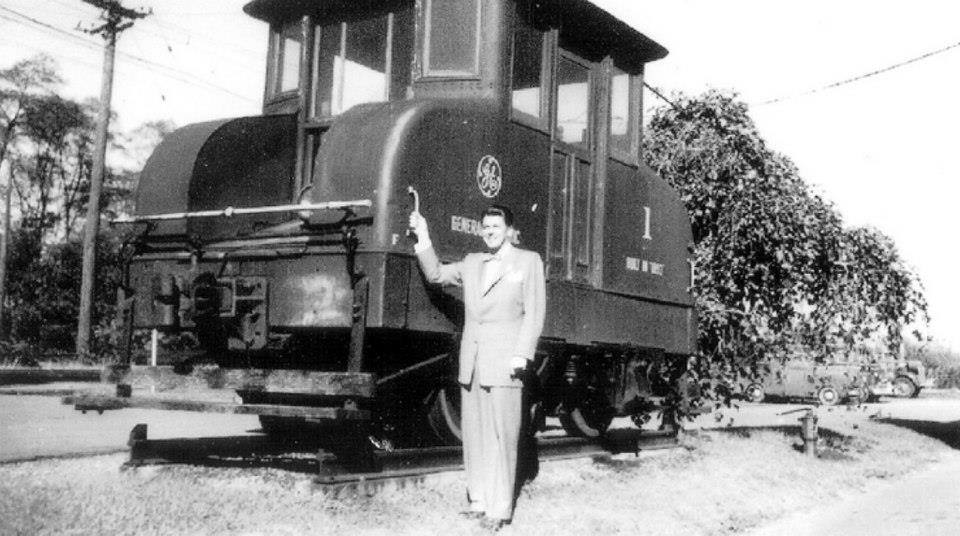
Just tell them ‘Morrisville turn’ – and enigmatically have them Google it if that doesn’t shut them up.
I am tempted to tell you to show them this

but of course there is a little more to that story.
Just tell them ‘Morrisville turn’ – and enigmatically have them Google it if that doesn’t shut them up.
I am tempted to tell you to show them this
but of course there is a little more to that story.
A little bit off-topic, United States v. General Motors Corporation. The case was dismissed for lack of evidence in 1964. Excerpt from
The offense charged in paragraphs 18 and 19 of the indictment is:
For many years continuously up to and including the date of the return of this indictment, the defendant has monopolized the aforesaid trade and commerce in the manufacture and sale of railroad locomotives in the United States in violation of Section 2 of the Act of Congress of July 2, 1890, entitled “An Act to protect trade and commerce against unlawful restraints and monopolies,” as amended commonly known as the Sherman Act.
General Motors has monopolized the above described trade and commerce by acquiring and maintaining power over price in the sale of railroad locomotives and the power to exclude its competitors from the railroad locomotive industry. General Motors has exercised its power over price and has excluded competitors from the railroad locomotive industry by its acts and conduct. In amplification of the charge, the i
Thanks Wanswheel…makes you wonder what the real backstory was. There must have been some specifics and allegations along with anecdotal accounts. They didn’t go forward with this based on nothing. As Overmod stated about that Davis fellow- “the stories I could tell”. We may never know “the rest of the story” as Doug Harvey would say.
Maybe Overmod, or someone, could shed some light on whether or not there were problems at Baldwin in terms of quality control, construction and overall engineering. I have read ( perhaps boneheads again) that there were quality control problems with the T1 built by Baldwin. The haphazard wiring in early Baldwin diesels seems to be rather poor thinking and the numerous hoses and oil leaks everywhere getting into the works, especially in those floor "troughs’ you would think should never have been in the first place. There are accounts of other rather avoidable and “should have known better” design and in construction. Some horror stories. Right or wrong? Myth or real?
The Baldwin AS-616 was largely passe by the summer of 1952. Espee writer Joe Strapac covers what was wrong with the AS-616 in his Southern Pacific 1970 Motive Power Annual on page 5. Baldwin could not meet Espee Mechanical Department requests for changes to the trucks and withdrew from the 1953 competition for new six axles. The six axle units Espee purchased in 1953 were all Alco RSD-5s and EMD SD7s. The then new Super AS-616 which demonstrated in 1953 sold two units in the US and 20 to NdeM. The two Super AS-616s demonstrators were sold to Pennsy in early 1954 along with that last RT624. Simply put Baldwin didn’t have anything to offer after 1952 to progressive US railroads.
One major failure of Baldwin’s engineering I’m aware of was in the double-ended diesel cab units they built for the Jersey Central’s commuter service, the “Jersey Janus” locomotives. Baldwin very foolishly placed the radiators in close proximity to the electrical cabinets so if and when there were cooling system leaks, guess what happened? When the CNJ tried to sell the units they had no takers and ended up using them for parts doners for other Baldwin diesels and then scrapped what was left.
One thing we have to remember about GM’s success in the diesel market is they had several things going for them, a superior product of course, but also a sales, parts supply, and technical assistance team second to none. GM wanted the business and went after it aggressively and had the wherewithal to make it happen. I don’t think it’s an exaggeration to say Baldwin and ALCO were just plain blindsided by the GM juggernaut and didn’t know what hit them.
Interestingly SMS Rail in Paulsboro NJ uses vintage Baldwin diesels almost exclusively and they love the things!
There was an article in TRP magazine a year or two ago by Lehigh Valley veteran Mike Bednar about the 'Valleys Baldwin switchers. According to Mike the Baldwins were good pullers and very popular with the crews, the 'Valley only retiring the units when parts availability became problematic.
So, it would be a bit unfair to say all the Baldwins were no good, some were very good indeed.
Oh, and those T1 flaws Miningman mentioned? The flaws were in the first two T1’s Baldwin produced. Got that from a great article on the T1’s in “Steam Glory 3” by David Stevenson. David said an experienced steam builder like Baldwin should have known better.
But don’t forget the one that was built into one of the shops – was it E’port? – nominally as a source of something like shop air from the compressor? I think there was actually a brick wall constructed in front of the thing to hide it from prying weasel eyes. (I saw a photo of the installation, so I know it ‘happened’, but this is now many years later and I don’t remember the details…)
That would have been double-ender 2004. It was around as late as 1964 providing steam heat for a CNJ building at the foot of Johnston Avenue near the Jersey City passenger terminal, and then for a time it was at the Communipaw roundhouse providing electric power. I believe the curtain came down on 2004 not too long after that.
The Pennsy bought locomotives from all the builders, either in an attempt to diesielize ASAP, also perhaps in fairness to all the builders. There was an opportunity early on for Baldwin to be the dominant builder for Pennsy but EMD’s lead in most aspect’s was insurmountable and Baldwin made a lot of design errors. One would think that by 1950 or so Baldwin could get it together and be competitive and actually I think they were. Just a hunch but there is more to the big story than we know, as Wanswheel has put forth.
There are a number of ‘conspiracy theories’ out there about EMD sharp business practices. One that was current circa 1963 was that GM would preferentially assign routings for rail shipments of its new automobiles – at the time a large and fairly lucrative traffic source – to railroads that were faithful (and probably repeat) purchasers and exponents of EMD locomotives. Another was that EMD tapped into the power of GMAC to be able to set up ‘sweetheart’ financing deals for new locomotives outside the regular constraints of banks or equipment trusts. I’m not sure why these things qualify as ‘abuse’ of market power.
It also pays to note that the case wanswheel mentioned was brought, probably with no little political motive, during the Kennedy and Johnson years, and went about as far as the tinfoil-hat conspiracy that GM was using NCL to buy up trolley lines to convert them to GM buses. It may pay to remember the exact controversy that led to the court decision against GM with respect to NCL, which had to do with sweetheart purchases of GM equipment rather than competitive bidding open to other manufacturers. Are there, in fact, court cases decided against GM (and not reversed on appeal) with respect to locomotives?
Baldwin was not in a position to finance locomotives in that era, and my understanding was that their lack of reliability began to hurt them very badly in the eyes of the banking and finance people by the early '50s. This was specifically noted with respect to dieselization of the NYO&W, where the understanding was that even large sets of F units could be easily resold almost at need, and therefore there was no risk of stranded cost should the railroad encounter
Well the 2 practices that you pointed out certainly don’t seem unreasonable at all. I was thinking more along the lines of the “hanky panky spanky” file.
I suppose that Baldwin and Lima, even with all those countless years of service in providing the finest in locomotive production, design and innovations just didn’t have the right pieces to face the challenges ahead. Still think that BLH could have made it to the second round.
Westinghouse is a whole different story and could fill volumes and volumes. Quick version 1st page Westinghouse, last page CBS.
Thanks again for the input.
Excerpt from From Steam to Diesel by Albert J. Churella (1998) (The Federal Government Intervenes, pages 129-132)
https://issuu.com/cruelty73/docs/from_steam_to_diesel
On April 12, 1961, EMD became a part of this “attack on bigness” when a federal grand jury indicted GM for alleged violations of Section 2 of the Sherman Act regarding its activities in the locomotive industry. In February 1959, Attorney General William P. Rogers, an Eisenhower appointee, intiated an investigation against EMD, and this led directly to the 1961 indictment. A grand jury, empaneled on November 17 of that year, met for the next seventeen months, while the new Kennedy administration continued and expanded this antitrust action.
Thank you for putting this in proper perspective.
Thanks yet again Wanswheel. That kept me up half the night reading away.
Especially like the line “Schpeterian gales of creative destruction”.
and…“customers like Ralph Budd did more to push GM into the locomotive industry than did the top management”
It does read as a bit biased on EMD’s side. There are instances in the text where what’s good for the goose…well you get the drift, however, I am sure the corporate mindsets, design errors and poor construction/quality at Baldwin, Lima, FM, and to a lesser extent Alco, were as noted, however, those tales seem a bit “thick”. The put downs of Samual Vauclain are particularly harsh and over the top.
The absolute perfect timing, all the time. every time, over decades by EMD/GM versus the perfect bad timing, all the time, every time, over decades by everyone else is a bit rich as well.
FM story is amusing.
If that’s the way it occurred then so be it. Different story up here in the Great White North, …and I’m leaving the files open
Take a look at Kirkland’s “Dawn of the Diesel Age” or “The Diesel Builders” volume on Baldwin. Baldwin had a modern diesel engine on the test bed when Westinghouse bought controlling interest in Baldwin and promptly scrapped all of Baldwin’s diesel research. They even replaced the design staff with Westinghouse people. Westinghouse promoted development of a clone of the Junkers aircraft OP engine to compete with the FM OP. When the problems of the OP became obvious to everyone Westinghouse bailed out and left Baldwin to die.
I am with you on my opinion of Westinghouse. The list of companies that Westinghouse executives mismanaged into bankruptcy is long.
Well the 2 practices that you pointed out certainly don’t seem unreasonable at all. I was thinking more along the lines of the “hanky panky spanky” file.
I suppose that Baldwin and Lima, even with all those countless years of service in providing the finest in locomotive production, design and innovations just didn’t have the right pieces to face the challenges ahead. Still think that BLH could have made it to the second round.
Westinghouse is a whole different story and could fill volumes and volumes. Quick version 1st page Westinghouse, last page CBS.
Thanks again for the input.
If you stood outside of the Eddystone Complex in 1945 and told people that in about ten years from now 75% of the buildings would be demolished and the rest sold off and Baldwin no longer makes locomotives they would have carted you off to the asylum.
That is the dichotomy I struggle to understand. That amount of experience, importance to the national interest, and the industrial might to simply just vanish.
Happens today. Research in Motion/Blackberry, anyone?
Point taken Overmod! That would sort of make Microsoft the EMD and Apple the GE. Looks as if Blackberry may get out of the hardware altogether.