Philosophy Friday -- The Layout Challenge

I’m not sure I want to dive in too deep on this one, but I will say this, even in building a linear walk around layout, contrary to popular practice, I think there are situations where the scenery and operational function benifit from the a deeper scene than the usual 24-30 inches or less.

I keep all my trackage within 24-30 inches of the layout front edge, but have many areas where the whole scene will be 48 inches deep or deeper. I’m not overly enamored with the backdrop only inches behind the trackage thing.

So on that note, 4x8 sheets of plywood are easily my “dominos”. But I also like the lower level of my multi deck layout at “chair” height, making access easy - even well into the 30" plus depth - the last 12-18 inches, just scenery.

Sheldon

A first layout for someone?

I would suggest something inexpensive and not very big - something you could get running fast, something you can use as a test bed for working on various aspects of the hobby, and not the least - something you can use to convince any other family members (say parents, or a spouse) that you can build a layout without leaving a big eyesore around for years :slight_smile:

Say something like this : 1 foot x 6 feet (will fit on the wall of most rooms), three medium turnouts, no electrical challenges for the first layout, only needs one locomotive, DC and 8-10 cars (or fewer), room for scratchbuilding or kitbashing buildings, room for a little work on grass, a culvert, some bushes etc, room for trying remote control for the turnouts, painting track, ballasting, painting and weathering locomotive and cars, room for interesting switching and so on and so forth:

Doesn’t have to be any bigger or fancier than that for a first layout.

Best thing? If you want to try something else, it won’t cost you a fortune to start over. Or just to make another shelf 15"-18" higher or lower on the same wall, or extend this shelf with another on one side of it, or something.

Smile,
Stein

In Japan in the 1960s, plywood came in sheets the size of a standard tatami mat, close enough to 3 x 6 as to make no difference. It’s also available in 2 x 4 panels at my local home fixit emporium.

I personally find the standard 4 x 8 sheet awkward to handle. A specific alternate size would be hard to pin down, since I only use it for cookie-cut subroadbed.

Really depends on the beginner. For my grandson (or one of my great-grandsons) I lean toward a 5 x 9 ping pong table, with the proviso that nothing should be built in the center (beyond his arm’s reach) except scenery. For a more mature beginner I might lean toward an around-the-wall or along-the-wall (or walls) The key would be, KEEP IT SIMPLE! No hump yard, multiple-track passenger terminal or umpteen-stall engine house in initial construction. Also - keep it expandable. As skills improve, turnouts can be cut in and more complex operating schemes can be developed.

If my private railway was built as a stand-alone, it would be pure point to point. My main line is a big loop, but in operation nothing simply orbits. Again, what a beginner should have depends on the beginner - but a run-around and a few spurs need to be part of the initial package. A pure roundy-round without the ability to stop and DO something simply won’t hold the attention of kids that like to put

I’ve probably shown it before, but here is my table in my basement.

!(http://i184.photobucket.com/albums/x218/MFJ_album/Model trains/10-8-08013.jpg)

Wish I had room for a 4x8 sheet. That concrete block post kinda holds the place up, and no room on the other side of it, need to keep the walkway clear. The closer end is roughly 4x4, then narrows to 3 feet by the post. The far turn is 18" radius, and extends onto the HCD I use for the yard. It certainly fits the space well.

Little better shot of my yard.

!(http://i184.photobucket.com/albums/x218/MFJ_album/Model trains/10-8-08017.jpg)

It is kinda tight, but I do have two run-arounds, roundy-round loop, yard switching, yard lead, and industry switching. I plan on redoing the industry switching, adding a bit more track and a diamond, to replicate a 1:1 scale area I have been to.
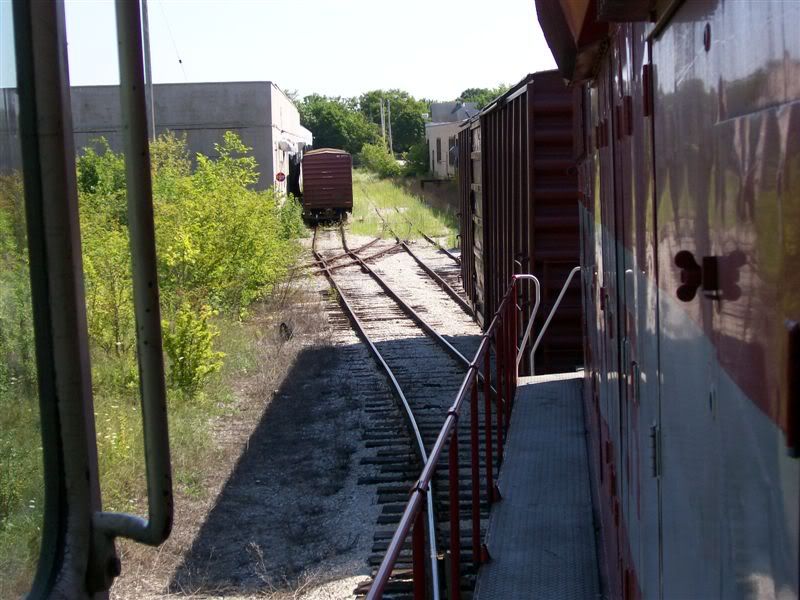
The two outer tracks have the industry spots, and the middle one is solely for the lead to go across the diamond to the other spots. The whole area is accessed by a switchback that holds 6-7 cars plus a motor. Drops down a decent hill as well, but I don’t feel like monking what that on my model.
(Some day I might make some progress, but after 12 hours operating in 1:1 scale a day, I just don’t feel like it sometimes.[zzz])

I feel around the walls, using HCDs is probably the way to go for somebody starting out. Or whatever fits in the space allotted. Each situation is going to be different.

My minivan fits 4x8 sheets of material inside. You mean to tell me that won’t fit in a pickup truck? Must not be much of a truck then…[:-^]

My first layout was 4.5x10 feet, ping-pong

Say, have you been sneaking around in my train room again !?!?!

[(-D]

John

I like your layout-- as plywood pacific’s go, its got some character! I think not having room for the 4x8 has inadvertently worked to your advantage. Its a lot more interesting the way it is. If you had the 4x8, you’d have an ordinary-looking oval instead of the nifty peanut shape you have instead.

Yeah, I saw that too… I wasn’t gonna say anything… :slight_smile:

John

Not trying to hijack the thread but rather inform. I think that houses in the US are built based on the size of lumber available, and I wouldn’t be suprised if the available lumber had something to do with what fit on the railroad back in the day. That being said, your not restricted to building by what is available but it is most economical to do so. Wood floor trusses are set at 19.2 inches on center and is represented by a little diamond on a tape measure and magically hits the 8ft mark. On my house, I have an 18 ft span that has joists set at 14 inches on center. Economics at work here again. It cost less to scrap a little plywood on a portion of the house rather then install 16 inch joists in the entire house.

Jon

I was just hoping to put bigger turns in. My passenger cars don’t really like going around the 18" turns. I was planning to kinda hide that far turn behind a row of foliage, so it would appear to go somewhere.

Sometimes I feel like switching, but the continuous run I feel is a necessity. Most of the time I just set a train into orbit and sit back and watch.

It is possible to have one orbiting the loop, and another switching the yard. DCC I feel is sometimes more useful in a congested space like this. Saved me a lot of wiring.

OK, a little construction history. Plywood, as a building material for your home, did not come into wide spread use until the late 1950’s and early 1960’s. Prior to WWII, the glue technolgy did not exist to make good exterior grade plywood, even for applications like your sub floor, roof sheathing or wall sheathing.

Before that time, plywood was considered a furniture building material, or interior material like door panels on doors.

I guess my first reaction here is that plywood really DOES come in whatever size you want. Have the hardware store rip it down the middle to make two 2x8 pieces (my local place will to this for free). You can easily – without any real carpentry skills, even – join a lot of these pieces together to make whatever you want. A 2" wide piece of plywood is easily cut with a circular saw if you don’t want the full length.

But someone earlier threw out the old fallacy “I only have room for a 4x8. Yet, allowing for 2’ aisles (rather narrow, actually) on all sides, you actually have an 8 x 12 space, which is the size of a small bedroom. You can easily put an 8’x12’x8’ shaped “c” which is only 24” wide in that same space, and get a lot more layout for the same space.

I have to take a shot as well, we call them self propelled wheelbarrows.

Not to argue with Sheldon, but I recall EXT-DFPA plywood being readily available in the late 1940s. Sears Roebuck, among others, sold it.

I personally suspect that the initial champion of the 4x8 construction module was a cat named Levitt, who fast-built Levittowns in several states shortly after WWII. I remember visiting Levittown, Long Island, in the 1947? time frame, and hearing the comment that the ceilings seemed low. The sales agent stated that they were eight feet high. Levitt built inexpensive but reasonable quality houses by designing to the standard module size - saved cutting and waste, and greatly speeded up the process of putting a house together.

I do agree that quality construction has joists and studs on 16 inch centers. I wonder how much that influenced Linn Westcott’s thinking when he spec-ed out the first L girder designs. It was kind of a knee-jerk reaction for me to design my steel stud benchwork with that spacing for joists - some of which have since been removed as unnecessary.

Chuck (Modeling Central Japan in September, 1964)

[quote user=“ATLANTIC CENTRAL”]

JonMN:

IRONROOSTER:

I suspect the reason for 4x8 sheets of plywood is because a lot of building is done with floor joists and studs on 16" centers. If they could get away with 20" centers then plywood would be 5x20. If you made them use 14" centers then it would be 3.5x7. Inherently, 4x8 is not a convenient size. It’s too large for one person to carry easily and it’s awkward to cut up unless you have a dedicated panel cutting rig. It doesn’t fit in most pickup trucks or other vehicles used by consumers.

Enjoy

Paul

Not trying to hijack the thread but rather inform. I think that houses in the US are built based on the size of lumber available, and I wouldn’t be suprised if the available lumber had something to do with what fit on the railroad back in the day. That being said, your not restricted to building by what is available but it is most economical to do so. Wood floor trusses are set at 19.2 inches on center and is represented by a little diamond on a tape measure and magically hits the 8ft mark. On my house, I have an 18 ft span that has joists set at 14 inches on center. Economics at work here again. It cost less to scrap a little plywood on a portion of the house rather then install 16 inch joists in the entire house.

Jon

OK, a little construction history. Plywood, as a building material for your home, did not come into wide spread use until the late 1950’s and early 1960’s. Prior to WWII, the glue technolgy did not exist to make good exterior grade plywood, even for applications like your sub floor, roof sheathing

Chuck, available and wide acceptance/use are two dramaticly different things. Yes developments like Levittowns had a lot to do with its later wide acceptance.

But for example here in the Mid Atlantic, Baltimore in particular, most of the post war suburban housing boom was true masonry brick/block (not brick veneered wood frame) “row houses” with diagonal plank subflooring and roof decking, veneer plaster walls over “rock lath” (a 2’ x 4’ drywall like product used as a base for plastering), oak flooring, two panel wood doors with plywood panels and either flat built up roofs or slate roofing. Houses like these were built in large quantities into the early sixties. I raised my kids in one built in 1954. Most of them still stand today and are considered good quality housing in the close in suburbs of Baltimore

“My garage, a 32 x 40 building with a second floor (which is the train room), has 16” deep wood “I” beams on 12" centers to span the 32’ with no posts or steel."

When you say I beam, are you talking about the kind that has OSB inbetween 2x2 wood on top and bottom of joist? If yes, that is an engineered joist that I spoke of. It did not require a 32’ tree to make it’s length. Your 12" center was determined by the joist and it’s maximum amount of deflection. Had the the engineer known you were going to model Mt Everest with 5000 lbs of plaster in the center they may have required a beam [:D] If you look close, the splices in the OSB are 4’ and I think the splices in the 2x2 are 8’ or 12’

“But lots of houses are still built with 14’ -16’ 2x10’s or 2x12’s to even longer lengths, up to 20’. Again it varies by region, availablity and local costs.”

Very true. I should have been more clear when I said we don’t use them, not to mean they are not available. However, now that engineered lumber is much more common I think a solid 20’ plank would be very rare these day’s.

“Many new homes built in the last 10-15 years have 9’ ceilings - that blows holes in all the 4x8 modular theories as well. In such cases exterior sheathing is often run horizontaly and overlaps the “platform floors”. This is actually a stronger application of plywood then the upright “modular” concept.”

This is a case of the industry adapting to the demand. Even on 8’ ceiling, we always used 4x9 sheathing installed vertical( installed vertical per local code). The sheet spans from the foundation wall to the rim joist on the next level. The 4x9 cost more per sq ft then a 4x8, but cut down on labor by not having to install backer inbetween every stud at the splice (local code) 9’ ceiling we use 4x10 wich cost more per sq ft then 4x9. The biggest thing a 9’ ceiling effected was the interior wall by adding an additional joint in the dryw

“My garage, a 32 x 40 building with a second floor (which is the train room), has 16” deep wood “I” beams on 12" centers to span the 32’ with no posts or steel."

When you say I beam, are you talking about the kind that has OSB inbetween 2x2 wood on top and bottom of joist? If yes, that is an engineered joist that I spoke of. It did not require a 32’ tree to make it’s length. Your 12" center was determined by the joist and it’s maximum amount of deflection. Had the the engineer known you were going to model Mt Everest with 5000 lbs of plaster in the center they may have required a beam If you look close, the splices in the OSB are 4’ and I think the splices in the 2x2 are 8’ or 12’

No, they are the kind with a 2x4 laying flat on the top and bottom and plywood as the web. I know exactly what you were refering to, my point is methods and materials vary from region to region. Just go on the George Pacific web site and find out how some products are only sold in the west, others only in the east, others everywhere.

I am well aware it did not take a 32’ tree to make those beams - but it took 28’ long 2x12’s to build the conventionally framed 12/12 roof that sits on top of it. We had no trouble buying those - the building is only 15 years old. I was the engineer, draftsman, project manager and electrician on the project. Part of the bulding can be seem in the lower left of the photo I posted.

True, engineered lumber is very common today and usually prefered for longer spans, but the usage, exact products, and so on, is affectrd by a number of regional factors.

“Many new homes built in the last 10-15 years have 9’ ceilings - that blows holes in all the 4x8 modular theories as well. In such cases exterior sheathing is often run horizontaly and overlaps the “platform floors”. This is actually a stronger application of plywood then the upright “modular” concept.”

Forgive me; I’m a little late chiming in on this one.

I hypothesize that the standard sizes of building materials have influeced such things as sectional track curve radii and minimum radius capabilities of locomotives to the extent that dimensions such as 48", 96", and 24" seem to work out well for us. It’s like we can use a full sheet and create a layout, or hack it up and use the smaller chunks to create a different form, but curve radii of sectional track work out well (unprototypic as they are). My point is that I suspect that the hobby has evolved to accommodate the standard sheetgoods size.

Looking at it another way, I wonder of the standard size of a sheet of plywood were different, would model railroad products be different (i.e., made to fit)? My guess is that the answer is that they would be made to fit the convenient standard size sheetgoods - whatever it might be - because products that fit the most typical applications are the ones that sell the best and this are kept on the market. Therefore, because model railroading “grew up” with 4 X 8, 4 X 8 is a good size for us. We can slice it and dice it, but it seems to be a pretty good size for a piece of model railroad raw material.

A nod that I’ll give the 4 X 8 format is that such a layout can often be moved intact (sans legs), or made to be lowered from a ceiling. For folks who need such flexibility, it can be a good way to go.

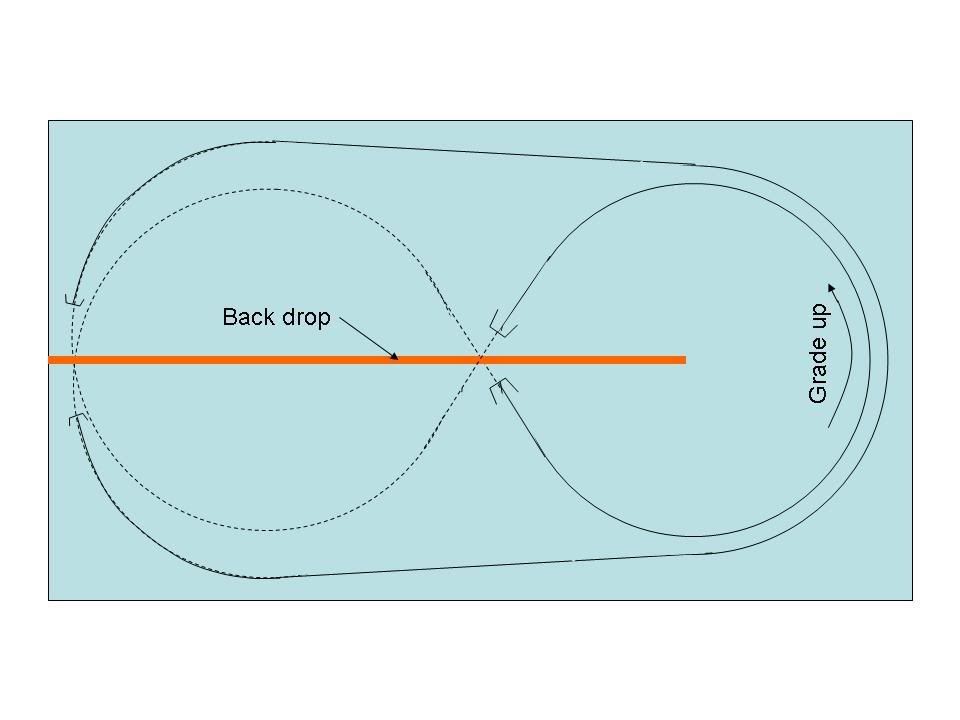
I think that we often default to the perimeter oval as the basis for a 4 X 8 track plan, but there are alternatives; this is an idea that I’ve toyed with for a 4 X 8 layout, for example:

I think it would be pretty easy to pull off in N-scale and it may be possible in HOn30 or HOn3.&nb