Yes, I model the Lebanon, NH, yard. It has two A/D tracks, three classification tracks, and one caboose/loco/RIP (shop) track, although I need to make this last one more usable as it’s usually clogged with locomotives. The yard is single-ended, although the A/D tracks can be made double-ended with some trackwork at the west end of the yard. Right now the yard job (LE-1) uses Lebanon Siding as a runaround track and yard lead. Yes, I’m breaking rules as to fouling the main (and the lead) but it works.
The yard is fully operational and except for the shop track and a non-operational storage track, nothing stays in the yard for longer than a scale day. Two locals are based out of the yard, and fed by the freight to Concord and transfer jobs from the railroad yards across the Connecticut River in White River Junction - New England Central, Pan Am/Guilford, and Vermont Railways.
My railroad operates with three operators, so it would be very boring indeed for the operator of the through freight and the crew of LE-1 if there was no yard. Operations would consist of running in circles and switching two industries, respectively.
Plus, yard ops are fun. And that’s what it’s all about, right?
Dave-the-Train: I really do like spending ages switching trains/cars around model yards… other peoples’… they have to pay for them and maintain them.
Dave,I missed this the first time but,I will ask: What maintenance?
As you will recall the majority of my layouts has been industrial switching layouts and I have had very little maintenance type problems with KD #5 couplers…I have worked yards on point to point club layouts where every train must be reclassified and seen no maintenance problems cause by switching.
So,why not enjoy yard switching on your layout instead of depriving yourself of this simple pleasure?
And those industries will be only switched once a day or week too. So that doesn’t meet you definition of a hotspot either.
The YARD may be switched all day and all night, but not the industry. When the switcher is working the tracks the industry can’t load or unload the cars. Normally the industry is only switched once a shift. Otherwise it interrupts the production of the autos.
In the larger yards on model railroads I operate on their are often 2 switchers and one to 3 trains moving around the area of the yard. Since I have smaller yards, I will only have one switch engine and one road train working at the same time. If I was really motivated I could have one engine switching while another weighed cars at the same time. The other two smaller yards will also allow one train to be switching while another train operates in the area.
[quote]
I guess that a lot of my thinking stems from going to shows over many decades. The “public” tend to cluster around layouts where trains move and not around the ones where (usually a single loco) switching endlessly repeats what to them are meanin
Mark, I’ll agree that not everyone is cut out to run a yard. Especially a busy one handling 20 or 30 trains during an ops session. Buy you have to agree, your job running that way freight is a lot easier if the cars are blocked together by destination, or otherwise organized to simplify your switching moves. That’s going happen in a yard, 9 times out of 10.
John,
Re: my slug, it’s modeled after the WM prototype that worked the Hagerstown yard into the mid 1980’s. The BL-2 is the Life Like N scale version, and the slug combines parts from a Bachmann H-16-44 (the shell) and an Atlas VO-1000 (trucks and frame). I couldn’t get it to sit low enough and keep the motor, so it’s a dummy. I did retain the power pickups, though, and I added weight to the frame to aid in keeping good contact with the rail. The BL-2 by itself is a brick, and will easily pull anything you throw at it, so the added pick up just helps as the engine works back and forth through the yard throat.
I took a bunch of pictures of the construction of it, but I haven’t put an article together yet for the website… One of these days…
Lee, I get a sense of relief when others have volunteered to be yardmaster and dispatcher. And, yes, I do appreciate having the cars blocked for me. Running way freights is sufficient challenge, keeping out of the way of everyone else, working out the puzzles some owners like to throw in, and trying not to “die” on the road before completing the task.
You might say that this is where I’m going wrong… I tend not to distinguish between the two.
I think that both varieties of layout (if they are different) may be different on opposite sides of the pond. A good many of our home layouts are small enough (that is confined by space) to double as show layouts.
Something that I find to be a let down at shows is constant switching (shunting) of yards. In a lot of cases this involves the viewer being presented with a lot of bald heads. I will admit that at the other extreme trains hurtling round in circles also have a dire lack of appeal.
Reason I ask lots of weird questions is (at least) two fold.
First: I’m thousands of miles away so that while I have quite a bit of experience of the real thing it is a very different real thing. I am fascinated by the differences - even if I can’t always get my head round them. One factor is that most of my working experience has been on lines that are predominatly passeneger traffic oriented. I would have to ask a lot of similar questions if I wanted to develop a UK freight layout… but it would be a lot easier to go out and observe!
Second: while I have settled into getting on with one layout I try to develop not just the modelled scene but a thorough concept of where (and how) the tiny bit of track fits into the whole scheme of things. This means that I think about what yards will be either side of my hotspot - both close to and further away… They generate the traffic and traffic patterns on my bit of track. In addition there is a theoretical yard only just off scene to one side - this means that some trains a
What maintenance? As little as possible! … which is achieved by good design and good practice.
I have known a lot of good layouts - but I’ve also known an awful lot that seemed to eat up more time in “putting things right” and/or “adjusting” than they achieve actual running time. … so I want to avoid this. I think that a very important thing is disciplined maintenance… a big part of which is “DON’T start poking things until you’ve figured out what’s wrong”. There are some modellers that should have there tools locked away in a time sealed vault before they start a session. [V]
I aim to provide enough simple (switching) pleasure to keep me happy… but I have been bitten by a “rolling train” bug. This is particularly to do with a location just outside London (Up end of Hither Green looking toward Lewisham) where trains come out of a fairly deep cut and sweep down a fill through very large curves. The result of this is that I have an 18 car set of Accurail ATSF covered hoppers that I can haul with a selection of Kato ATSF GP35s. Apart fromm individual weathering they are all the same… and they look gorgious sweeping through a scene… or creeping through it so slow you have to look twice to see if they’re moving. I can’t achieve this with a yard! I have other strings of matched cars for the same reason.
For me there is an endless fascination in the flow of a train on the move. Switching is repetition (and work) that i
I wonder where more rail fans are to be found? At places where trains are majestic or where they shuffle about? Maybe the answer would scale out at 50/50…
I had to think about that…
From my experiences they/we seem to mill about around main lines,juctions,crossing diamonds and near yard throats.
It’s Muuuuuuuunnnday, and I’m awful late for Philosopohy Friday. But I was out of town and out of touch with my computer Friday, Saturday and Sunday. That’s my excuse. Some might want to edit my post to read “I’m awful” and “out of touch” but…
And I have probably written about this same thing before, but the QUESTION is different. – Do you have a yard on your layout? Do you have more than one yard on your layout? Do you have a yard that “doubles” as two yards? …Have you completely eliminated the yard? Cut it down?
For some 20 years, I was happy with a layout with no yard. At least I was happy with the lack of a yard although I was unhappy that my curves were too tight for passenger cars and I did not have enough staging.
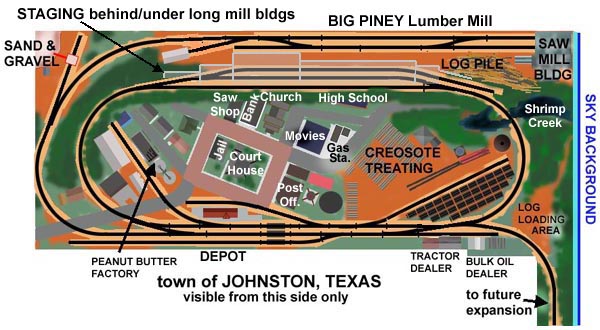
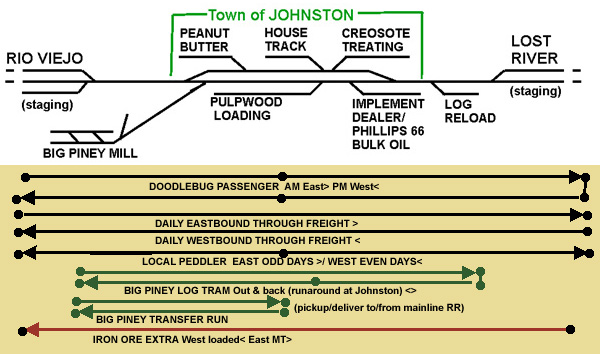
I modeled trains that came THROUGH this town, local peddler that originated elsewhere and a privately-owned shortline to a lumber mill.
(I ran all these trains at one time or another but there was not enough staging to run a full schedule in one session…)
There was a runaround and enginehouse for the shortline terminal, and an interchange spur at the main town scene, but nothing I called a yard. Perhaps this was partly my stubborn individuality at wanting a build a layout WITHOUT what many model railroaders consider indispensable.
I have long dreamed of a superduper layout that would include a “real” “working” yard, with a layout schematic like this:
The headlight is fabricated from a Microtrains bolster insert, with a grain of rice bulb stuffed into it. I filled the gap between the bulb and the insert with clear gloss medium, and painted the wires going down into the hull black so they don’t stand out.
A little putty a little paint, make it something that it ain’t!
This question once again begs the question, are building a display layout or an operating piece of a railroad? Where railfans hang out has nothing to do with the business of railroads or how they operate. Where railfans hang out is where they can get pictures of different trains or engines. So if given the choice of having 200 opportunities to photograph 1 switch engine in an afternoon or 10 opportunities to photograph different consists in an afternoon, they will go for the more varied consists. That has nothing to do with how the railroad operates, what it is or what it does.
If the question, “Where do railfans gather?” has any part in your decision on what to model, then I would say you want to concentrate more on display or running than switching.
That may be true for some (not everyone is interested in operations, and many don’t have much of an idea about how it works, either). However, just because someone wants to model photogenic scenes doesn’t necessarily preclude operations. While today’s experience may differ, unless you lived near a railyard, that was an unseen part of railroading, especially if your first contact with railroads, as a child, was in a small town or rural area. For me, even though I grew up in a city served by four railroads, my contact was with the trains that rolled past our front door, or, after my Dad finally got a car, with what rolled by when we were stopped at a crossing. A yard was somewhere that we couldn’t go, and, except for the odd occasion when we might have driven by one, there was not much to see other than whatever was on the track closest to the road - it blocked the view of everything else.
While sorting cars and blocking trains may be an interesting and integral part of model railroading for some, I find that I can accomplish the same results by doing so manually (0-5-0 method) on a staging track, cycling cars onto the layout and, once they eventually return to a staging track, forwarding them (again, with the 0-5-0, back to their box), which represents the rest of the North American rail network.
In the interim, those cars may be switched out of one train and into another, left on a siding for pick-up by another train, delivered, full or empty to a customer, then routed elsewhere to deliver a load (often off-layout) or returned to staging as an empty. They may spend only a couple of hours on the layout, or several operating days (which could be weeks or months of real time). In any case, they’re performing the same function as the
Never said they were exclusive. Never said you shouldn’t include photogenic scenes.
The discussion was about choosing what type of operations to have on the layout and choosing the location of the layout. My point was that if a person were selecting a location based on that being a popular place to photograph trains, that may mean the person’s interests aren’t necessarily operating and so they might want to design their layout more towards that interest. There was NO value judgement regarding one type over the other. It is merely that a person’s criteria can give an insight into what type of layout might meet their needs most.
That was not my suggestion, it was actually the opposite. If a person values a location that is a railfan hotspot then he should design towards that end. I’ve said all along that you can slice any piece you want out of a section of railroad, with yards or without.
Where railfans hang out is where they can get pictures of different trains or engines. So if given the choice of having 200 opportunities to photograph 1 switch engine in an afternoon or 10 opportunities to photograph different consists in an afternoon, they will go for the more varied consists. That has nothing to do with how the railroad operates, what it is or what it does.
Dave H
Dave,One can watch switching and still get 10 or more opportunities to photograph different consists at a yard throat and that can give a better “action” background in some cases instead of just another (yawn) 3/4 main line view…
 ]
]