In a way, I can understand Amtrak or other railroads shutting down with really nasty weather. They don’t have the personnel to keep everything moving as it should like they did years ago. Add to that many of the employees don’t live near the tracks anymore, they have to drive to work like everyone else does. Railroad workers walking to work are a athing of the past.
As good as that video I posted it, it give the wrong impression of NJ Transit trains today, so there’s no ol’ Jersey guy gloating from me how NJ Transit’s getting it done while Amtrak isn’t. From what I’ve been reading the whole NJ Transit system’s a shambles.
Seems like it’s been all downhill since Hurricane Sandy.
Yes the airlines did upgrade from the DC-3’s as the plane manufacturers used the knowledge they learned from the War to improve their products - DC-4, DC-6, DC-7 and then Douglas in the 60’s made the jump to the DC-8 and DC-9. By the time the DC-8 and DC-9’s became common air travel became the way to get there fast except in some rare corridors.
I thought I might return to the subject of the thread.
In Locomotive Profile 20 - The American 4-8-4s by Brian Reed, he refers to failures of axles and crank pins on 4-8-4s as being more frequent than on other types.
“High bearing loads on the main pins took their toll In one batch of 4-8-4 fast freighters 22 main pins went the full statuatory mileage of 250 00 without removal for wear or cracking but 25 others were removed for excessive wear or cracking but 25 others were removed for excessive wear after an average of 125 000 miles and three broke.”
This section is on pages 172 and 173 for those interested.
These loads and failures are indicated as a reason for the interest in duplex drive locomotives.
Thank you for the question, Firelock76. My answer is…Absolutely yes! it worth the expense and the risk; In hindsight, it was a must to achieve 100mph for some RRs business survival when competing with airlines, automobiles including motorcycle, and long distance coach services like the greyhound. As Balt and Overmod pointed out, which I absolutely agree that the ability to reach, or able to reach 100mph at an acceptable time was a basic requirement to maintain the schedule for a heavy consist at a rather slow average speed (less than 75mph), let alone beating the aircraft speed.
The postwar challenge to RRs passenger service involved the rapid development of airplanes which providing feasible high-frequency services and successfully eliminated almost all long-distance overnight through trains without encountering any difficulties; popularize of automobiles and long-distance coach services benefit from the Federal-Aid Highway Act of 1956. I think it was a reasonable act to concentrate the resource and men power for the development of aerospace engineering and automobile engineering. It was more in line with the national interests of the United States in the
But this is one of the very reasons the Good Lord invented tandem rods. It is hard to imagine a Niagara running very long at developed horsepower without the arrangement… or without Timken lightweight thin rods in the first place. Even then the loads might be conducive to pin cracking at speed.
And the arrangement of lightweight rods ‘as originally built’ would not just endanger main pins. Note the similarity of the Niagara layout to the original version on the J&W J class, with its long, tapered fourth-pair pins. Which cracked and fractured fairly readily at the speeds the balancing design otherwise facilitated. (I confess I don’t understand the reason the third-to-fourth rods weren’t carried inboard, like the first drivers’ set are, but doubtless maintenance was an important factor…)
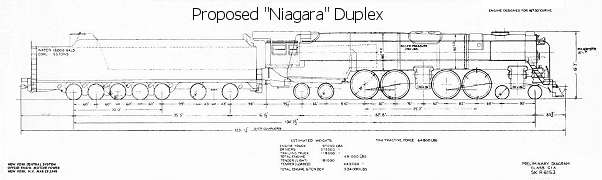
Bear in mind that in my opinion the drawing here is almost certainly a fake, probably by the same person that did the “Ohio” class 4-8-6 drawing (which is largely redrawn using Allegheny details). It does not reflect many of the significant details we know to be included in the C1a design (as of March 1945 … remember that date carefully) – the non-stop tender, outside-bearing lead truck, Baker gear, and workable smokebox length/Worthington heater position among them. On the other hand it does reflect that the C1a was intended to have as near a Niagara boiler as possible (and yes, I have to wonder if that might have resulted in a T1-like rapid retirement when the great boiler-alloy disaster became manifest…)
From peripheral discussion we know that at the time the C1a was going to be the high-speed passenger locomotive, and the 75"-drivered Niagara the successor to the L4s as a (somewhat) more capable freight engine, on a par with the Rock Island & D&H designs the Niagara was initially derived from. The 64T tender was an important part of this picture, as eliminating fuel stops gave a significant time saving on a number of prospective runs.
What happened, of course, was that the improved Niagara turned out to be most of the things the C1a intended, without the drawbacks and compromises that the duplex ‘state of the art’ then involved. I don’t remember if the S-class engines were pressure-derated because of bending rods (we had someone tell this as a Hudson story but it seems less likely to me) but if I recall correctly they were taken all the way down to 265psi and still, of course, fulfilled everything NYC could really demand of them.
The drawing was in Richard Leonard’s NYC Fantasy Steam
The Pennsylvania Railroad’s T-1 duplex drive locomotives, introduced in 1942 and produced in quantity in 1945-46, were the epitome of modern steam design in the United States with their poppet valves and striking “shark nose” streamlining. At the same time the New York Central was introducing its efficient but more conventional Niagara 4-8-4s.Not to be outdone by rival Pennsy, the Central’s Motive Power Engineering Department proposed a design for a duplexed version of the Niagara, to be classed C-1a. (See the 1945 elevation, below). Class C had been assigned to the 4-4-0 or American type on the New York Central, but by 1945 the last of the 4-4-0s in Class C97b had been retired for several years.
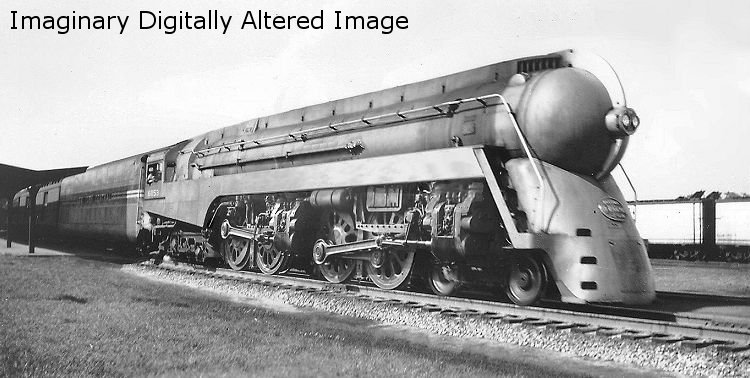
The elephant-eared Niagara duplex was never built. Instead the Central, working with favored builder American Locomotive Company, borrowed the Dreyfuss streamlining of the ten last J-3 Hudsons of 1938 to create a main line duplex passenger locomotive as striking as the P
Dr. Leonard said he got it from a physician circa 2010, who had scanned it from Staufer’s NYC Later Power. This and Staufer’s ink drawings were my only source for C1a tech material until Hugh Guillaume graciously sent scans of his copy of the March 1945 spec.
Good information. Have noticed you refer to the C1a on numerous occasions in several different threads. Too bad a prototype or a small run of them did not happen. Have to assume it was pretty darn close.
The rods were really in parallel rather than in tandem, thinking about the real meaning of the words. Tandem compounds had one cylinder in front of the other which is a correct use of the term.
And it doesn’t help that there are two different senses of ‘tandem’ applying to side-rod practice! (Neither of these having anything to do with tandem compounds…)
The earlier approach, which I believe was first used in the 1920s, used a combination of fork-and-blade rods and concentric bushings to spread the effective thrust of the main rod between the main pin it worked on and another pin, usually the one in the following driver.
The type seen on the Niagara (and the original J configuration) has two parallel thin Timken rods sandwiching the big end of the main rod, passing back to sandwich a single rod at the following driver pin. This puts all the thrust of the main in a straight line down three sets of drivers. (“Tandem” here being two side-by-side, as if ‘yoked’, as opposed to two in line as on captain/stoker bicycles)
It is interesting to compare the rod layout of the original and ‘revised’ versions of the N&W J, which we discussed several years ago here. That puts the big end completely outboard of the rod system, with only the valve eccentric crank further out.
Thank you, Overmod. I find this thread from 2005 created by forum member feltonhill, he provided even more background about “the sketch in Trains magazine”, I think he implied a sketch of a NYC C1a in the Trains mag but I am not sure if it was the same sketch I posted.
"feltonhill : I located the book you referenced which had more info than the sketch in Trains mag. Thanks for the info!
The drawing is dated 3/28/45. The Niagara test report was dated 7/3/48. Tests with 6023 were run 6/46 to 11/46. Tests with 5500 were run 6/47 to 11/47. As you can see, the tests were run after the C1a sketch was made. It was probably one of the considerations that came out of the design process for the Niagaras and Central’s awareness of PRR’s activity with the T1’s
I am reading the book “Know Thy Niagaras” by Thomas R. Gerbracht. In page 53, it shows a report of “Delays Chargeable to Engine” for the month of October 1948, when delays of Niagaras totaled 254 minutes due to various reasons; with thirteen failures and nine cut-outs.
The Niagaras were almost three years old at this time and had received Class 2 repairs in 1948 for boiler replacement and any other work required. Intensive use of these excellent engines caused excessive wear and tear, but there is no mention about this piston rod failure in the book.
I wonder if there was any other RRs 4-8-4s surpassed Niagaras’ workload in terms of average monthly mileage! The most interesting part of this book for me is the test result of S2a #5500 and production Niagaras as well as operating data compared with N&W Class J.
A very informative book with a lot of clear photos. (Why is there not a single book about PRR’s Duplexes? I wish I will see one in the future!)
Siri changes whole words on me all the time when I’m not looking.
One can really screw up when texting, it can lead to disaster!
Too bad about the New York Central thing … it’s the Water Level Route and You Can Sleep!
The NYC is my #1 US road because we spent summers and other occasions on a family farm right along the Canada Southern right of way.
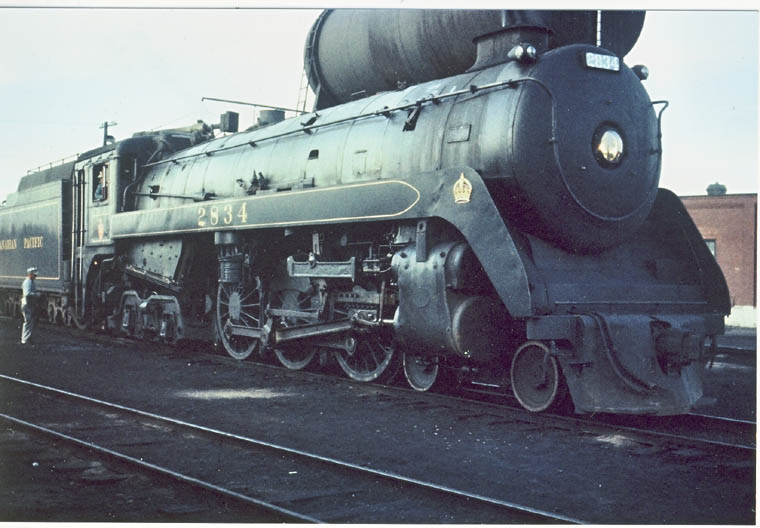
Let me tell you it was magnificient and magic. It was incredibly traumatic when the steam stopped. I detested the Diesels intensely but I still had the CPR and the CNR for another 5.5 years whistling away.
BUT… the Central’s Hudsons, Mohawks and Mikes and those 2 teapots in St. Thomas were unmatched really. Mind you I was just a wee gaffer and they were very special to me.
Yeah, change can drive you nuts, especially if you haven’t been asked about it first!
I look at it this way, when I visit New Jersey and see that Hiram’s Roadstand, the B&W Bakery, and the State Line Lookout Inn are still there, my unchanging constants in a changing age, then things aren’t so bad.
My other constant used to be Hiway Hobby House on Route 17 in Ramsey NJ. It’s where I used to blow all my money before I met Lady Firestorm. [:-^] It’s been gone for a while now. Hey, the owner wanted to retire and the kids didn’t want to take over the business, so what are you gonna do?