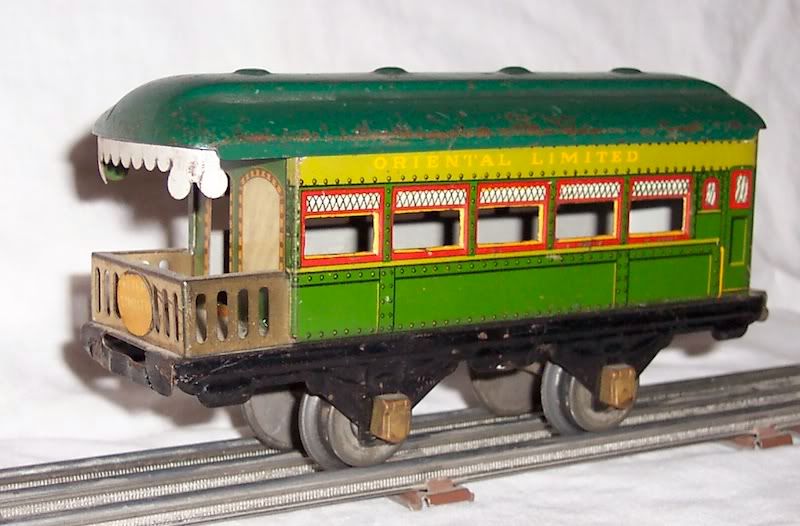
Here is the 3110 set that I have that was mom’s. It was purchased new in 1928, but it may be “last year"s stock.” The engine still runs good. We had to put new wheels on it, as the originals “ballooned” in the heat of the attic years ago. The letterboards do have “Oriental Limited” over the windows. There is also a yellow “medallion” on the back railing that says “Flyer Limited.” I have attached a pic of the rear of the observation car. 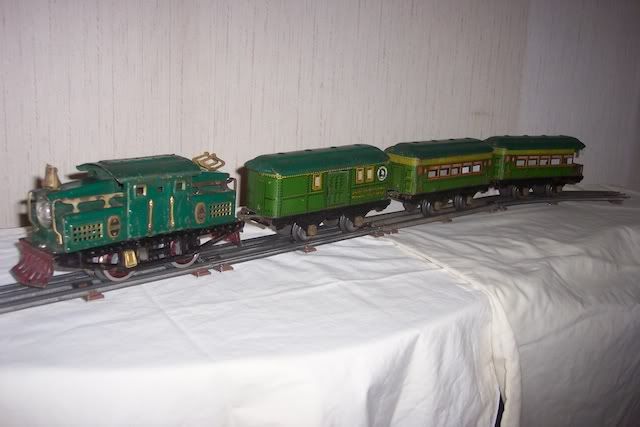
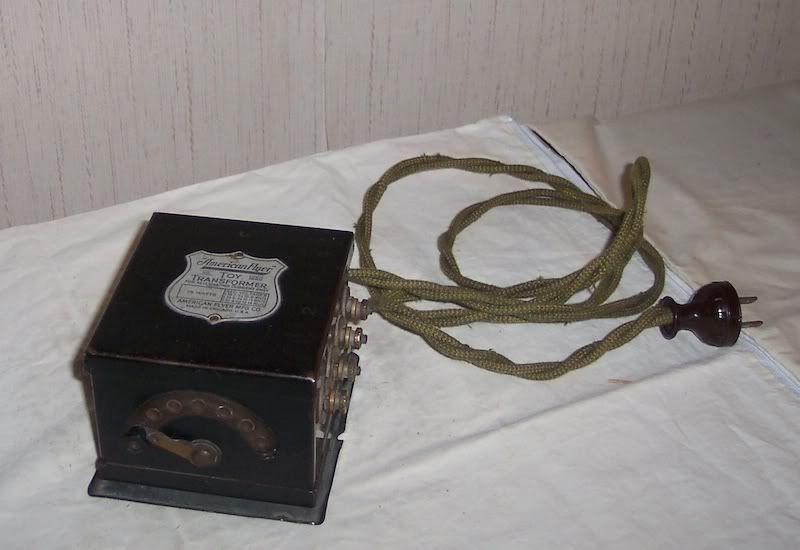
 And here is the original transformer that came with it, still works. I had to replace the cord, and was lucky to find a local hardware store that sold “braided iron cord,” so it matches the original cord. As the entire insides is sealed in potting material, I had to dig out the potting to replace the cord. I also have a friend that worked at an electronics firm that was able to repot the transformer for me.
  I also kept the original track, but it is too beat up to use anymore. And finally, here is a group shot of the 6 wooden houses. These also date from 1928. I do not know who they were made by, as there is no manufacturer’s mark that I can find. Originally, they had a light socket in the rear roof. My grandfather mounted them on a platform, and moved the lights to the bases inside, and plugged the holes in the roofs.
 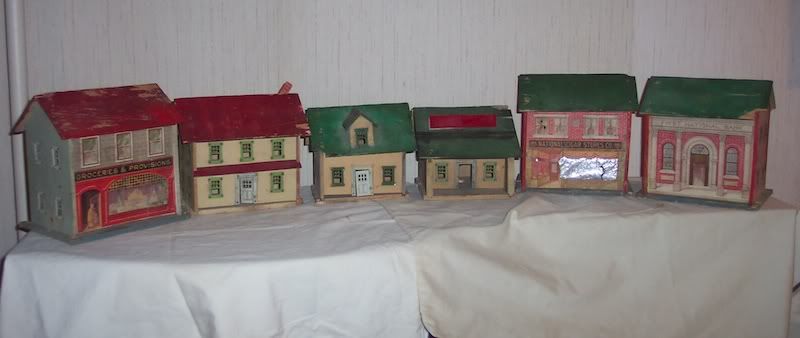 I have never seen other examples of these houses, which makes me wonder how may survived the 80+ years. They are as fragile as eggshells. They are definitely manufactured, not home made. I have close-up front and back pics, if desired, I can post them. I am in the process of repairing the platform, and will remount them. When i get it done, I will post a pic or two of the platform, much as it wo
Quick question for you, I have a 559, a 531 and a 534 all with their original RDC coils for the remote directional reverse. I always thought these used a DC pulse like the Lionel whistle and have had sporadic success using my KW and ZW to actuate the RDC coil. I guess I was wanting to know if the little RDC control button ( I belive the catalog calls it a 540 control button) has anything special in it. I would kind of like to find a couple so I could set up using all original controls with my 12B for these loco’s.
BTW, you nice City of Denver makes me want to put mine back together, its been in a box for about 8 years stripped and primed…
ironmaster,
The set that you inherited from your mother looks to be in great condition. Thanks for sharing the pictures and the story of its significance. I have never seen any buildings like the ones that you have. They are indeed a family treasure. You might want to post them as a seperate thread on the forum with a request for information. You will probably get a better response there. I know I would enjoy seeing the close up pictures that you have taken.
ogauge,
I’m afraid that I am not going to be much help to you either. I have almost no representative pieces from Gilbert’s 3/16 O gauge line. From what I can tell from the Greenberg guide you have almost the whole range of wheel arrangements that they offered during its brief 3 year existance. The only thing you lack is an example of the 0-8-0.
Here are some links to catalog pages:
534 http://www.myflyertrains.org/AF_Catalogs/1941Catalog/AF_1941_catalog_page6.htm
http://www.myflyertrains.org/AF_Catalogs/1941Catalog/AF_1941_catalog_page26.htm
I posted pics in a new thread. I included front and back pics of all the houses.
Here is the link.
http://cs.trains.com/trccs/forums/p/167497/1840217.aspx#1840217
The Ironmaster
3/16th O gauge is not well knoen by the collector or the operator groups. Many would say that American Flyer was only made in 2 rail S gauge. Some would remember that 3 rail tinplate O existed, less that Wide Gauge was made for years. But least known of all is 3/16th O.
I do not have the entire collection of 3/16th O, but do have a the 806 Northern 4-8-4 with Remote Directional Control (RDC). When a Lionel Transformer with whistle button has the button depressed, the engine will stop, when released, the engine will continue in it’s origional direction. Now, if the transformer control is brought to no voltage, the engine will also stop, and when voltage is again applied, it will be in neutral, and finally if cycled by the control arm once again, it will go into it’s origional direction.
RDC is a direct current signal carried in the third rail from the transformer (if Lionel whistle button) to the RDC controler in the American Flyer engine. An over-ride is available by means of a hole about the dimension of a regular paper-clip in the top of th boiler, if the AF button is not available and a whistle button is also not available. (A non-RDC will have a slot and metal flat on-off for FNR in the same location).
AF and Lionel have made controllers which will send a DC signal on the third rail. These DC signals controllers can be set to provide either a positive or a negative signal. At the same time as AF made RDC, they also made the #490 whistling baggage car. As they both responded to the same polarity, the whistling baggage could only be used with FNR non-RDC 3/16th engines.
Lionel at the same time of the late 30’s and early 40’s brought out their scale masterpiece Hudson for T-rail solid track and lesser detailed Hudsons which run on 72" Dia. Tubular track. This and Lionel’s B-6 were made with and without sound. When Lionel provided the equal of RDC, then they could not prov
Very true, Most don’t know its exists… and that is part of the fun!!! I got the 559 about 30 years ago and from that point studied as much as I could on the subject. I’ve had all but the 0-8-0 but admittedly a good portion of my 3/16th’s O Flyer has been what many would consider junk but I am happy to restore them. A few years ago I sold some of my favorites including a couple of 556’s and 561’s and a boxed passenger set among others… the sting is still present. Just recently I have aquired two 556’s a 553 and the 534 for a good price so I am once again smitten. I know what they are and truely belive they are all very much worth more than their postwar S counterparts (of which I have a few)… but thats just one guys opinion… They sure are tougher to find in any kind of usable condition!!! I’ll have to post some pics of my “junk”
Happy 2nd Anniversary
Two years ago today I posted the first entry on this thread. When I started it I never expected that I would still be posting photos and stories to it. And I didn’t envision the number of folks who would participate by posting photos, and their own stories and asking questions. It has been a great deal of fun for me; taking and posting photos, making strategic purchases to expand my collection and then sharing them with readers, waiting to see what the next post might be and by whom, and attempting to answer questions that have been posted. It has been a lot of fun and I have learned a lot. Its been my therapy, and I can tell you it has been very satisfying.
I want to thank all those who have posted to this thread. It would not be what it is today without their participation. And thanks to all of you who have read it. I hope that it has provided as much fun and enjoyment to you as it has to me. I also hope that it has provided a source of information.
One of my favorite catalog covers from American Flyer’s Prewar era is the cover from 1936.

It has been one of my collecting goals to be able to reproduce that cover with the models produced by Flyer contained in the catalog. It has taken a number of years, but with the help of Santa and his elves I can finally do it. I added the Union Pacific set recently.
So here is my anniversary gift and greeting to all of us who enjoy Prewar American Flyer trains.
Greg, thank you. I may not be a frequent contributor to this thread, but I do enjoy the stories and pictures. I’m sure this thread will be a source of Flyer reference for years to come.
Cheers,
Graeme, Scotland
Northwoods Flyer,
Thanks for being such a great resource on all things American Flyer! I’ve spent several late nights (and early mornings) reading and researching AF history through this thread. I found our AF structures (mid- to late 1930’s) here, along with my dad’s train, the Pennsy passenger train set (steam locomotive, tender and three red cars) first offered in 1936. What a great catalog! That said, do you know how long AF sold the Pennsy passenger train set? (Any history would be appreciated. My dad believes he received his train as a Christmas present in 1939.) Any ideas on value today? (I never see one on eBay.)
Thanks again!
geeppe,
Hi Graeme, Its nice to hear from you and have you pay the thread a visit. I have appreciated seeing photos of your collection, and I think you provided a link to some video at one time. Please contribute anytime you have the opportunity. Do you have any examples of British Flyer?
O-GaugeOscar,
[#welcome] to the thread. Thank you for your kind words. I’m glad that it has provide you with some entertainment (and bags under your eyes? [;)] ) and that it has helped you find some information about your family trains. Your questions about your American Flyer Pennsylvania Passenger set sound deceptively easy to answer, but they point out the discrepencies that exist in resource material about Flyer, and the inconsistencies that Flyer has in their own catalog.
The very simple answer is that the Pennsylvania Passenger set was first cataloged in 1936 as set number 1710-RT

and appeared again in 1937 using basically the same catalog illustration and description but had a different set number of 1715.
By 1938 A.C. Gilbert had taken over the company and changes were taking place. The catalogs looked very different and the descriptions of items changed as did the items themselves. There is a Pennsylvania Passenger set labeled as Train Set No 2. I believe that is a misprint and should be Train Set No.3 (which is hand written in my original catalog), sin
Northwoods Flyer,
Very interesting…thanks for the additional insights on the Pennsy passenger set. I didn’t realize Gilbert took over American Flyer in 1938. Was AF bankrupt? Did Gilbert purchase only the assets - existing merchandise inventory, trademarks, patents, etc?
As for posting photos, I’ll first have to open an account at a photo hosting website (any recommendations?). Unfortunately, I start a new work project this weekend, so I may be delayed…
Thanks again.
O-GaugeOscar,
From what I have read, American Flyer was not doing well in the late 1930’s as far as sales are concerned. In 1938 W.O. Coleman, who owned American Flyer sold (or as the story goes - “gave”) the company to A.C. Gilbert. Coleman wanted to be rid of the ailing company. At the time Gilbert made Mysto Magic Sets and of course one of the other toys that every boy wanted - Erector Sets.
The story goes that Coleman and Gilbert were shooting at Gilbert’s private game reserve in New Haven when Gilbert mentioned he was thinking about manufacturing toy trains. Instead, Coleman said he would give his struggling American Flyer Company to Gilbert in return for a share of the profits. Gilbert quickly agreed and the deal was completed within a short time.
Gilbert soon moved the company from Chicago (hence why earlier examples of American Flyer trains made during the Coleman era are referred to as “Chicago” Flyer) to New Haven Connecticut and he redesigned the product line. Gilbert pioneered 3/16" O gauge in 1939. Apparently Gilbert aquired everything American Flyer in the deal since the older designs of Flyer continued in the catalogs through 1940. By 1941 the old designs were gone from the catalogs. I have read somewhere too that all of the employees from the Chicago factory were offered positions in the new location in New Haven and that a number of them made the move.
This is a link to a great site to do research on the Gilbert era trains. It has most of the catalogs posted for the years 1938 to the end. I have linked to it serveral times on the thread.
Enjoying
Streamlined Sets
The Burlington Zephyr
I have posted photos of the Burlington Zephyr previously on the thread, but I thought I would follow through with the theme of streamliners for a while or at least until I run out of examples.
According to the Greenburg Guide to American Flyer Prewar O Gauge, Flyer introduced its strealined sets with the cast aluminum Burlington Zephyr. It was cataloged from 1934 to 1938.
1935 Catalog Cover

1934 Catalog

During those years it appeared in the catalog in a number of forms. I believe that this is the 1934 version, which is a three car set.
3020 Large Boxcab
In 1922 American Flyer added large boxcab electric-outline locomotives to its line of trains. The 3020 was first cataloged in 1922 and ran through 1925. It was patterned after the New York Central’s Twentieth Century. It is an impressive 12 1/2 " long.
This is the dark green version with red windows (version C)

The number 3020 and ownership are rubber stamped at each end.


The distinctive pony trucks add to its impressive and powerful appearance. You can tell it is related to its cousin used to run the President’s Special in Wide Gauge.

It makes me wish that American Flyer had actually manufactured Narrow
Northwoods…I feel like a freakin’ voyeur. Thanks for your continued dedication to this superb thread.
Jack
Jack,
Thanks for the compliment. Your comment has me wondering exactly what it is I have posted on the thread. [:O]
I haven’t been found anything risque yet that I posted [X-)].
I’m just glad you have found a certain level of excitement at looking at Prewar beauties. [:I]
Large Box Cabs
Since I posted pictures of the queen of the fleet of electrics in the last entry I thought I would post some photos of additional engines that classify as large box cabs.
3015
The American Flyer 3015 Box Cab loco was available in 1927, and shares a body with locos 3019 and 3020. The body color is medium green, with a length of 10 1/2 inches and a track activated reverse.

3019
This New York Central type large box cab was available in 1923-1924. It looks like a 3020 without the pony trucks. It is also 10 1/2 inches long. It comes in several colors. I don’t have an example of this engine in my collection at this time.
3020
By the way…I have emailed Eric Trickel several times in the last couple of months, with no response. Anyone have contact with him recently? Really want to get restoring my 1938 Flyer…thanks!
Also…I cleaned and oiled my 1938 Flyer today and put it on a Fastrack O-guage track with a Lionel 80 watt transformer. It runs backwards. I do not see a switch anywhere on the engine that would reverse the loco. Any ideas on what is going on? It’s beautiful to see it run for the first time…but would like to see it run FORWARDS! Haa… thanks guys.
DocBen,
Congratulations on getting the 4615-6 from your set to run. [:)][yeah] And if all you had to do was oil it and set it on the track its a testimony to the endurance and reliability of these old “toys” Unfortunately I don’t have an example of this engine in my collection to look at. My assumption is that because it is an engine produced under Gilbert ownership - that it has the typical e unit from that era. I’m not particularly knowledge about about the electronics of those engines (maybe someday when I retire). One of the other folks who is familiar with the inner workings of the engines can help. I’m wondering if it has anything to do with your use of the modern Lionel transformer.
Enjoying the World’s Greatest Hobby
Northwoods Flyer
So I’m reading through the 1938 catalog, and I see that in page 2, it says “All locomotives are equipped with remote-control reverse motors”. Does anyone else have a locomotive from this era that they run on Fastrack with a Lionel transformer? I guess my question is…is there is separate reverse motor in these trains? If so, how is it remote-controlled? I looked at the transformer that came with the set, and it is the #7 75W unit. There is no reverser on the transformer. I see no switch on the engine. Anyone have any insight on what a remote controller would look like for this, or how it would work. It runs very nicely in reverse. Nothing so far gets it to kick over to forward drive. It’s gotta be something simple…My father-in-law wouldn’t have possessed a train that didn’t run forwards.