Scale Trains

I can assure you, a great many of the passenger cars that ran in North America in the last 120 years will never get enough preorders to justify the tooling.

And that even includes big railroads like the B&O who took heavyweight cars bought from Pullman in 1948 and rebuilt them in the B&O shops into what at first glance are streamlined modern cars - but they are not underneith.

One off cars, built by and used only by the B&O, each one or two completely unique, never passed on to AMTRAK, yet desirable to any B&O modeler of that period.

Many of which have only been done once or twice in brass over the last 40-50 years…

Sheldon

I model a specific railroad. I want the specific cars that would be found on the railroad. Incorrect models have no interest to me, it is not a fantasy.

That’s fine, but what do you do when those models do not exist?

Do you scratch build them yourself?

Do you select a different railroad to model?

Do you select a different era to model?

Do you pay professionals to build the models for you?

And how close is close enough? Or how wrong is too wrong?

I’m not judging here, I’m asking practical questions?

I model the early 50’s, and I want a big enough layout to pull realistic length trains. I have the room, the resources, and as I approach retirement, the time.

That means I need 100 50’s era piggyback flat cars, for one east bound train, one west bound train, and some cars in the piggy yard.

Show me the selection of accurate high detail 50’s piggyback cars that have been offered RTR, or even in kit form, in the last decade or two?

They don’t really exist. Especially considering that most early 50’s piggyback cars were railroad shop conversions of existing flat cars or homebuilt from old boxcar underframes.

No two railroads did exactly the same thing, and even if I was inclined to scratch build 100 flat cars, detailed documentation is sketchy at best, few drawings, mostly just distant shot old photos.

Please ex

I do get it, but I don’t subscribe to limitations like that. If I decide to have a piece of rolling stock that was used by a particular railroad, I might settle for a model that’s fairly close to the prototype, then tweak it a bit to bring it a little closer to the real one.
Sometimes, I’ll go to more extreme lengths, but for things I’m unable to do (or am disinterested in), that’s the point where I consider it good enough.

Some may reach that point sooner, and some later, but I certainly wouldn’t agonise over it if I feel that I’ve done my best…ya gotta know yer limitations.

If I later decide to sell that model, there might be a good response because it’s fairly true to its prototype, but there could also be someone out there who initially wants it too…until he notices that something’s not quite the way it should be. Do I care? Do the majority of potential buyers care?

When I model a prototype, whether for myself or for a friend, I try to be as true to the prototype as possible, but my skills have limits, as does my time to devote to a project. There’s a point where it’s “good enough” - my “good enough” is past that of some modellers, and nowhere near that of many others.

For me, perfection is the golden ring for which I can’t be bothered to even reach, let alone grasp. I much prefer to do my best, and leave it at that…freelancing some stuff and attempting to replicate prototypes gives me free reign to do what interests me best at given anytime.

If I were limited or not having a good time, I wouldn’t be in this hobby. Others may have a different opinion, or different goals.

Wayne

richhotrain,
Yes, of course manufacturers prefer to err on the side of caution. After all, it’s their house payment/college tuition fund/food-on-their-table income. They’d rather make 1000 things and be short by 200 units than make 1200 things and end up sitting on 200 unsold units. Making too few just means that their profit isn’t as high as it could be; making too many means losing your shirt and going out of business.

Speaking of Monon, a friend of mine purchased a small train’s worth of Rapido cars for Monon (4 or 5), the Athearn Genesis F-units, and a Walthers troop sleeper conversion. All because he had one of those Howard Fogg posters on his wall as a kid. BTW, there’s a Rapido Monon coach on that auction site right now for $230(!).

There’s one big problem with your idea of having a generic coach available in “any” paint scheme…namely, there was well over 150 Class I railroads. How many is “any”? All of them? Who’s going to make them? The only way these things are affordable is if they make at least 200 of them per scheme. Even if they only made 100 different Class I paint schemes, that’s 20,000 cars to stock. And even at a very mild $50 per car, that’s $1,000,000 of inventory. Who’s willing to risk a million bucks making generic passenger cars?

Sheldon,
I used to buy generic passenger cars (and engines, cabooses, etc.) painted in my road of choice. I no longer am willing to do so. Why the change? Because in the 1990s there was no choice. If I wanted anything in my road, I had to make do. Sure, I could customize it (and sometimes I did), but generic models were the rule. It was either that or expensive brass or difficult-to-build resin kits. Today, all the major classes of diesels of my road are available, plus some steam and even some electrics, both major class

Yep, that’s what happens when a limited run is discontinued. Price gouging!

The MSRP was $84.95 when Rapido originally produced the coach car. Inventory quickly ran out with discounted prices as low as $60. To the swift go the spoils.

Rich

Paul, I’m going to try and be brief here.

I model 1954, many roads had JUST ENTERED piggyback and were still converting 50’ -53’ flats to piggyback and were still building single van 40’ piggyback cars.

I know the NH piggy history pretty well, they were an early inovator, but they are not the only railroad in North America.

I have a nice size fleet of the Walthers 75’ cars, but they were actually brand new in 54’ with the first of them having just been built the year before. But PRR and Wabash were the only early users of them (and of course the ACR).

And there are lots of photos showing all types of 40’ and 53’ cars still in use well into the 1960’s.

The Walthers 53’ GSC cars were rare in piggy service, but it is a nice enough model, I have them as well.

Even back in the day I was not painting any Athearn ATSF cabooses in eastern or freelanced roadnames…

1930’s piggys, sure, 50’/53’ cars with two vans on about 3 railroads that never/seldom left their home road trackage.

And still there are no B&O converted heavyweights except brass and not many of them…

Still happy to be modeling the B&O, C&O, WM and protolancing…

And again, reagarding passenger car lengths, the NH was not the only railroad in North America…

And I am still asking the same question, even with all these great models, what does one do for the stuff that has not been made? It is easy to talk about what has been made, but that is far from being everything desirable for many roads.

And again, I don’t freelance for the reason Tony did…

Sheldon

That is an option that I have done in the past, along with kit bashing.

Sigh. Nope

Deeper sigh.

Anytime you buy a RTR model, you are doing that.

As I get older and models get better, I demand more and more. I recently purchased some 40’ Tanget box cars that are spot on. It permitted me to sell some Intermountain cars that I had that used to

Its always interesting to read different points of view. Sheldon has repeated his many times here, so there is not much need to ask him.

But in answering his questions, is it safe to say that the simple answer is , no, you don’t wait for a manufacturer to build the correct models?

You mentioned scratchbuilding, kitbashing, and selling previously purchased models when the producer makes an upgraded model (so you have purchased good enough versions that you now sell.)

It sounds like you actually approach the hobby pretty mainstream; looking at the situation totally.

At this point in my life, I do. I have scrathbuilt and kitbashed in the past, not anymore. I will add detail to a model that is lacking, but there is not the need for that as much in the past.

I still have some stuff that I once considered “good enough”. When I was young, a 40’ box car was a 40’ box car. The internet has permitted me to research models before I buy them. So I still have a few Intermountain or Red Caboose stuff from the 90’s that are not correct. They are being replaced.

Good to know, and I didn’t really think that I was that far off of center.

n012944,

OK, I will explain how I am more like you on some points, and not at all on other points.

I like well detailed correct models, I have lots of them, some RTR, some built from craftsman kits, some kitbashed or upgraded from lessor products.

Stuff like Kadee, Intermountain (which in the era I model are all pretty good), FoxValley, Spring Mills Depot, Proto2000, F&C, Tichy, and others.

I have some of the Rapido F30 flat cars on preorder.

I already have a bunch of the Walthers flat car you linked to, a model they have made in both kit and RTR for three decades or more. A nice model, but not overly detailed. It is a good model of a GSC cast frame flat car, but VERY FEW of those were ever converted to piggy service. By my standards they are close enough to add some variety to the fleet.

I also have a sizable fleet of Wathers F39 75’ cars, a great many lettered PRR.

You mentioned the Athearn car, they are what you see in the photo of the SP cars. It is very generic and not very correct as offered by Athearn. Those shown and many more like them in my fleet have been modified to be more correct, but are still very “generic”.

If you compare my photo to actual SP piggy train photos, the effect is pretty good.

I “fix” the Athearn vans to make them more correct. I fix the flat car side rails, I add bridge plates, and put better trucks on them. Some are my paint jobs, some are Athearn paint jobs.
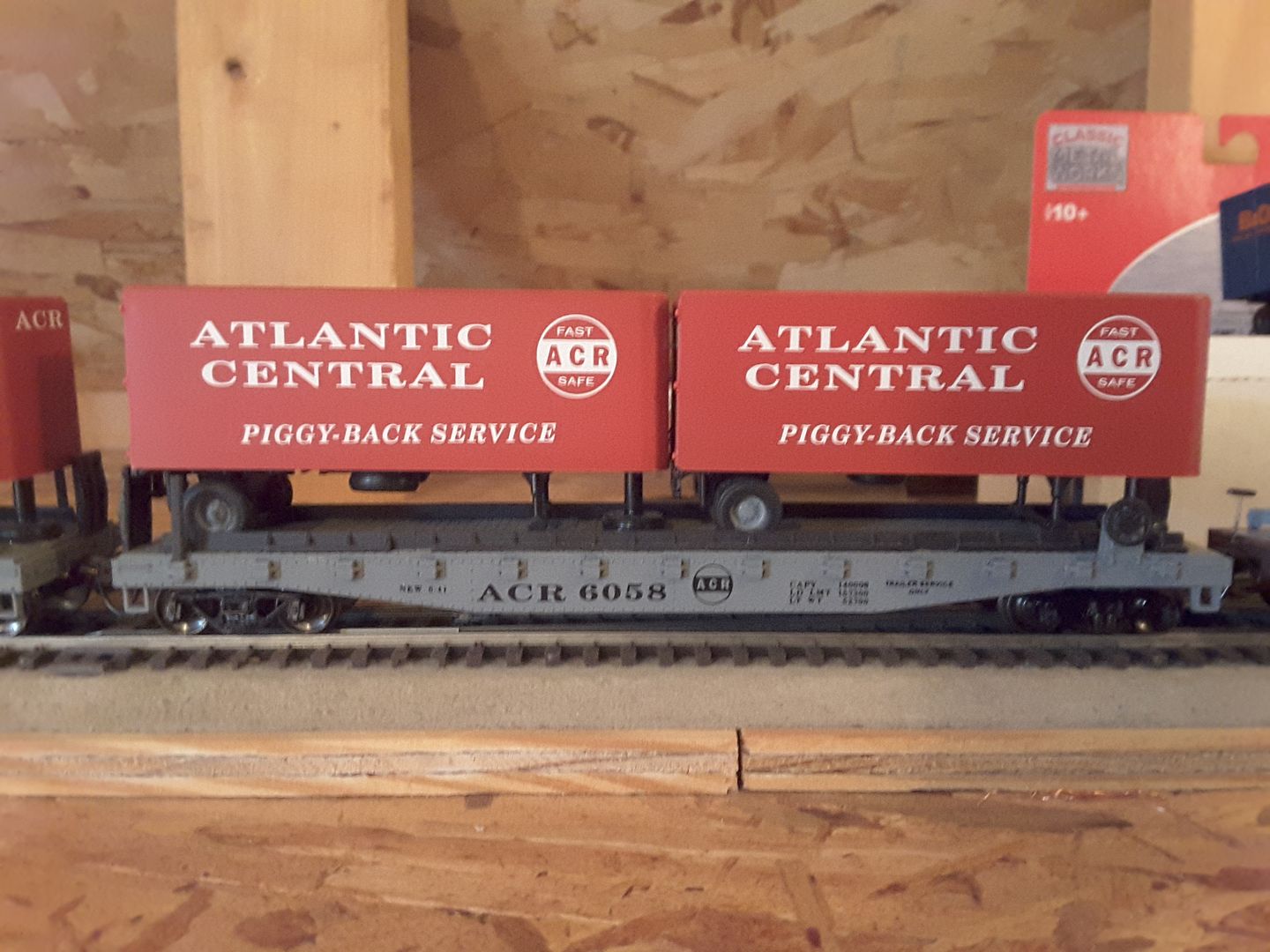
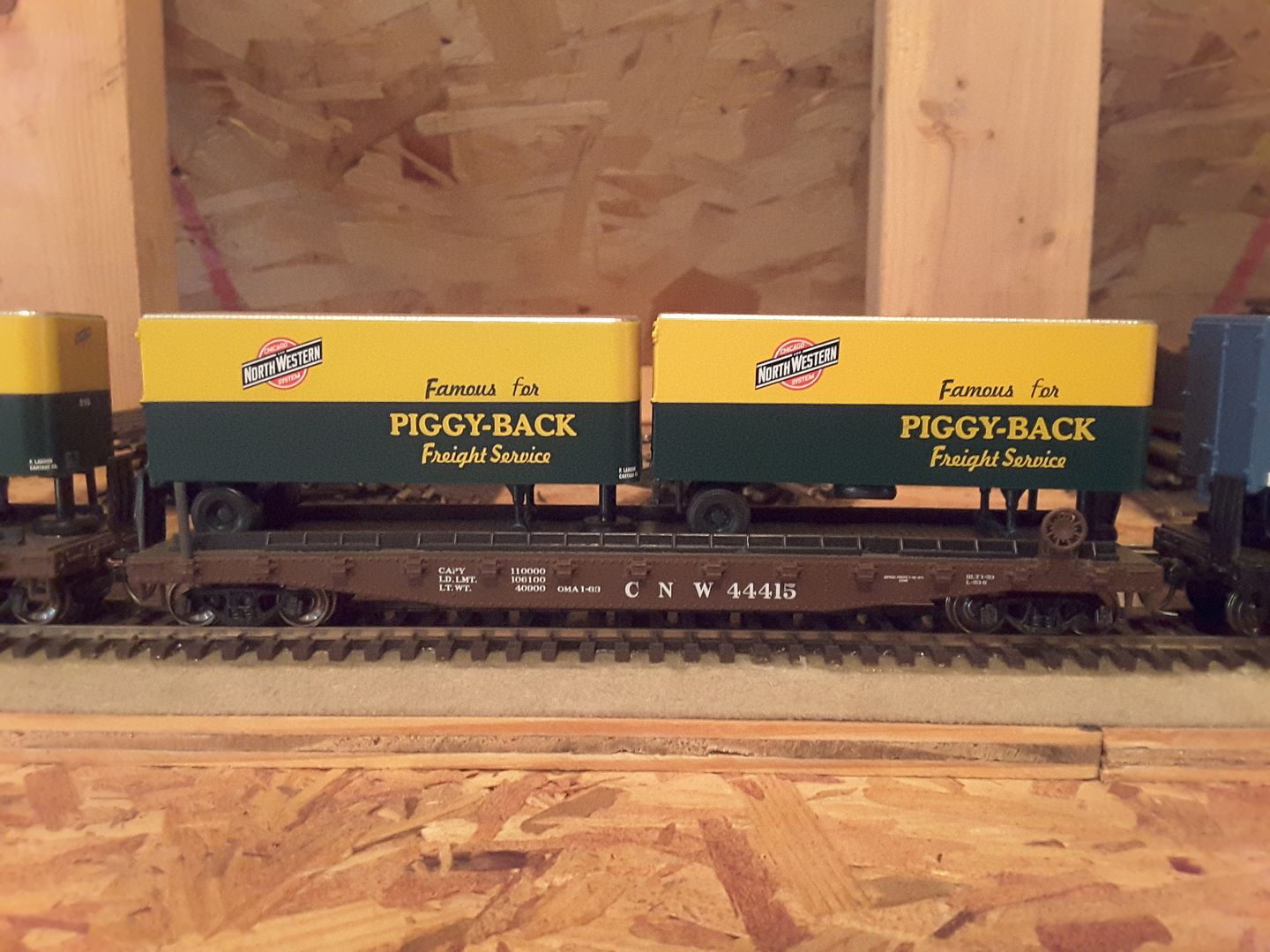
No weathering yet when these photos were taken.

I take no issue with you or anyone who wants better models, as stated above, I have my share.

But here is where we differ. I’m not replacing what I already have

Well, hang on a minute. There aren’t 150 railroads to worry about. Vast chunks were paper railroads, subsidiaries, wouldn’t have owned the specific category of railcar, or exited the passenger business early.

Well, maybe 150, maybe not, but a review of some NMRA data sheet info, D9h.1, lists 79 lines that offered passenger service as of August 1954. There is nothing in that info to suggest it is a complete list. It is simply a list of major carriers, their official names, heralds, track mileage, and indication of freght, passenger or both.

Sure, even some pretty major freight carriers had minimal passenger service. The Western Maryland only had coaches, combines, baggage, RPO’s and two private company cars.

But Paul is right, it would be massive for manufacturers to make “every roadname”, even on generic cars.

ConCor has 32 different paint schemes currently listed on their 72’ streamliners, they use to have at least a dozen more schemes.

And as I keep saying, much of the nations passenger fleet were designs built in very limited quantities, often a quantity of one…

If you count all reporting marks of cars in interchange service, there were way more than 150 railroad “companies” prior to the 60’s mergers. Clearly not all those represented passenger carriers.

But in any case, it’s a lot more than a dozen or two…

Sheldon

Sure, it would be massive for manufacturers to “make” every roadname. But, wouldn’t there be some way to have paint schemes “available” to make a small run of a specific railroad upon demand?

Back in the day, when stuff was still made here, companies like BevBel, Bowser, and others bought undecorated Athearn passenger cars bulk and lettered them for less popular roads or simply paint schemes Athearn did not make.

But again, a generic shorter car with minimal detail.

I will use the B&O for example, from 1930 to 1968 the B&O had at least five different passenger paint schemes depending on how you define them. In 1968 you could still find cars in all five paint schemes…

Athearn only offered one scheme on each type of car, streamlined and heavyweight, and never really had them correct. So some of these schemes have been offered by others over the years.

The selection and correctness of B&O passenger cars is limited even today.

Sheldon

That’s how pre-order works.

The capability is there and has been for a while.

Insufficient demand is likely the obstacle to production.

Even a whole car can be more or less custom built on an assembly line these days. I’ve seen the Jaguar factory build cars this way. The paint booths can switch colours between cars. The interiors are matched by computer bar coding, just in time organized parts supply and computer assisted and robotic assembly methods, all computer scheduled.

I pre-ordered my current Jaguar this way for no extra charge. Most cars sold in Europe now are pre-ordered and only actually built after the sale has been confirmed. Some dealer stock is made but most is manufactured after the demand has been aggregated by dealers.

Computerized manufacture of model locomotives and rolling stock would be child’s play by comparison.

Ok, so simply put, you still play with trains that yo

Genericized PS-1 boxcars and PS-2 covered hoppers have even larger demands for “every road name” and that doesn’t seem to slow anyone down.

I suspect the real hurdle is that passenger modelers tend to be few and far between, and the ones that do exist are rather meticulous in their demands.

Well, being the age I am, and the era I model, I can’t imagine trains without both passenger and freight operations, but I get what you are saying.

Sheldon

“Trains” or layouts?

Rich