If I had a narrow space to deal with, and wanted to have both a passing siding and a double-ended track to serve multiple industries, I would run the main line down the center of the space, and place the house (industrial) track to the back of the scene, using building flats or low-relief structures to represent the industries. Then I would put the passing track on the aisle (outside) portion of the scene. The house track, main line, and passing track could all run parallel to one another, and take up a total width of about 10 inches in HO scale.
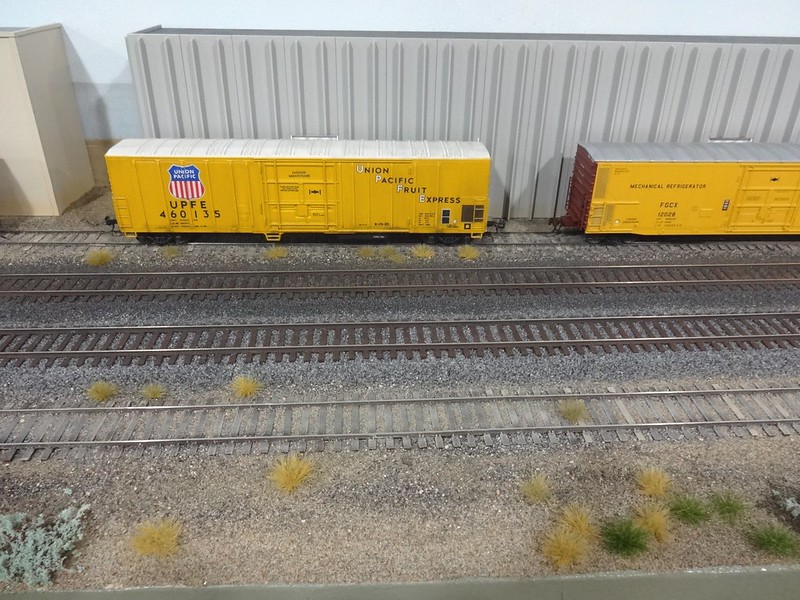
To illustrate how do-able that is, here’s a location on my layout with a main, passing siding, company set-out track, industry spur, and building flats. Benchwork is 12" deep. Remove one track and you could get by with 10".
Kkbridge and wp8thsub hit the nail on the head. Thank you. My track plan, thus far, is still only in my head.
Since the prototype does it for a variety of reasons (as the ACR was discussed as an extreme example) – maybe they don’t feel obligated to follow the rigid interepretations that model railroaders sometime impose on themselves? – to suggest a hard and fast rule about it for model design and operations seems overly rigid.
Except for rare occassions, the typically sized layout would not have more than one or two siding with this dual use at a time. I don’t believe anyone suggested creatuing a layout based on such a concept. Likewise, we should remember the changes wrought by time. Most of those ACR sidings formerly hosted more active tgraffic &nb
Indeed Mike…All things railroad will nip you in the end because railroads do what the must to get the job done.A obsolete passing siding could become a transload track with or without a rail owned (contractor operated) distribution center.
Their thoughts would be simple-why build a new siding when we can used a old passing siding that we never used? A paved area for trucks and bingo you can now efficiently unload tank cars and covered hoppers for off line customers.The results of the savings of using that passing siding instead of building a new siding would be seen in the bottom line…
As far as operation railroaders must abide by very ridged rules from the company and the Feds.Grant it back in the day old head conductors knew what rules could be bent and those that can’t…Try that today and you will be taken out of service and get street time or fired.That doesn’t mean we must be that ridged in our operations though…
I agree with Cuyama 100%. The use of the term “passing siding” inferrs that it will be used for two trains to pass, and frequently, that is its primary purpose. No, it should not also be used as a industrial spur.
If it is “abanoned passing siding” or a seldom used passing siding, then it would be a spur and the assumption for how it is used changes so the answer may change.
The best advice to give the OP is, that if he wants a passing siding and industries along the same linear footage of benchwork, then he will need to plan for the tracks to be three deep.
No, the prototype does not do it. The ACR situation was disused sidings as long-term storage, not the Original Poster’s single combined siding/active industry track.
Again, not the Original Poster’s question. He mentioned specifically a single track being used as both an active passing siding and an active industry siding at the same time. [By the way, every transload facility I’ve seen has been set away from the running track a greater distance than a former passing siding would have been to allow for safe loading and unloading of commodities.]
Why anyone would want to confuse a poster with comments and examples that are not answers to his question is always puzzling to me.
Now that all of the experts have chimes in - I have to agree that most passing sidings are kept clear for meets between trains. However, even back in the old days, there were passing sidings that has industries on them. The ETT clearly stated which ones were affected, and noted that the siding may not be available. Some railroads handled this with a ‘Blocked Siding Order’. I am looking at a couple of old Milw ETT’s from the 50’s. For some stations they note that the house track is considered the passing siding, but may be occupied. I guess that is what the ‘Blocked Siding Order’ is used for.
Myself, I try to keep the passing siding clear on my layout…[:)]
Jim
Doc Wayne
Not wishing to hijack this thread (sorry) But in your picture, the grain elevator, who is the manufacturer? (assuming it’s not scratchbuilt)
I love it. [tup]
Thanks
If the argument here is about semantics, I happen to agree with you. A passing siding is a passing siding. Simple enough.
But if we want to discuss what happens in the real world, well, best I can say at this point is that labels are interchangeable. When something changes, change the label if the old one doesn’t apply. That what the RR does, as Jim noted, one way is in the ETT notes.
Then their is the layout. I know the hobby as a whole tends to obsess about the prototype because…well, it’s stylish. I do it myself. But in the end, it’s still a model RR layout. Since this was not posted in the Prototype Forum, but in the Layouts Forum, I think a discussion of what model RRers do is relevant. For whatever reason - space, time, money, etc - it’s not always possible to follow strictly prototypical practices. You do your best – and there is no shame in fudging things here and there if we must. I always say it’s important to know the rules well if you intend to break them. So your words of wisdom are still apt, just not the only relevant POV on the matter.
Some railroads has indeed used former passing sidings for transload tracks like I stated.Of course these are usually found on downsized main lines.As far as being to close…There would be no need to next to the main track since the unloading devices would be in the paved unloading area.
A pump and a hose between the car and trailer is all that is needed to unload tank cars or covered hoppers.Not a very fancy setup.
The original question wasn’t about anything changing; it was about the two functions simultaneously occurring on the same track. Not via a long term change documented in the ETT or orders issued on a Form 19, or anything of that nature. Since the Original Poster now indicates that he hasn’t even drawn a track plan yet, why not help him do it the most plausible and realistic way instead of indulging in flights of fancy, one-ofs, and could-have-beens?
It’s theoretically possible to install an engine service turntable directly on a main line. And it may even have been done in real life somewhere in some bizarre scenario. But it’s a bad practice.
My suggestions aren’t driven by slavish devotion to the prototype; they reflect what has been found to work the best in the most situations … either on the prototype or the model.
But others prefer unicorns to plow horses, so carry on.
A Passing Siding is under the control of CTC. If they give you a Warrant to use it for other purposes, you may do so. When the warrant expires, you must clear the siding just as you would the main track.
Their used to be a passing siding in Richardton, but when trains got longer they took it out. You cannot block all three crossings, now can you. Passing sidings tend to be out of town, work sidings tend to be in town.
LIONS tend ot be found in a cage in the zoo.
ROAR
But only in Centralized Traffic Control territorry. Depending on era and locaton, that may be another exception to the rule, but just that: an exception.
The good folks in the MOW and operations can take a passing siding out of service to store camp cars for a track project-this of course is limited time deal.
The DS will tag that siding as out of service and will work his meets at other sidings-the ones that pays the price for the longer delay at meets is the train crew and customers and now add the slow order through the work site and its not a very pretty picture.
Anybody that believes railroading is cut and dry is believing a myth.
Absolutely true. Back when I was in train service on the Milwaukee Road, I was familiar with the Timetable Special Instruction that said when occupied outfit cars were placed on a siding both switches had to be spiked closed.
And cars could be left on sidings, so long as that was consistent with authority, whether it be by Special Instruction in the employee timetable, train order, bulletin on the bulletin board or oral instruction from the dispatcher. Likewise, team tracks could be designated as sidings, and sidings as team tracks by Special Instruction. More recently, as Lion points out, I guess it can be done by Track Warrant. But if a siding is obstructed, operations in its vicinity get more difficult. Now, that may be the object of an operating session, which can be varied to increase “play value” or interest generally.
All of which is fine and good, but the original poster just wanted to know if, on a narrow shelf layout, he needed to have lineside industries located on his passing siding, or whether there were other options. The answer is, sure, on a 12" wide shelf in HO you can have an industrial (house) track, a main line, and a generally-unobstructed passing siding, as illustrated in a photo of a really realistic looking scene of that kind.
Nah, no need for unicorns or plowhorse’s here. I actually model a prototype with a turntable on the main (Silverton RR), but just not enough space to model it so that I didn’t.
I think your point is an important one: Consider the way things are usually done. Sometimes you do that until it turns out that something else may need to be considered. That’s all. No need for a unicorn roundup.
Absolutely…Looking at my old Slate Creek ISL one could easily see my short runaround track could be used as a short passing siding if one turned the clock back to th 20-30s and say that was a branch line and that’s where the daily local met #134 the branch passenger train.

I live in a small town (Clinton, MO) and we’re served by the Missouri Northen Arkansas. There is an oil distribution company here in town and new tankers are brought in every week. They arrive in town trailing the locomotive, so there is a passing siding to place the locomotive behind them. My girlfriend and I spent about an hour train railfanning the train, watching it place the new tank cars on another siding, retrieve the ones from the plant, spot the new ones and haul the empties away. Made for a fun part of an afternoon.
Yes you can… trust me seen it and switch lines like that myself.