Lets assume you are going to use a 2-56 screw. That size fits most coupler boxes and couplers. For 2-56 the tap drill (drill that leaves enough metal for the tap to cut threads in, is a #50 or #51. The clear drill (lets the 2-46 screw go clear thru, no threads, like the hole in a washer) is #41. It may require quite a bit of filing or Dremeling to open the hole in that pilot big enough to accept a regular coupler box. Assume that is a “hot chassis” locomotive (juice for the motor flows thru the locomotive chassis) you will want electrical insulation in your coupler installation. Otherwise double heading with another hot chassis locomotive (the common case) you have a 50-50 chance of a short circuit if the coupler is conductive. The common Kadee #5 is made of metal and conducts. It may be easier to find a brass pilot that accepts a coupler box than filing that Zamac pilot out enough to accept a coupler box.
Good news! I like to provide a wrap-up when my original issue is solved so here it is, and I hope this thread may prove useful to the next person who wants to add a front coupler to a mid-'70s Roundhouse pot-metal locomotive.
I have been successful in drilling and tapping a hole for a 00-80 screw in the center of that boss behind the pilot and I’ve mounted a Kadee coupler in there.

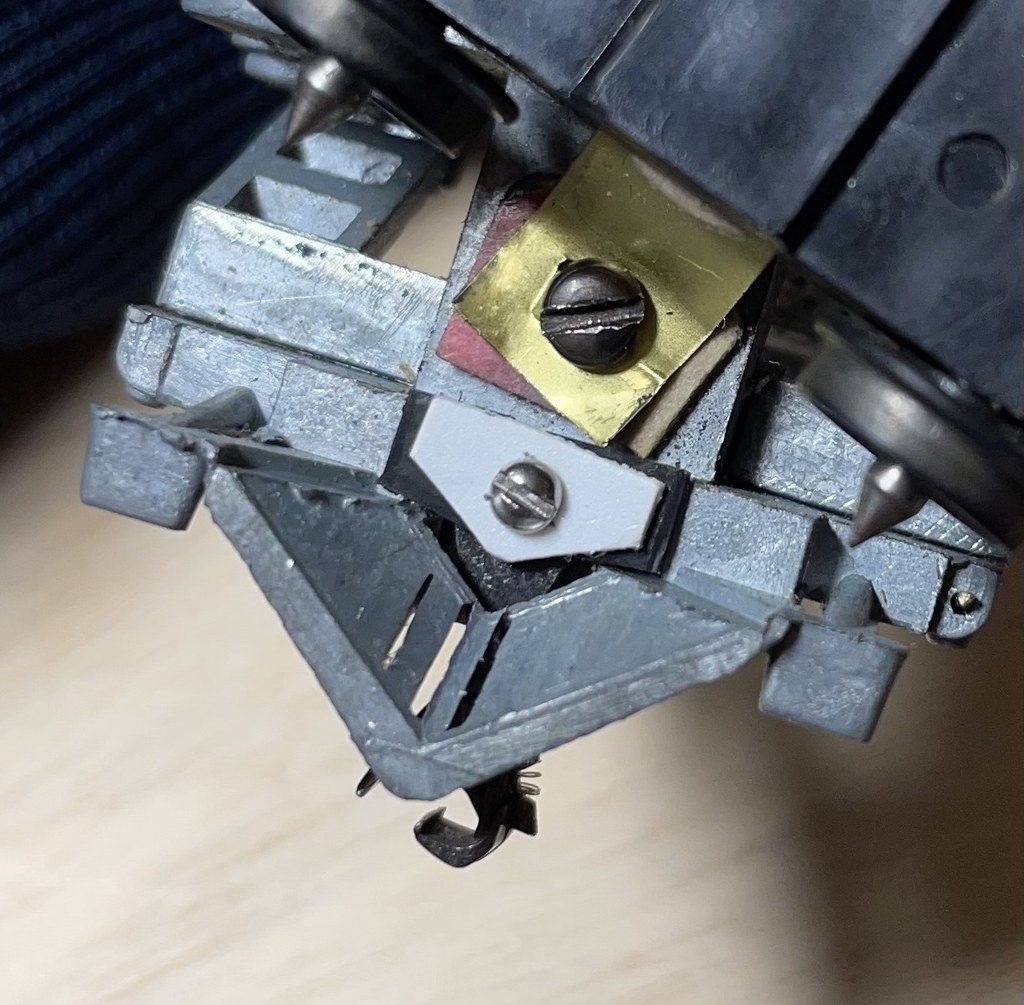
I drilled the hole by hand with a pin vise. It was a challenge to drill the hole perfectly straight up and down to the plane of the underside of the loco, and it was equally challenging to tap the hole, but I did like you fellows said – took it slow and used machine oil – and I got enough threads for a grab without even having to drill all the way through the pilot.
To keep the coupler on I used one of the box lids from a Kadee ol’ No. 5, cutting it down to just a narrow strip with the hole in the middle. Because the hole was bigger than the screw head, I also cut a small strip of white styrene to act as a washer to hold everything together. I used the clearance bit to make a hole in the styrene for the screw.
The only 00-80 screw I was able to get at my local hobby shop was way too long, about 7/8", but I cut it down to about 1/8" and it worked without even any filing.
It still needs some work. For starters, my LHS didn’t have plastic couplers, so I used a #148. When I can get a plastic coupler I’ll replace it, but since the plastic coupler does
Hi Matt,
Congratulations on solving your coupler installation challenge!
I’m going to go out on a limb and make a suggestion regarding your locomotive project. I can see some flash and some mold lines on the locomotive. Before you add any more details, I would suggest that you clean all that up. If you have details, like the grab rails that are already installed for example, they may get in the way when you are trying to file things smooth.
I would also recommend that you take the locomotive down to the bare shell before starting to file off the flash. That will avoid getting filings into places like the motor and drive system, or the couplers, where you don’t want them. It will also make the locomotive much easier to clean before painting.
Also, grind off the pointy tips on the leading truck’s axles. Pointy tips look good on Harleys but not so much on locomotives.[swg]
If you have already thought of these things I apologize for not giving you enough credit. I look forward to watching the locomotive progress.
Cheers!!
Dave
Well, it’s good to see that you’ve finally got a workable coupler installed, but it seems like there was a lot of unnecessary worries about how to do it.
Were it mine, a suitable file would have made enough room for a Kadee coupler in a plastic Kadee draught gear box, likely shortened somewhat (on the front) so as to be placed where the back end would not interfere with the lead truck, but still allow for the gladhand to be left in-place for easy uncoupling.
Pretty well any size of screw, from a #2-56 to an 00-90 could have been used, as it’s very easy to “bush” the mounting hole in the Kadee coupler box.
Every time we do something which we’ve not previously tried, we usually make a mistake (or three), but those mistakes are what teaches us to not give up.
I’m not surprised that you carried it through.
Wayne
Not to worry Dave, I’m not proud. Thanks for the tips.
Wayne, worry is what I do best. I usually worry myself into inaction. The success here is that I managed to do anything at all 
-Matt