RME- Private messaged you regarding the metallurgist…please me know if you recieved it.
Trinity writes: Item: Compare the map of Florida on M-Day when Seaboard Coast Line commenced operations on former ACL and SAL track to today’s map of CSX. It is Shocking indeed!
It has been mentioned by others over the years that too much track was ripped up in Florida to the point that there are even regrets in the industry. I’m no expert on the South part of the US…is this true as well across the Southern States all the way over to Louisiana? I do have those merger maps showing the “before” and “after” but they dont show everything, as in all the branches and industrial spurs and there are errors. I suspect A LOT of prairie trackage is gone as well That does not show up on these maps.
Point being once its gone its pretty much done forever as it is too complicated and expensive to replace if not darn right impossible these days.
Losing trackage and right of ways is really short sighted in resource rich areas such as Northern Ontario. I’m certain there are other areas facing the same fate. Bad enough that technology is replacing employment for the folks and that there is no solution whatsoever by anyone to this dilemma but to also deconstruct nation building along with it opportunities for the future and movement of natural resources is dangerous. I cannot see the destruction of railroad infrastructure as a natural progression of market forces. It is madness that we will come to regret.
But, by the same token, we are rapidly acquiring the ability to produce, deploy, and align (and keep aligned!) new and far better track structure for most of these prospective uses than ‘two streaks of rust on rotted ties’ could ever provide. So if either economics or expedient reasons require restoration of railroad service (with nothing but “renewable resources” in and for construction) what goes ‘back’ will be much more usable than anything that ‘had been’. And that specifically includes track built over railbanked routes converted to trails.
In a very real sense it’s more important to see the trails succeed many places (the Adirondack line being a comparatively rare exception, for at least two reasons) as they keep the old roadbed both integral and free from encroachment – that being the point of railbanking in the first place. When the time comes for the rails to go back (at whatever cost is justified) it will be possible to get them there with much less cost than “modern” (I’ll be slightly wicked and say ‘socialist’) governments spend on their light-rail projects.
Yes, I received Dr. Lanke’s information, and I thank you very much.
RME- Agree all the way with what you wrote. There are 2 sides to every coin and it’s good to point out the other side. Many of those points could have been included but that was not the side I wish to have presented. Many of the places I have personally seen have a total loss of the right of way…there are now homes and other buildings, roads and playgrounds,…in other words those not retaining any of their former aspects are lost forever. In several big cities you cannot get into the downtown core areas by rail any longer and, if a passenger you must detrain at some suburban bus shelter type outpost miles and miles, many miles away. Saskatoon and Ottawa come to mind. Using the 10:1 ratio US to Canada this would mean at minimum 20 cities in the States. This only leads to more road congestion and worst of all forfeits permanently the one big advantage rail had. You cannot even travel by rail to several larger cities at all…the beautiful CPR station in Regina is now a casino for cripes sake and no passenger service to that city at all…and its the capital of Saskatchewan and the home base of the RCMP.
The CASO is another, the CNR Grimbsy sub is yet another…those have been sold off piecemeal to any and all and are not coming back.
For years there were articles on how there was too much trackage in Iowa with the whole state crisscrossed and paralleled with redundant track. Now its “uh-oh” too much gone. The Milwaukee Road beautiful speedway comes to mind, then jump to the whole Pacific extension, lock stock and barrel. Not good. Same in Florida.
Also there seems to be a renewed concerted effort to take out even more in the name of efficiency. I strongly caution against this de-constructing of nation building as being self destuctive in many cases.
One last thought…I believe your new President Elect has a good handle on this. If you have 95 million people unemployed, given up looking, holding a college degree with huge debt or underempl
This is one of the big reasons for regret at the loss of ROWs into and within urban cores, or their being broken up by intermittent development. It probably has to be said that the old “interurban” approach, with the train running local over streetcar tracks with all their problems, is still not favorable over buses for most cities that cannot justify full light-rail or heavy-rail service with sensible headways. And those were … rightly or wrongly … among the first ROWs actually lost to development (overlay the routes of the Pacific Electric, for example).
But it was for just the reasons you give that ‘railbanking’ was initially established. The problem is that far too many miles of American railroad were, indeed, superfluous or built to poorer standards than alternatives (the Pacific Extension being a particularly egregious example) and not particularly ‘needed’ in any likely upcoming version of society. That particularly applies, in my opinion, to many of the ‘granger’ lines that are incapable of taking even the smallest economically-justifiable covered grain hoppers, but serve relatively small numbers of independent farmers (vs. ADM or Cargill which isn’t concerned with ad hoc access by transport to the products of its ag operations). Trucks, particularly hybrid autonomous trucks, are far better suited to any such service.
No, th
Apparently the rail-banking law has holes big enough to drive a Mack truck thru, but sadly not big enough to still pass a train. In the linked map, note the area below (south) of the former diamond rail crossing, and then look in satellite view. The yogurt factory wanted to expand, and the path of least resistance was across the rail-banked line. I guess they didn’t think there would be any problem bigger that the bicyclist having to detour around the factory.
Thanks for that Midland MIke. Developers and business interests will always create problems unless rail banking is cast in stone and untouchable and that is unlikely. Newer generations take over and all is forgotten about…and so it goes.
I suppose anyone can justify a position with rationalization, some will buy it, some won’t.
Regardless of ideology, be it capitalism, socialism, crony capitalism, “it’s better”, “it’s cheaper”, “it’s more efficient”, “it’s global warming”, “it’s a new ice age” and all the bs and nonsense that goes along with those things the fact remains we have lost a lot of rail and a lot of service.
Six railroads, three of which had successors, are all gone and tore up in my former county alone, leaving none. As previously mentioned I could purchase sleeping accommodations from a very grand designed Edwardian era station to just about anywhere in North America. Of course I would have to change trains here and there but still it all connected and the sleeper, along with the diner, was there faithfully waiting. I cannot do that today. The station does not exist, the rails are gone.
However, as Dave Klepper states, there are still some things, some trains, so enjoy what choices we have. Who knows when thats gone as well.
Few will agree with me but I think somehow much more could have been retained and would fit right in and be agreeable with whats to come.
Miningman, I am one of the few who agree with you. In my opinion, had Rail Banking been created in the late 50s when the Interstate highway system was expanding a lot of track that was lost in the 60s and beyond could have been saved.
Just before the Rock Island shut down, it was working with the labor unions to assign reduced crews to branch lines when traffic levels were light, increasing them during high season, mainly during the annual wheat rush.
A perfect example is the onetime M-K-T Northwestern District which included subsidiary BM&E. The year the trains stopped running the region experienced a bumper wheat crop with no railroad left to haul the golden harvest to market. The Katy had been in financial trouble for several years as it was, and by the time the Oklahoma DOT created Farmrail, saving some of The Rock, the Katy Northwest, as it had become known, due to the excellent book by Don Hofsommer, was gone for good, save a short segment which is operated by the Northwestern Oklahoma Railroad in Woodward, OK and interchanges with BNSF.
Couple thoughts re the original post -
In 1953 when Eisenhower was sworn in, the US didn’t own the railroads, unlike Canada or the U.K. where the government controlled things. He wasn’t responsible for the “huge wholesale mean natured taking apart of the railroad industry”. He didn’t order deferred maintainence or anything else. The railroad industry did it itself. After 20 years of the New Deal, the GOP was running on a platform of getting government out of business. Doesn’t seem likely that Ike as a Republican would be ‘anti-business’ anyway.
Although often credited with the idea of the Interstate Highway System, the plans they were based on went back to FDR’s administration. Had Adlai Stevenson won in 1952, most likely it would have been created anyway.That being said, it is apparently true that Ike’s experience making a cross-country trip across the US early in his military career, and seeing Germany’s autobahn system, did make him amenable to the Interstates.
Passenger train usage began sliding downhill in the 1920’s. Streamliners in the 1930’s brought some folks back, and the incredible amount of rail traffic during WW2 gave many railroads a sense of hope in the future that caused them to spend money on passenger cars and engines that would soon prove to have been a mistake. That would have happened regardless who was president 1953-61. Once automobiles could be bought by any working man, the passenger train was going to be hurt. (Blame Henry Ford’s Model T!)
w jstix- First off, don’t tell Canadian Pacific they were ever government owned or many many other Canadian railroads. They were as privately owned and widely held stocks as you can get. Canadian National was, or at least a “Crown Corporation” and the Ontario Northland ( T&NO) was owned by the Province of Ontario.
I’m not accusing Eisenhower personally of being mean to the railroads, but I am suggesting that his administration paid no attention to the problems that were rapidly developing for the railroads but instead favoured anything but the railroads.
There was no recognition for the Herculean effort put forth by the railroad industry for its role in winning WWII. De-regulation and many of the common sensed proposed mergers should have come sooner and been allowed. By turning its back and seeing it as “old fashioned and slow” created a mindset and even more problems.
When Ike warned of the “military-industrial complex” perhaps he saw the free fall of the railroad industry as a part of a consequence ( in addition to other things as pointed out) and was taken back by how far things had gone.
Well Ok, Santa Fe and Union Pacific in the west were unscathed but the wests day would come as well. If you were real long haul you were immune, to a degree anyway.
A couple of years back, Paul North posted a couple of WW2 era PRR ads. One in particular explained how the RR’s couldn’t perform a lot of maintenance due to wartime traffic needs, and the money that should have been set aside for postwar rehabilitation was treated as income and taxed. Greyhounds has posted several pieces over the years about how, in the 1930’s, RR’s such as the NYC were prohibited from pricing containerized traffic at a discount that reflected the greatly reduced cost of providing containerized service versus traditional LCL.
The rapid increase in pressurized airliners after WW2 also made for formidable competion with LD passenger trains, flying in greater comfort at 250 to 350 MPH versus the 150 to 200 MPH in the DC-3 era.
The ultimate killer was the boon the interstates were for trucking, not having to slow down for every town and having to deal with far fewer stoplights.


Fascinating that the official typescript of an order this significant has a period after the S in the President’s signature.
…also, the S. Middle name stood for just that …“S” that was his middle name. Gotta luv that accent he had. Are there yet folks in Missouri that retain that?

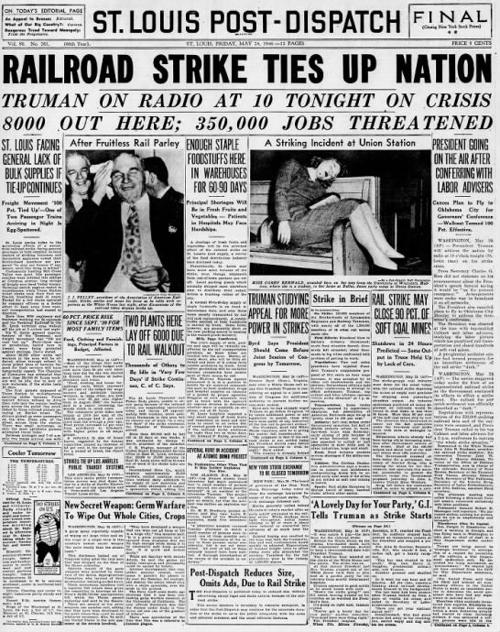
Truman’s executive order was probably a copy typed by Fred Gurley’s secretary.
http://www.kansasmemory.org/item/221732/page/5

Ye gods, that’s harsh!
… but at least she didn’t muss her hair doing it. [:D]
I don’t how much Ike could have done to stop people and businesses moving west and to the sun belt…or stop people buying imported goods from Japan. The eastern railroads were the ones that were failing, the western ones were doing pretty well. Yes, deregulation would have been very helpful, but not doing so (as would no other president until Carter in 1980) doesn’t mean they were anti-railroad.
The government taking mail off the rails in the 1960’s was the death of passenger trains for the private railroads, as the mail was in effect a subsidy. Without that, most (all?) passenger trains began to really lose money. But that was LBJ not Ike.
Miningman, my father told me what a letdown it was when everyone heard Trumans voice on the radio after 12 years of Franklin Roosevelt, who sounded just like what everyone thought a president should sound like.
But as Dad said, “Harry did all right after all.”
Firelock’76- Yes Indeed, Truman did very well as President, …he was the right guy at the right time with solid judgement in a fast changing world. He sure was treated badly at the end, undeservedly so.
History has fixed that and he is considered among the top ten Presidents.
I agree that Harry was one of the great ones. But it took the passage of time to reveal that. By 1952, he had fallen victim to the Sparky Anderson rule, articulated when Anderson departed from his long-time manager’s job at the Detroit Tigers before he could be fired: “I think sometimes they just get tired of your face.”
If Britain could “fire” Winston Churchill after the war, Americans are not uniquely to be blamed for firing Harry Truman.