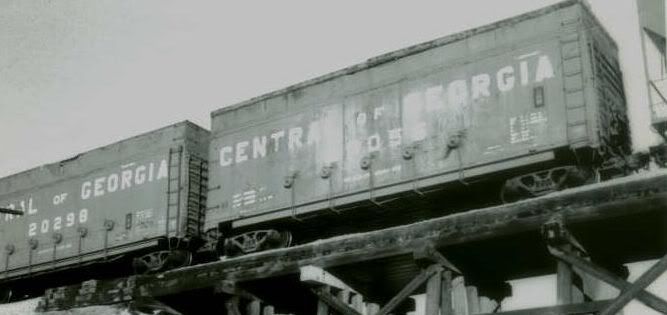
For my layout I decided that I will use 3 Tichy Group Sugar Beet Gondolas for the woodchips (leftover from logs becoming lumber at the sawmill) and shipping two from the mill to the steel mill and the other to a local customer in one of my three cities (one city, one log village, one city). Later on I might add a power plant to be a new customer.
For the Sawdust, I purchase and will use 2 of the 4 covered hoppers, to also transport the sawmill to the steel mill (to fuel the fire) or local business to make mulch or bag for fuel to power stoves or fireplaces.
Hoppers are self-unloading (having sloped sides and bottoms with chute doors/openings), gondolasare not (must be clamshelled/shoveled/etcetera out even if there are bottom hatches or turned on their sides or ends).
Incorrect. Those look like regular old 40’ boxcars rebuilt with extended sides and roofs removed. This sort of thing shows up on other railroads like CN, CP, BAR, MEC, etc.
Also, once more with feeling, HOPPERS are self-clearing cars with bottom dump outlets. Do you see any of those??? This is a boxcar rebuilt into a GONDOLA, NOT an hopper.
Southern Pacific woodchip cars. The first a modified drop bottom gondola is also known as a sugar beet gondola, a commodity it often carried into the 1970’s. Other railroads used similar modified gons cars for woodchips. (ie. the Northern Pacific and Western Pacific). The second car appears to be a purpose built woodchip car, it has a drop bottom too.
These are (were) indeed 40’boxcars with roofs removed and sides extended. Some of my photos show a definite weld line diagonally down from each end, indicating the presence of an added slope sheet. There are drop doors underneath, raised and lowered by those round windlasses on the sides, and there is a large hole cut in one end, giving access to the air reservoir, valve, and brake cylinder that have been displaced from underneath.
ummm ok? My bad if I didn’t put more time into the photo and what is your problem with hoppers? It’s my layout I use what I want and I’m using covered hoppers.
All freight cars will carry wood chips and sawdust however flatcars don’t do it very well particularly at high speeds or in high winds.
Wood chips were USUALLY transported in hopper cars with raised sides however gons were sometimes used in this service. Manufacturers in both HO-Scale and N-Scale have offered wood chip hoppers although I don’t remember anyone ever offering a wood chip gon. I don’t know of any (wood chip) hoppers currently being offered in N-Scale; I can’t answer for HO-Scale.
Sawdust had to be carried in enclosed units and boxcars were likely candidates for this service; I would take a WAG and suppose that any boxcar used in this service would be dedicated complete with some kind of external markings. Burlap bags of sawdust were sometimes available at the local lumber yard and the printing on these bags indicated that they were commercial product.
I know for a fact that Walthers has both Woodchip gons and hoppers right now in HO scale. They are prominent at the moment since they have reissued the paper mill series.
As stated much earlier in this thread, that really depends on your area. On some railroads and in some areas hoppers would have been used exclusively, and in others they’d be virtually unknown, and gondolas ubquitous. Or even standard boxcars using wood/cardboard doors like old fashioned grain doors.
If not specifically modelling a particular prototype situation, the modeller is free to choose whatever type of car he pleases, but each mill receiving chips from sawmills will probably have a preference to receive a particular type of car (as the unloading equipment/facilties for each would be different depending on whether you’re bottom-dumping a hopper, rotary dumping a gondola, end-dumping a gondola with hinged end doors, or digging out the chips through the side door of a boxcar or gondola).
That should work fine. Railroads often re-purposed older cars into woodchip service, including older gondolas, old open hoppers and even cutting the roofs off boxcars as shown earlier here. Any place receiving woodchips would probably only receive one type of car since that’s what they’d be set up to unload.
What other type of cars would lumber mills or logging camps use because I was thinking of having a few covered hoppers to haul the sawdust to a powerplant and that as fuel while the woodchips be used as BBQ fuel or other uses.
Well, depending on whether they actually ship/receive certain things by rail or truck, a lumber mill has one basic input (logs) and a primary output of lumber. Secondary byproducts of lumber production are sawdust and woodchips (created from chipping the bark and scraps).
The logs would be shipped flatcars with side stakes or in gondolas. Or just shipped in by truck from local loggin cuts.
Depending on era, the lumber is shipped in bundles on flatcars, or loaded by hand, board by board, into boxcars.
Woodchips are shipped to paper/pulp mills for turning into paper. Chips are shipped in open cars. Usually tall gondolas (solid bottom cars), but some areas used hoppers (bottom dumping cars). A lot depends on era as well, the big 60’ cars built specifically for woodchip service didn’t really show up until the late 1960s. Prior to that lot of older cars were rebuilt with extended sides for woodchip service and not much was built specifically for woodchip service. If your railroad had a bunch of excess beet hoppers with tall sides, or was able to acquire a bunch on the cheap, it’s conceivable to use these for woodchip service.
Sawdust was normally just burned as waste, although if the mill could actually make money by selling it to another industry like a wood pellet producer for pellet stoves and barbeques, or MDF/pressed particle board, then they might do it. The fine sawdust would be light enough to be required to be shipped in a covered hopper (or it would just blow away - even woodchips have had issues with blowing out of cars in transit) - IF the mill actually shipped sawdust to another mill, and IF it was shipped by rail instead of locally by truck.
I’m pretty sure it was mentioned a few times earlier in this thread that shipping sawdust or woodchips to a power plant for burning would be unlikely.