I started this road about Monday of this week.
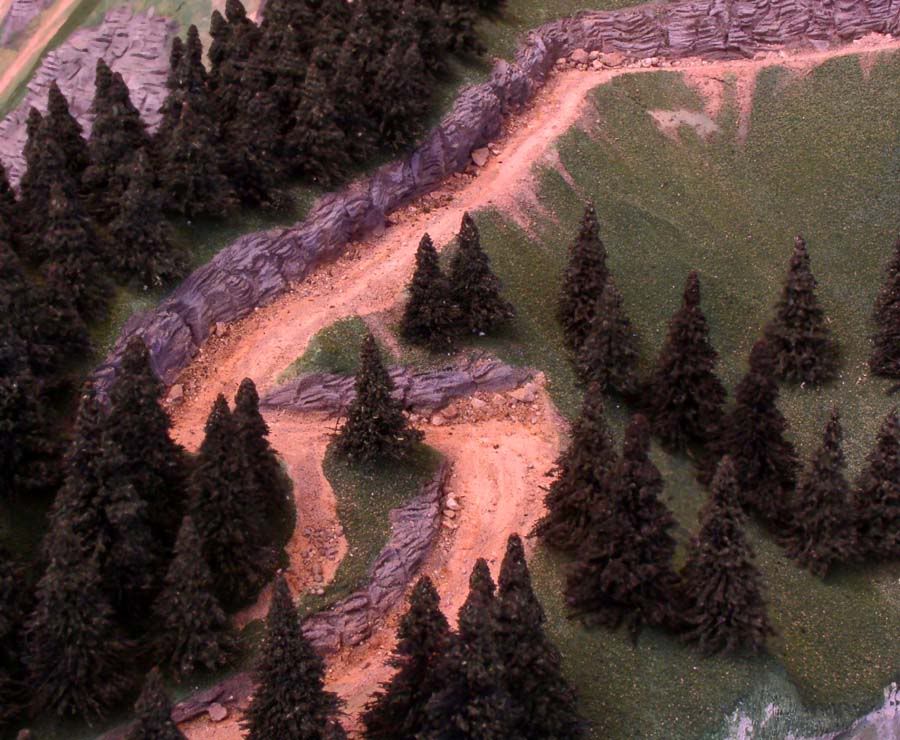
It used to be just mountain, but I needed a way to get from one valley over to the next, which covers a new drop leaf I added for staging.
First I cut the hardshell with a steak knife, one vertical cut, one horizontal, and cleared out all the scrap.
Next, I troweled lightweight spackling compound on for the road surface and smoothed it with a one inch putty knife. You don’t have to get the road surface perfectly flat, but if you want to position figures on it without having to glue them, the flatter the better. Pockets and bubbles I smoothed out with some additional spackle and my fingers.
Next, I finger daubed in spackle for the rock walls, and spread it and carved it with a butter knife. You have to sort of finger tamp it down to get it to stick well on vertical surfaces.
Then I painted the road surface with my standard “dry dirt” shade, mixed with Wal-mart acrylics. While it was wet, I sprinkled variable sized sand on the paint, covering the whole surface. I got the sand from a bad spot on my dad’s driveway. I’ve used playground sand before and was unhappy with it. Much to even and didn’t look real at all. Concrete spall makes good modelling dirt because the pieces are more angular than WS talus, which doesn’t look like Rocky Mountain talus at all. Pebbles that were too big I weeded out when pinching up the sand with my fingers, prior to sprinkling.
Once it dried, I hit the whole road with the dustbuster to suck up anything that the paint didn’t stick down. Then I repainted and sand sprinkled a few small areas where there were sand gaps and let that dry too.
Then I painted the rock, dark gray first, them medium gray, then highlights in near white.
Then I took a regular pencil and used the eraser to wear in two wheel ruts along the length of the road. At the switchbacks I took m

