Caveat - this is purely an opinion, and should be taken as such.
Taking a locomotive for example -
If you fabricated your own frame and superstructure, even if all your detail parts are ‘store-boughten’ castings, that locomotive is scratchbuilt.
If you took a mechanism, modified it (shortened, partially reshaped) and then mounted a scratch-built superstructure on it, that locomotive is partially scratch built.
If you took a mechanism, modified it, modified the original superstructure with a different cab or fittings, then put both halves together, then that locomotive is kitbashed.
If you took a complete locomotive, swapped out brass investment-cast details for cast-on parts and added all the appropriate plumbing (including valves and unions) that locomotive is superdetailed.
If you took a complete locomotive, disassembled it, polished the bearings, installed extra weight and added centering mechanisms to the lead and trailing trucks it’s still a kitbash, but it will run a lot better than one right out of the box.
I will leave determining which, if any, of the above I have done as an exercise for the student.
Dan; That , to me, is scratchbuilding–note that I said to me. If I was into purist–you must wind the windings,build out of yourself --mode then I’d have quibbles but–GOOD WORK, MAN!!!
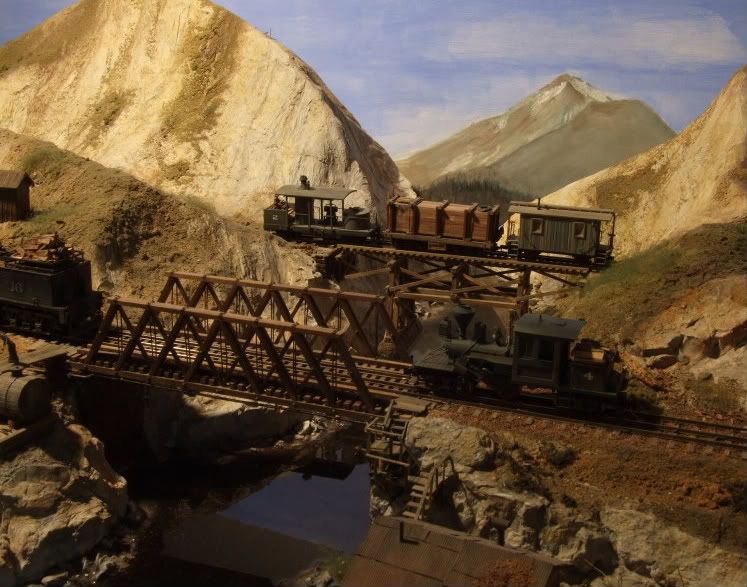
This is all kind of interesting. Many years ago the club I belonged to had a practice contest using NMRA rules so that the entrants would have some idea of what degree of skill and detail was required to win an NMRA judged contest. I mistakenly thought that my “scratched” built HOn30 4 wheeled caboose ( See Photo) would be an easy winner. I had drawn my own plans. I hand built the link and pin couplers from brass stock. I individually cut each board from sheet basswood. I cut the journal boxes off an HO truck. I fashioned the smoke stack from brass stock. All of the handrails were made from brass wire. I made the windows and door frames from tiny pieces of basswood. I hand weathered each board before gluing it individually to the wall frames. The only purchased parts were the wheels and the brake wheels. Other models entered that were basically kit bashed from plastic kits or super detailed kits were awarded far more points than my model. The reason was that I did not add an interior and did not properly letter it. I also did not add underbody detail because the floor was removable so that I could drop in an N gauge mechanism to power the caboose as a dummy behind an even smaller totally scratch built vertical boiler Climax. I do appreciate the fact that I did not meet the rules but thereafter I lost all interest in ever trying to build a model just for the purpose of trying to win a contest. Peter Smith, Memphis
Dan and Peter, I don’t recall that scratchbuilding required every possible interior and exterior detail to be present - but contest rules might require that. (Employee timetable with an appropriate date on the conductor’s desk, perhaps…) The joker with any contest is that you have to read, understand and follow the rules - and then hope that the judges will do the same.
In my not particularly humble opinion, both of you have done beautiful scratch-building jobs. OTOH, I’m not a certified judge and I don’t have a copy of anyone’s contest rules. Nor do I have my official nitpicker tweezers - and I mislaid my handy counter, so I can’t count rivets. All I am is a modeler who is satisfied with models that look good at normal viewing distance, and who is willing to use whatever method, fair or foul, to obtain my model of choice, even (especially!) if it never had a 1:1 scale prototype. (1:80 scale Golwe, anyone? I need it to pull my seven-axle articulated hoppers up the 4% to the mine.)
Chuck (Modeling Central Japan in September, 1964 - with tongue in cheek)
Thanks for the additional information on how NMRA judges contests.
What I find interesting in this thread, is the number of different views of what scratchbuilding is. As you point out the quality of the scratchbuilding has to exceed that of a purchased part to make it worthwhile for a contest. Yet, for a model to be scratchbuilt the quality is irrelevant.
There is OTOH a consencus that if one is doing scratchbuilding as competition then standards are needed. I find that in most places that get into these discussions the opinions vary but when it turns to juried shows standards are there for that purpose—although one can in fact push(or rather–encourage) themselves into improving their work by incorperating those standards. The difference lies in the context: I am doing scratchbuilding for my own purposes–not necessarily based on some other’s purpose, or definition…[:-^]
I’ve always defined scratchbuilding in my mind as manufacturing something from raw materials that cannot/instead of purchasing it as a kit. Ideas include manufacturing a building out of raw styrene material (raw being the plastic sheets you get at a store- cut them, paint them, etc, viola- building) or making a retaining wall out of wood via pictures and no dimensional prints. Thats what I’ve always thought of when the scratchbuilding word is presented.
I like the NMRA parameters, but it appears that their definition precludes the use of cast brass/plastic detail parts and I would allow them in my definition. I’d say that if it meets the NMRA terms, and the builder only bought items that a prototype builder might have bought, then it’s scratch built. Here are some examples:
If I build a prototype building I’ll buy lumber, siding, pre-fab windows, pre-hung doors, shingles, etc. When I scratch build a model building I buy miniature siding, miniature lumber, miniature windows, miniature doors, etc. In many ways, I model prototype practice.
If a car builder is making a box car they probably buy the trucks, brake rigging, grab handles, couplers, etc. just like many of us model builders do.
If a locomotive builder is building a steam locomotive they probably buy the pipe fittings, compressor, air pressure reservoir, headlight, etc. Just like many of us model locomotive builders do.
Well, after reading the NMRA rules, I’d say that I’m a kit-basher more than a ‘scratch-builder’. Though I HAVE ‘scratch’ built a few retaining walls and abutments. I remember one time a visitor was admiring a particular locomotive of mine and said, “Where did you get that?” “I built it.” “Wow, from SCRATCH?” “Well, no, I started out with a PFM Santa Fe and tore it apart and added a whole bunch of new castings and turned it into a Rio Grande F-81. Sorta.” “Oh,” he said, sniffing. “It’s a KIT-BASH then. Why would you want to do that to a perfectly good brass locomotive?” I just stared at him. “Because I CAN,” I answered.
So I’m a kit-basher. [:-^] But I’m an inveterate one, LOL! Can’t keep my hands off of all those little parts. Whattaya mean, DIRECTIONS?!
Well, it’s a gray area. I don’t know the date of inception of pre-fabricated windows and doors, so I sort of assume that they’ve been pre-fabed to one degree or another for a very long time (centuries). Frankly, if I’m wrong I’d rather not know it.
Where does the NMRA contest rules preclude the use of cast brass/plastic detail parts? In the case of the doors/windows - Grandt Line can make stuff much better than I can. I use them on my structures - I ‘kitbash’ Grandt Line or Tichy windows if I need a special size.
If I used Evergreen siding(cut to size), Evergreen dimensional(cut to size), Grandt Line windows/doors, and some addition purchased items - I would garner NO scrathbuilding points(15 max). Depending on my skill & neatness of construction - I have a possible 40 points to gain.
The bottom line is do a good job ‘building’ your model - that is where most contest points can be gained. It is a ‘Model Contest’ - Not a ‘Scratch Building Contest’.
To be fair, the NMRA did change the points structure(maybe 15-20 years ago) and ‘scratchbuilding’ lost some points - ‘construction’ & ‘conformity’ gained some points. This change has been argued, but it addressed the problem with ‘scratchbuild everything’ and have it win even though the scratchbuilt parts are of rather poor quality. The current points structure balances the quality of a scratchbuilt part vs what is available on the parts rack at your LHS.
A model is considered “scratchbuilt” if at least 90% of the model’s pieces/parts (other than those specifically exempted in the list above) are fabricated by the modeler. This is a quantitative assessment based on the number of pieces with no weight given to complexity. This is a separate determination from the scratch building score.
I agree that the point is to make models that satisfy the builder, but the topic of the thread is putting a definition to scratchbuilding. In terms of my own model building, I prefer to start with a craftsman kit, because I enjoy building, but research, drawing plans, shopping for parts and materials - I’ll pay for someone else to do that stuff - it’s just not my bag. I don’t plan to enter any contests, so there are no rules.
It’s copy and pasted verbatim from the NMRA web site, as linked in the other post. Just scroll down the page to find the section entitled Scratchbuilt.
vsmith: If the engines you have are kitbashed they must’ve been very rare pieces. I OTOH prefer to call them ‘Scratchbuilt’. As far as that is concerned the NMRA rules apply if one is doing this competitively but… …in my layout only some will[:-^][:D]