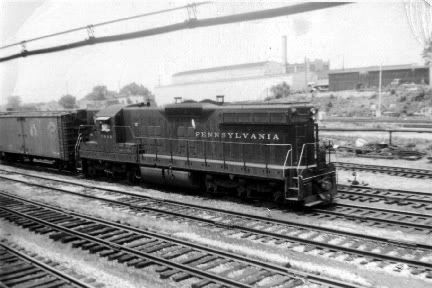
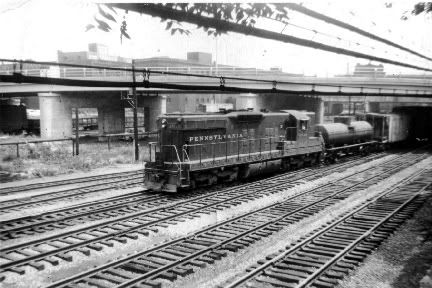
GPs have four wheels per truck, not four wheels per axle; SDs have six wheels per truck, not six wheels per axle. {i}ALL[/i] axles have two wheels, one at each end.
Trucks with two axles, both of which are powered, are designated as “B-Trucks”; trucks with three axles, all three of which are powered, are designated as “C-Trucks”; Onion Specific and Suffering Pacific (DD35s and DDA40Xs) had four axle trucks designated as “D-Trucks” and were unique to those two railroads.
The truck found under most passenger diesels of the thirties, forties, and fifties were designated A1A trucks. They had three axles but only two of these axles were powered; the center axle of each truck was an idler axle and used for weight distribution/buffering. ALCO produced some standard “B-Truck” road switchers configured with A1A trucks; these had a lower axle loading than the “B-Truck” version and were designed for use on light rail. Fairbanks-Morse, on the other hand, produced one of their C-Liner models with a “B-Truck” in front and an “A1A-Truck” in the rear. I have never quite been sure of just what the company hoped to accomplish with this unconventional configuration but it appears to have been a weight distribution measure.
Baldwin Locomotive, I believe, produced a road switcher with “A1A-Trucks” under both ends.
GP road switchers are “B-Truck” affairs and designated BB units; SD road switchers, on the other hand, are “C-Truck” affairs and designated CC units.
Just to add a little color to the issue GE produced a &q
Geeps were generally used for switching because the 4 axle units could navigate tight curves better than six axel units. The “SD” units had more trouble in tight curves, so the geeps ruled the industrial switching.
One other thing, and this may not apply to all Geeps, I know it applies to most. Geeps traction motors run strictly in parallel while sd’s run in series until transition at about 20 MPH and then they run parallel. This means that an even amount of electricity is sent to all traction motors in parallel and each traction motor in series receives the power it requires to pull without slipping until transition is achieved.
Baldwin circa 1948 had a standard 1500 hp road switcher design that could be ordered with B-B trucks, C-C trucks, or A1A-A1A trucks. The railroad I grew up with, the Minneapolis Northfield and Southern, had one. It was no.15 and was a model 6-6-1500, meaning 6 axles, all six powered (six motors), 1500 hp. You could also get a 4-4-1500 with BB trucks or a 6-4-1500 that was equipped with two three axle trucks but only four axles powered (A1A-A1A).
With GM, I’m pretty sure all the E units were A1A-A1A and all the SD’s were C-C. I don’t think you could ‘mix and match’ like you could with Baldwins. ALCO did something similar, an RSD-5 was pretty much an RS-3 with six axle trucks instead of four axles, and I think you could get them C-C or A1A…although I do seem to remember reading that one railroad converted some RS-3’s to have A1A trucks, perhaps the C&NW/CStPM&O??
Also I believe the FM passenger diesels with a B lead truck and A1A second truck were indeed designed that way for weight considerations on lightly built branchlines, primarily in Canada (eh?) [:D]
The FM C-liners with the five axles (B-A1A) was a weight deal, for the steam generator and extra weight that brings.
F-unit was for Fourteen hundred hp (well, 1350 hp for the FTs).
GPs are four axle. Easier on curves. Better for switching, at least in non-turbo form. Some have a “switch” mode. When you open the throttle to Run 1, it jumps pretty good. Helps when switching, don’t have to open the throttle as far. To change direction is a simple “clunk-click”. GP38s with AC main gens don’t make transition, they just keep pulling. GP7s make transition around 20 mph, at least the ones I have run. GP35s take 16 steps to make transition, sometimes they don’t work right.[censored]
SDs are six axle. They can pull more at lower speeds. Above 12 mph, given good rail condition (no rain/snow/ice/leaves), a GP of the same hp rating should pull about the same. Changing direction takes a while longer, “click-buzz-whir-clank”. SD40-2s transition at 25 mph or so. SDs are longer than the equivalent GP. Early 6-axles were to spread out the weight, to ease the load on bad track. Locomotives could be financed, but trackwork and bridgework takes actual money. Modern engines are heavy, to maximize pulling power. Most 6-axles are rough on curves, but the EMD radial truck helps out a lot in this area, much less squealing when going around sharp turns. There is one place on the WSOR where 6-axle power is banned. It was tried once. Rail rolled over, SD40-2 had all axles on the ground.
As mentioned earlier, early E units were not used in freight service (well, for the most part) partly because their long wheelbase trucks were not sharp curve friendly, and also because their high gearing was not suitable for hauling heavy tonnage. Also, in the 50’s, many freight cars were not rated for sustained speeds over 60 MPH or so (due to friction bearing trucks).
Some RR’s bought unballasted SD units for lighweight branchlines (in the 50’s), other ballasted units for more pulling power. I don’t have my book (Diesel Locomotives: The First 50 Years; Kalmbach Publishing) handy, but Milwaukee I think it was, bought the SD38’s with extra small fuel tanks for weight savings. I seem to recall the SD38 vs SD40 (at the time) used a V12 turbocharged vs V16 non-turbocharged engine, respectively, they took the lighter, but more maintenance-intensive, V12 engine that produced nearly the same power. My prototype, The Southern Railway, didn’t buy any early SD units, and they bought very few GP units (only about 10 or so), although they had quite a bunch of RS3’s. They rebuilt many of their F units in the early 50’s, and skipped the first generation GP and SD units. Their first mass-purchased SD units were the SD24’s, and the first mass purchased GP’s were the GP30’s (both from 1959 onward, and early 60’s onward, respectively). The Southern DID have some early SD and GP units, but most were “inherited” from other roads it absorbed.
Dave,I should know…I took the picture…As far as the cabin car its on the end of the train with conductor and brakeman protecting the shove just like I would be doing about 5 years later.
Notice the engineer is TURN and looking BACK instead of looking forward.