Have you guys seen that commerical for prostate pills where the guiy in the commerical is a professional model builder working on a large city scene? How do I get that dude’s job?
Believe it or not building model buildings appeals to me…maybe more than building model rolling stock.
I figured a person could use something like this : http://www.modeltrainsoftware.com/model-builder.html
to fill their city scene with paper buildings to a) give the layout a finished look and b) allow for operation.
then the person could take thier time and build high quality ‘regular’ model buildings over a long period of time and replace the paper ones as the ‘regular’ buildings are completed.
If you pick the right city, or make up the right one, you can get a lot of bridges and such done. Yeah they might not be as visually engaging as a timber trestle, but a monster concrete approach to a bridge flanked by equally monstrous concrete flyovers is pretty complicated looking. Even my little home town of 20,000 features at least three multi-track bridges and two long (300+ feet) viaducts in the urban core.
Deleted.
Hmmm
Interesting thread. For myself I like the mountains, Our vacations are usually in the mountains.
In the cities by the tracks and especially in the steam era it was a very dirty and depressing place. I never thought about modeling a city. I don’t even weather my rolling stock.
For the most part we model our interests and emotions, what ever gives us satisfaction, and that’s as it should be. IHMO “different strokes for different folks” [:D]
I love seeing pictures of other peoples interpretations of the hobby.
Having fun is the name of the game.
Lee
Most of the layouts I have seen here in Europe are of the sort I call the Disneyland or Fairy Wonderland type - sweet and lovely scenery with gingerbread houses, lovely forests with Bambi in them! So much sweetness - gives me a toothache!
Railroad reality is something else, especially in the US. Railroads serve business and usually run through the more dingy parts of a town, so why don´t we model what is the reality around us?
Not all of the world is like Switzerland, which is a scale 1/1 giant-sized model railroad … [(-D]
Agree with all three.
The issue with space is true if one thinks that ISL’s don’t count as a layout. In my case I chose the great northern plains/prairies just because the area has its own attractiveness to me.
Scratchbuilding is not as labour intensive as what some people think it is. I think it is all perception anyhow.
The thing about urban layouts though, for me, is the amount of people it would take to populate urban scenes to make them ‘believable’----and if you hand paint your own well then----[:-^]
I’ve not so much space. So my layout - the Westport Terminal RR - has different switching districts. The Third Street Industrial District is finished, Plywood District and Harbor District are on the way.
I like switching, and street running!
Wolfgang
And it does. You have accomplished your goal. Urban doesn’t mean skyscrapers, especially when railroading is the real love. Your pictures depict an urban industrial setting. If you wanted to change the era you model it would only be necessary to get more modern railroad equipment and automobiles. The buildings constructed in the 20’s but to the 40’s certainly may still be around. Rail yards and the industries they serve are almost always at the edge of town, far, far away from the busy downtown.
I do not have the depth you do but I would like to accomplish the look. I think you are on the right track to “represent a small city” and the industrial area.
Thank you for the kind words, Bob. [:)] The city scene is about 3’ deep in most places, although almost all of the track is within easy reach, as the layout there is not too high. Eventually, the scene will encompass about 18’ linear of layout. There are some backdrop buildings to add and a small residential area, but all of the major structures are in place.
Here’s a view of Mercury Knitting Mills, which is on the outskirts (where real estate costs were lower),
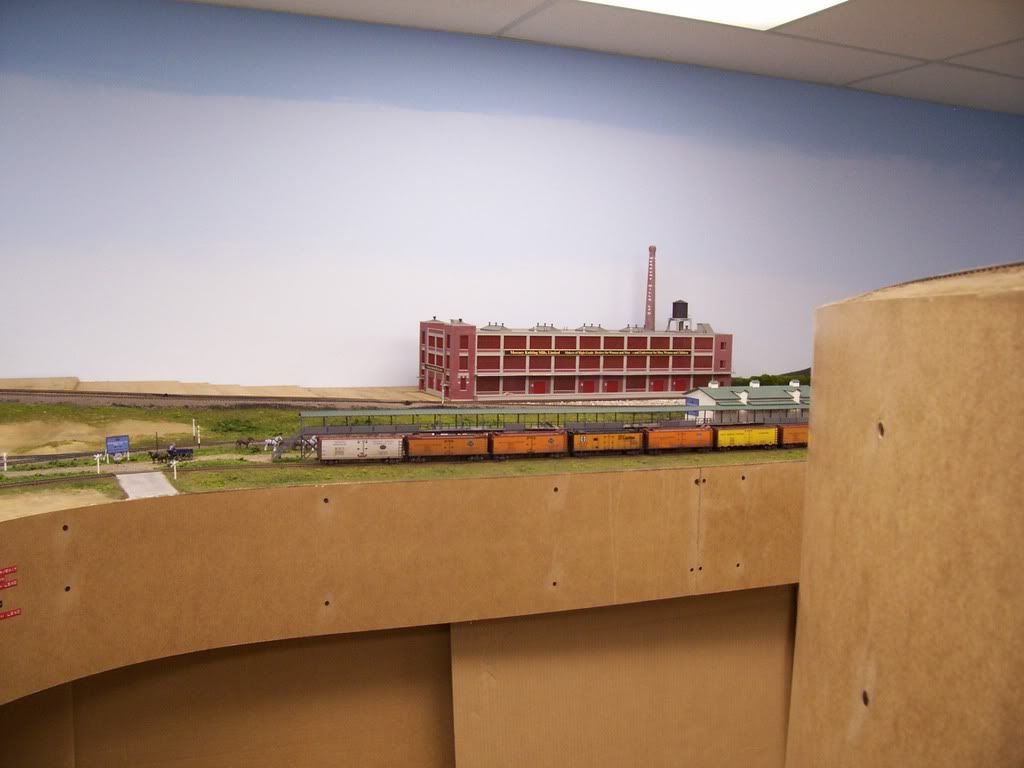
…with a residential neighbourhood to be added between it and the rest of town:
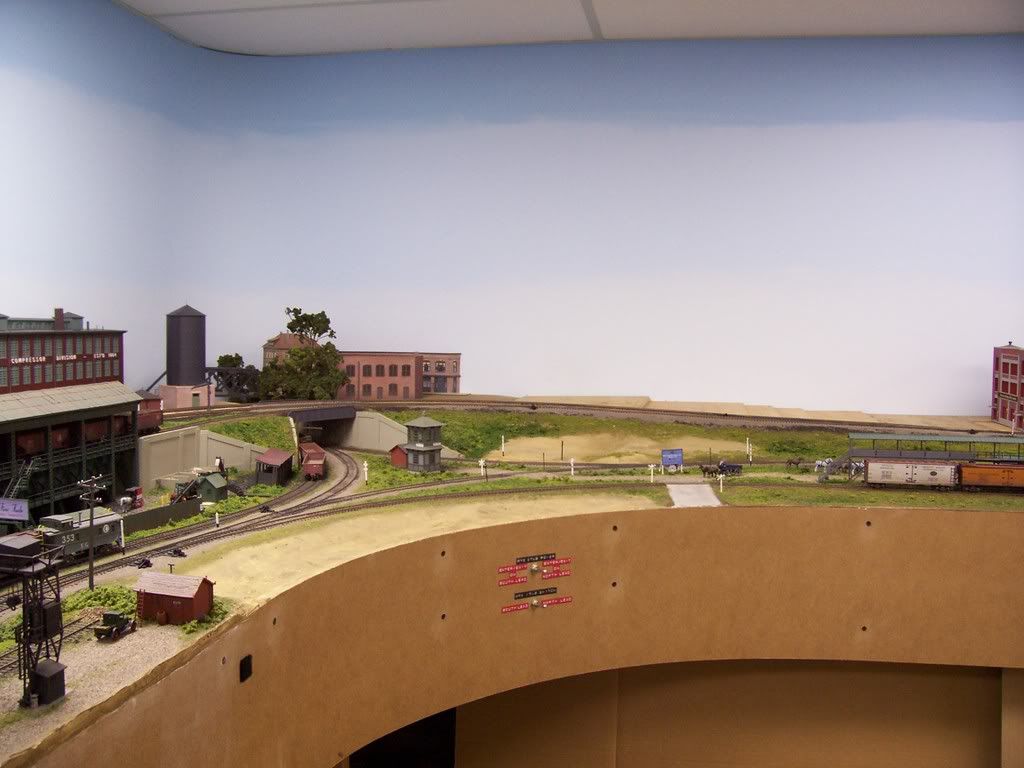
Wayne
Hey Bob: Have you seen Model Railroad Planning 2002? In it, Bernie Kempinski has an article about a waterfront yard that is accessible only by car float - and I believe it’s in Norfolk. The buildings are warehouses and the like but not very tall, maybe 3 stories max if remember correctly so this might be of interest to you? Also, Lance Mindheim of Shelf Layouts fame is building a modern day industrial switching line based on rail operations in Miami. At any rate, I too am in the planning stages of an urban layout. However it will be based on the numerous switching lines that laced the streets of the Brooklyn waterfront for nearly 100 years. It will also feature an elevated rapid transit line that runs to a ferry terminal like the ones at the Brooklyn and Williamsburg Bridges. Truth be told, this is my primary modeling interest, but the concept just evolved over time to the point where the industrial switching is the main feature. I don’t really have enough room to make an exclusive rapid transit-themed layout. I am planning a layout 24" wide and 12 feet long. If I can manage it, I would love to add another 10 foot section which would form an “L” shape along two walls. I live in an apartment so space is at a premium. Though some structures will be tall, (perhaps with the base of one of the river bridges’ towers!) the layout will have a top which will serve as a lighting valance. The effect will be diorama-like and focus the viewer’s attention to the scene. This might be something for you to consider if you are concerned about structure height. Track plan is loosely based on John Armstrong’s classic Southside Connecting RR. It’s not the most ideal plan but I have been fascinated by it since first seeing it nearly 40 years ago. Plus it resembles the jumble of street trackage found on the prototype (to me anyway) and will work a bit better when widened and stretched. Good luck!
Hi!
I’m 65 and been playing with trains since the mid '50s, having O, HO, and N scale layouts over the years. All have represented rural areas circa the '50s. Landscape has always included hills, fields, and a must have farm. Also included were loco terminals, and rail serviced small industries. The only hint of a town would be passenger/freight stations that gave the illusion of being on the edge of town. My HO layout currently under construction is designed like all the previous ones, with a little more emphasis on “edge of town” rail served facilities.
Ok, so why is this??? Ha, you are making me think! I grew up on the northwest side of Chicago about a stones throw away from the C&NW tracks. I spent a lot of time there, away from the hubbub of the city streets. I longed for the countryside and for the vacations each year at Grandmom’s (see my Avatar) in Anna Illinois, right across the road from the IC racetrack. She lived on the edge of town (6500 pop), but it was the country to me. I loved those times there, and I guess I’ve always tried to recreate that atmosphere on my layouts without really thinking about it.
Another reason is that my interest is in the railroads, and not the cityscape.
Now the good news is that we can each model what we want - be it city, country, mountains or seashore. That is another greatness of our Hobby!
Mobilman44
No one seems to have mentioned “Building City Scenery for Your Model Railroad” by John Pryke [link] which is available from Kalmbach. Lot’s of great information, illustrations and instructions on building urban scenery without robbing a bank to pay for it (oh wait, they don’t have any money either).
Some of the City Classics buildings lend themselves to “kit bashing” as do the buildings from RIX’s SmallTown collection.
John Prkye’s Union Freight project layout is one of my favorite MR series. I also love his Building City Scenery for Your Model Railroad. He gives several ways to simulate urban areas in small spaces, and I’ve used many of them. But the tour de force Union Freight project is a massive undertaking.
A quick glance at my insurance spreadsheet shows structures as the second most expensive component of my layout behind rolling stock.
Nick
My opinion only, but it seems to me that towns and especially cities require a much greater investment in time and resources to get a realistic effect. You need an awful lot of structures, streets, etc. to pull it off. Note that those who do such a great job of it, like George Selios, or Rod Stewart, really enjoy and are committed to that part of model railroading. John
Sorry, but I have to disagree!
If you plan to have a little forest on your layout, you will be spending either a lot of $$$ to buy realstic looking trees, or you will spend years in fabricating the required amount…
Fortunately, the industry offers a lot of not so expensive kits and modulars, that building urban layouts is not as expensive as you think. The time requirement is IMHO not much diffrent also!
Anything you have a lot of, will incur a significant cost, or a more significant amount of time to fabricate.
I originally wanted to model one city section including the hint of a seaport, but I don’t have enough space to do it justice, at least to my satisfaction. I’d always be dreaming of what might have been instead of enjoying the scenes that I can represent effectively. I do enjoy building structures and scenery. I’ll have to make do with a staging yard to suggest the traffic to and from the seaport.
I think a major railyard and engine servicing facility would be the most expensive and time consuming to model accurately, even when scaled down considerably. Impressive, but that’s a lot of expensive trackwork needed.
It all comes down to this: If you like to build models, make an elaborate layout, city or countryside. If you like to operate on a finished layout, keep it simple and buy readymades.
I am in construction of an urban based layout and am starting to work on structures, a favorite activity in the hobby almost as much as rolling stock. The January 1999 Model railroader issue has a fantastic article by the Master of kitbashing, Art Curran. He has in this article built a really nice double-sided divider of mostly 4 and 5 storey buildings to separate the sides of an approximately 6’ X 10’ penninsula thay might be part of a larger layout, or possibly I think attached to fiddle and staging yards and operated as a stand-alone theme. This project really captures the essence of a large central city warehouse-commercial-manufacturing district.
This article as well as the others mentioned in this discussion are my inspiration.
Bob Bochenek
Though I’ve seen some beautiful urban/city based layouts, I’m also wondering if it isn’t a kind of ‘psychological’ thing for a lot of model railroaders, in that the City is the Destination. It’s where the trains ‘stop’ and are broken up or re-assembled or (in the case of passenger trains) often terminated and turned.
In other words, it’s modeling the Destination, not the Journey. Now before everyone jumps on me, let me say that on my own model railroad, if I had the room (or had planned better) I would have included either a ‘making up’ or ‘breaking up’ terminal representing a fairly large Northern California city in the Central Valley. However, like a lot of model railroaders I know, I instead chose to show the portion of the railroad where the trains were passing THROUGH smaller towns to get from point A to point B. I’m in the planning process of at least partially redeeming that particular mistake by having a major urban yard on the other side of the garage, and yes, with an actual ‘city’, but sometimes it just doesn’t figure out into the original planning.
It didn’t in mine, and that was a mistake. And yes, it’s going to be fairly expensive, I’m thinking. Buildings and warehouses cost a lot more than just making your own pine trees, LOL!
Tom