SCR by it’s design is a filtering system for diesel exhaust and has an internal filter for the particles in the exhaust. The DEF in combination with the catalysts inside it convert the exhaust into the required combination of chemicals that the EPA wants. In the OTR industry after a decade of dealing with SCR usage we know what the systems are. Cummins isn’t going to risk running a foul of the EPA again after yheir recent problems with the Ram truck and their B series of engines. A catalysts requires a filter to work it has to be a honeycomb of tubes to get the contact needed with the exhaust. Now they’re correct on no EGR which solves about 50 percent of the issues with tier 4 to begin with.
1 Like
Note that Metrolink has a centralized locomotive servicing facility, so the logistics of handling DEF is likely simpler than railroads that fueling facilities spread out over half of the US.
I know that a car or truck exhaust aftertreatment system looks similar to this: https://www.autoserviceworld.com/wp-content/uploads/sites/2/2020/12/Chart1.png
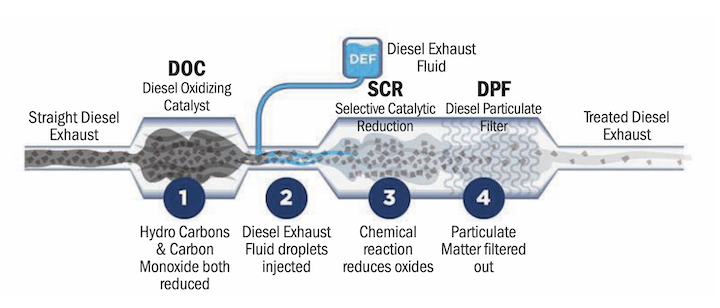
But it doesn’t have to look like that. it isn’t a requirement. If the manufacturer can limit particulate matter through an adjusted combustion process and meets the Tier 4 limits why would he use a DPF that can cause problems because of the necessary regeneration?
Since 2010 Mercedes Benz offers busses mit SCR but without DPF: https://www.greencarcongress.com/2010/04/benz-eev-210100415.html
Sorry, but I trust the linked sources more than your opinion.
1 Like
Not mentioned is that a lot of railroad refueling is done by fuel vendors using tank trucks.
Jeff
Is that really a problem? If I send one or more diesel tank trucks to refuel locomotives, why not also send a DEF tank truck?
It’s a little more complicated and is reflected in the costs.
These costs have been saved by refusing SCR, but at the same time the additional costs for poorer fuel efficiency have been incurred.
Perhaps the DEF infrastructure has just been put off, because when an EPA Tier 5 comes, it will no longer work without DEF.
Most of the additional logistics for DEF have been worked out; it’s just that the additional costs are ‘unnecessary’ for PSR-style mindset. A major issue in operations for the United States at least is the Government-mandated response when the DEF delivery system fails for any reason: as a ‘deterrent’ the engine is disabled from making power (the euphemism is ‘derated to zero’ and will not move under its own power until full functionality has been restored. This was starkly demonstrated during the initial press rollout of the F125 for Metrolink, where the new engine, clearly visible in the background, became inhibited on its way to the station platform and could not be moved even the ~300’ to static display, blocking part of the station plant in so doing. That was extremely poor advertising for the future of a road locomotive, perhaps in poor weather in an isolated North American location, perhaps on a ballast prism or bridge with poor foot access.
Until recently, the kind of tank truck used to refill Amtrak locomotives was not set up to dispense DEF, even though usually provided with multiple containers and pumps. DEF is aqueous and somewhat corrosive, and freezes at a somewhat elevated temperature, which implies extensive and careful rebuilding of a vehicle built for hydrocarbon dispensing; again, given sufficient demand, this is less of an issue but ought to be subsidized by public money if absolute minimization of NOx even at the cost of much higher carbon emissions is deemed a ‘public’ necessity. Perhaps some here are ‘au courant’ with how Amtrak services Chargers on LD routes.
In my opinion, the practice in the N&W lubritoria is a guide to how DEF dispensing would be handled at typical fueling points. The hoses and nozzles would be color-coded, and sized so that DEF could never be dispensed into fuel by mistake (this is harder to assure in a railroad context than in ‘automotive’ practice because of higher filling rates with prompt shutoff detection; my preference would be with ‘keyed’ extensions on the DEF dispensing head) and tracer preheated. Additional incremental hookup and disconnection time per unit need not be substantial, and could be accomplished ‘in parallel’ if more than one employee is working a fuel pad.
As with TLM and bridge construction for HSR, the ‘key’ is standardization of all equipment and systems, and careful development of procedures, training, and constructive (rather than merely punitive) discipline.
2 Likes
If we go back to the 1970’s, there was an effort to get widespread availability for unleaded gasoline some 4 years before cars with catalytic converters hit the road. The early converters didn’t handle NOx, so the engines were set to run rich to dampen NOx production with subsequent reduction in fuel economy. UOP had developed a three way catalyst which required precise control of the air to fuel ratio which was not doable with the technology that existed in the early 70’s. The answer came when a Volvo engineer was reading NASA Tech Reports and saw an announcement about an oxygen sensor.
For commuter locomotives I would wonder if gas turbines burning compressed natural gas and equipped with steam injection would be an even cleaner solution. The weight saved using a gas turbine should allow for a battery pack that would allow the turbine to run at near constant power.
The way it was explained to me by Cummins: you can design an engine to have low NOx and high particulates OR low particulates and high NOx. Cummins went with the latter and added the SCR equipment on the exhaust to get the good vibes and rainbows.
The ‘particulates’ involved with a DPF are purely ‘soot’, and they are caused by a combination of inadequate promotion and short combustion time at higher engine rpm. Obviously increasing peak CR and charge temperature in the presence of sufficient oxygen will reduce the size and ‘frequency’ these form from the hydrocarbon fuel backbones.
Meanwhile the “PM 2.5” and under carbon particulates form when direct injection is used at high speed (both in gas and diesel engines), and again, avoiding early quench is just as significant in a CIDI engine as in the radiant section of a steam locomotive. These are the real health hazard from modern IC engines. No practical filter, especially not one amenable to ‘cheap’ regen, captures essentially any of this except insofar as adsorbed onto sticky trapped soot.
The ‘correct’ solution, imnsho, is to run the boost up with twins or triplets, and take the ‘hit’ of additional DEF consumption (and the additional contrivances needed to avoid ammonia slip) to get the better engine thermodynamics.
1 Like
I hear there are changes going on in the US with diesel engine emissions standards .
It sounds like the smog gear may be removed allowing them to return to 2006 or 2008 standards ? Is this only for on road or could it extend to rail transport .
You have to wonder what the effects will be on your US economy if impossible to achieve standards are enforced on your transport industry .
Clearly battery electric technology is not yet viable and merely stating it has to work because “it’s got to” isn’t going to fly .
Something else to ponder is that in a troubled world can you allow tough standards to influence national security . Food for thought .
So far, nothing has happened, except that the EPA has announced its intention to rescind the 2009 Endangerment Finding declaring GHGs harmful to human health. This means that GHGs fall under the Clean Air Act.
EPA administrator announced publicly at an Indiana truck dealership the agency’s proposal to rescind its Endangerment Finding (EPA-HQ-OAR-2025-0194-0093), beginning a public comment period ending September 15, 2025.
Source: https://en.wikipedia.org/wiki/Regulation_of_greenhouse_gases_under_the_Clean_Air_Act
From an EPA press release: https://www.epa.gov/newsreleases/epa-launches-biggest-deregulatory-action-us-history
Reconsideration of light-duty, medium-duty, and heavy-duty vehicle regulations that provided the foundation for the Biden-Harris electric vehicle mandate (Car GHG Rules)
Locomotives are not mentioned in the EPA press releases and for the time being it is probably about the new stricter rules that will come into force in 2027, which are not to be introduced.
The irony of the story is:
The U.S. Supreme Court ruled in Massachusetts v. EPA that GHGs are air pollutants covered by the Clean Air Act. The EPA may regulate GHGs if they are determined to be a danger to human health.
Source: https://en.wikipedia.org/wiki/Regulation_of_greenhouse_gases_under_the_Clean_Air_Act#Legal_timeline
With the current composition of the SCOTUS, that shouldn’t be a hurdle.
The question is whether American consumers want to go back to 15-20 miles/gal cars when it comes to fuel prices.
I suspect locomotives are not publicity effective enough for Trump.
But you should never say never.
Regards, Volker
PS: But why go back to the 710? It is an outdated engine and his worship seems to be more of a Railfan thing, as many urban legends surround him show.
One of them, that the 710 only just missed Tier 4, is contradicted by EMD. The 710 made Tier 4, but it got so big, heavy and ate so much fuel that it became so uneconomical that EMD deemed it unmarketable and began development of the 1010.
Go back and look at the data from the EPA for that period, and you will see how narrowly the 710 missed the NOx target, and over how small a percentage of the test duty cycle.
There is no reason whatsoever than ameliorating NO and NO2 would make an engine ‘eat so much more fuel’. That is normally a function of implementing an idiot DPF with an even more stupid requirement to clean it via ‘regeneration’ with intentionally rich fuel mixture.
The four-stroke engines will inherently provide cleaner HC and lower SFC, and if Progress can actually get the 1010J to run at comparable HP and duty cycle without SCR or cavitation issues, more power to them (no pun intended).
Personally, I wouldn’t trust Caterpillar entirely when they come up with an excuse for losing all that money and time. These are the same folks who tried to prove Siemens couldn’t achieve PRIIA required performance with the Charger, while trying to peddle their C175 alternative.
2 Likes
The Railway Gazette International had an article called Tier 4 locomotives take to the tracks in their December 2015 issue.Developers from GE and EMD also had their say.
EMD’s long-established and popular 710 series engine had been successfully upgraded from Tier 2 to Tier 3 with few problems, but going to Tier 4 was reaching into unknown territory. Using a modified 710 engine, EMD put its initial two-stroke solution on one of its test cells even before EPA had published
its final Tier 4 requirements for locomotives. It therefore used EPA’s off-road rule of 3·0 g NOx per horsepower hour. Much to their delight, the 710 engine easily met the off-road requirement,
and EMD felt that success was within their grasp.The 710 loved it’, recalls Lenz. But the euphoria was short lived. ‘The EPA came out with 1·3 g/bhp-h for Tier 4, not the 3·0 we were hoping for.’ Not to be defeated, the engineers looked at adding more EGR and installing giant particulate matter filters on existing locomotives.
Using a pair of borrowed Union Pacific SD70ACes fitted with large roof boxes for emissions testing, Lenz says EMD successfully got the 710 engine up to Tier 4 requirements. But while The tests were successful, the resulting design was too heavy, too cumbersome and not cost competitive enough to be marketable. In particular, the fuel economy was worse than for Tier 3.
The artice was once on GE’s website but not available anymore
This discussion feels frustrating for a number of reasons.
1: As for the 710 hitting Tier 4 we’re talking about 2 different tests and conflating the 2. UP9900 and SD59MX with a v12 ECO Kit was fitted out in an attempt to meet Tier 4.
They called it Tier 3.5. This is the engine that got almost to Tier 4 and was off by a ridiculously small amount
https://www.railjournal.com/locomotives/union-pacific-tests-low-emissions-locomotive/
However, the discussion that was posted by EMD was a second test using SD70ACes to get to T4 on a 4400HP unit. that was the test that succeeded but was not a viable product.
Also, for the record, the Engine in the GE T4 is not just an evolution with some doodads added. The difference between the EVO and the T4 is almost as much as the difference between a 265H and a 1010J.
As noted the J and H denote the engine block. EMD skipped I, but the 710 used the G block, the 645 the E and then F block, the 567 the A-D block. 265/1010 is a reference to the power assembly. I’m not sure how different those are.
A 710 comes in many flavors with different types of injectors, different cooling, but their all still 710s.
It’s worth remembering when discussing EMD is that many of their Engineering problems are due to corporate neglect. GM had been letting the division rot since effectively the 80s. Greenbrier was not going to spend money on big Engineering efforts. So EMD really didn’t get back into funding engineering until Caterpillar came in. They were very very late at that point.
As to why go back to the 710? Well, don’t think about it as going back to the 710, maybe we need a 710I block or a 710K block. The 710G is maybe at the end of it’s useful development life, but that doesn’t mean that there isn’t more that could be done with the classic 2 stroke design. Especially given that the 16-710 in the ACe is about as fuel efficient as the T2/T3 V12 GEVO.
There are potential advantages.
But honestly, I think EMD is probably going all in on Battery at this point. Or, they will look at developing smaller engines that can complement the battery locos.
1 Like
Someone said that the PSR mindset is to avoid DEF , maybe what it will take is the eventual gun boat approach by your EPA when T3 units can no longer be rebuilt - to T3 spec .
It would be interesting to see how the eventual T4 spec fuel consumption/maintenance costs compare to DEF distribution infrastructure .
I don’t think it was PSR, the roots are earlier.
PSR was widely adopted by class 1 railroads from 2012 on. The Tier 4 emission standards for locomotives were finalized by EPA in June 2008. From that time on the class 1 made clear that the would only buy EGR equipped locomotives:
‘We’ve thought about Tier 4 since 2005’, says Tina Donikowski, recently-retired Vice President of GE Transportation. ‘We had plenty of time and notice to meet the deadline.’ She says GE realised early on that it could meet the new emissions standard using urea, but there would be consequences.
‘Aftertreatment could add almost 2 tonnes to the locomotive’, she says. ‘And as far back as 2008, the rail
roads told us in no uncertain terms that they did not want to handle SCR and its attendant aftertreatment infrastructure, at an estimated cost of $1·5bn.
Source: Tier 4 locomotives take to the track, Railway Gazette International, December 2015
I think as long as there is a Republican party led government there won’t by any more strikt emission standards. The fact that the current ones have not yet been relaxed is probably only because Trump cannot impress his supporters with them.
In the Final Rule for Tier 4, the EPA already assumed that locomotive manufacturers would use SCR.
For more far-reaching restrictions, it can be assumed that the limit values will be set at a level that can only be achieved with SCR.
Alternatively, this step will be skipped and the aim will be to achieve net-zero straight away, as CARB has attempted to do with regulations for existing locomotives.
Regards, Volker
Trump’s administration is seeing what the actual economic and operational experience has been with the latest generation of emissions standards. Then they compared using real world data not the cherry picked data and realized something. The current emissions systems are costing the economy billions in lost productivity and lost time and billions in higher maintenance costs. Plus loss of jobs as no one wants to order new locomotives anymore it’s been almost a decade since EMD sold anything new. GE is surviving doing overhauls with the occasional new order. They got an order for 100 that’s it for this year. UP is just overhauling. BNSF buys the occasional new bunch but mostly overhauls NS has yet to order a tier 4 CSX same thing.
No one wants them period in their fleets. The emissions savings in terms of actual produced emissions are less than .2 grams of CO2 per hour and .4 grams of NOX between tier 1 and 4. That’s what overreach on regulations got us.
1 Like
Your President is probably the only one that could get them relaxed to a degree .
And a lot of this is going to depend on where people sit with where things are ATM ..
Transportation costs are a large part of your economies viability .
Some industry insiders are saying that the jump from T3 to T4 was too big , history has shown that the migration from Tier 0/1/2 in greater volumes to T3 has had a greater real world effect than T3 to T4 .
Many would be curious as to how informed your EPA reps were when they er drew the T4 line in the sand . It’d be interesting to know if they genuinely didn’t realise that the update of earlier tech locos on mass would be a neat work around in economic reality land .
And , the fact that the then GETS and EMD could at considerable cost and complexity achieve T4 without DEF .
Truly independent economists would have noticed that GE and GM got out of the locomotive building business very likely because their market for new units was all but disappearing . The operators were clearly not impressed with the operating costs and reliability levels of more complex EGR derived T4 offerings .
I’m beginning to wonder that if the whole US rail transport industry got together and looked at exhaust emissions as a national fleet thing rather than on an individual locomotive basis , improvements could be achieved without financial pain .
Is it possible that say a tier 3.5 level would give greater and more immediate overall change and be financially viable to your rail providers .
I think this could make the drive for technical innovation more palatable and more likely to actually happen .
What are you talking about? Ns has a bunch of et44acs. So does csx.
There’s no need to buy anything when you have half the roster in storage or sold off.
NS has a total of 80 on the roster per NSdash9.com out of those 80 60 are stored. 75 percent of their newest power stored. CSX has 250 total on their roster but has stated no more.
I’ll admit I was wrong. But still when class 1s are flat out refusing to even consider new engines. The only reason why UP and BNSF have been placing the odd orders is one reason to keep California off their backs. By ordering new power they can say they are trying to reduce their emissions. But now California is losing their exemption to regulate emissions standards so look out.