It’s a moot point now, but getting the power to the frogs and the diamonds without a plethora of switch gangs or relays was my issue. But your solution (my reply above) solves everything. Thanks again!
Regards,
Bruce
It’s a moot point now, but getting the power to the frogs and the diamonds without a plethora of switch gangs or relays was my issue. But your solution (my reply above) solves everything. Thanks again!
Regards,
Bruce
Thanks for the help, Mel. As you have probably seen above, Lastspikemike suggested an alternative that solves the issue with a lot less fuss than my being locked into thinking a double crossover was even necessary.
Everyone on this thread has been very helpful, and I thank you all.
Regards,
Bruce
You are welcome, and I was about to suggest the same thing Mike suggested. The real railroads avoided double crossovers. Modelers should use them sparingly only when spacs and function really require them.
Sheldon
Have to agree with you Sheldon.
I was fascinated with double crossovers and double slip as a teen and never got over it. I finally decided to include either a double slip or double crossover in my final layout design just because I wanted one.
I couldn’t find a manufactured code 83 double crossover that would pass my fleet of large flange Rivarossi Cab Forwards without the wheels shorting so I ended up with a single crossover using a pair of Atlas #6 turnouts. Running SP Cab Forwards was more important to me than the double crossover.
After about 20 years of frustration not having a double crossover I decided it was time to do something about it. All my large flange Rivarossis would clear all my code 83 #4 & #6 Atlas Custom Line turnouts without problems so I decided to build my own double crossover using Atlas turnouts. And it worked first try and has never had a single problem since it was installed in 2012. I didn’t have any problems with the #6 turnouts on my layout but I included the frog wires to all four turnouts. Every locomotive ran without problems so I never used frog power. I have one 0-4-0 switcher with a slope back tender and it doesn’t have problems with unpowered Atlas frogs.
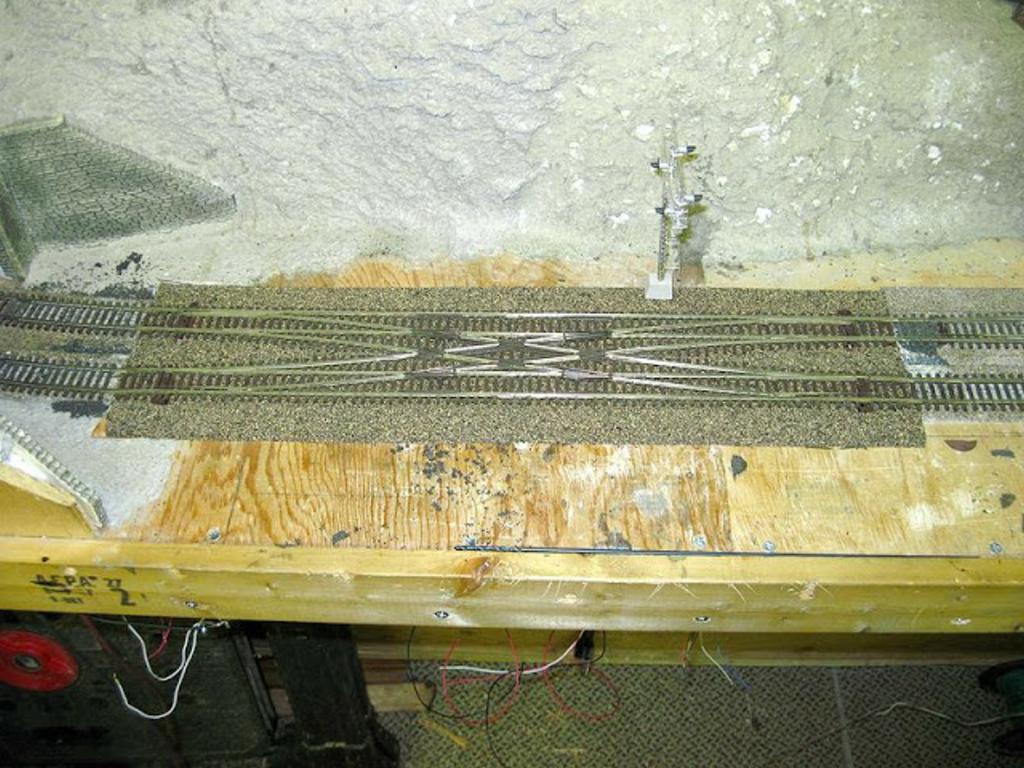
The angle of the dangle is pretty good too, no problems with the ‘S’ curve even at full speed (about 70MPH scale).
Mel
Well, love to take credit but there’s a lot of brainpower and even more expertise available on this forum. I dig around and maybe put stuff together in one post but it’s pretty much all from somewhere else on this forum or in one or more of the excellent books on model railroading.
One other thought you might like to consider if you can fit the required grades in is the well known and popular “twice around”. This is a pleasant variation on your inside and outside loop. Come to think of it you can also achieve this with one of your crossings if you don’t mind dealing with the risk of collision.
You connect your inside loop to your outsid
This is my HO twice-around layout.
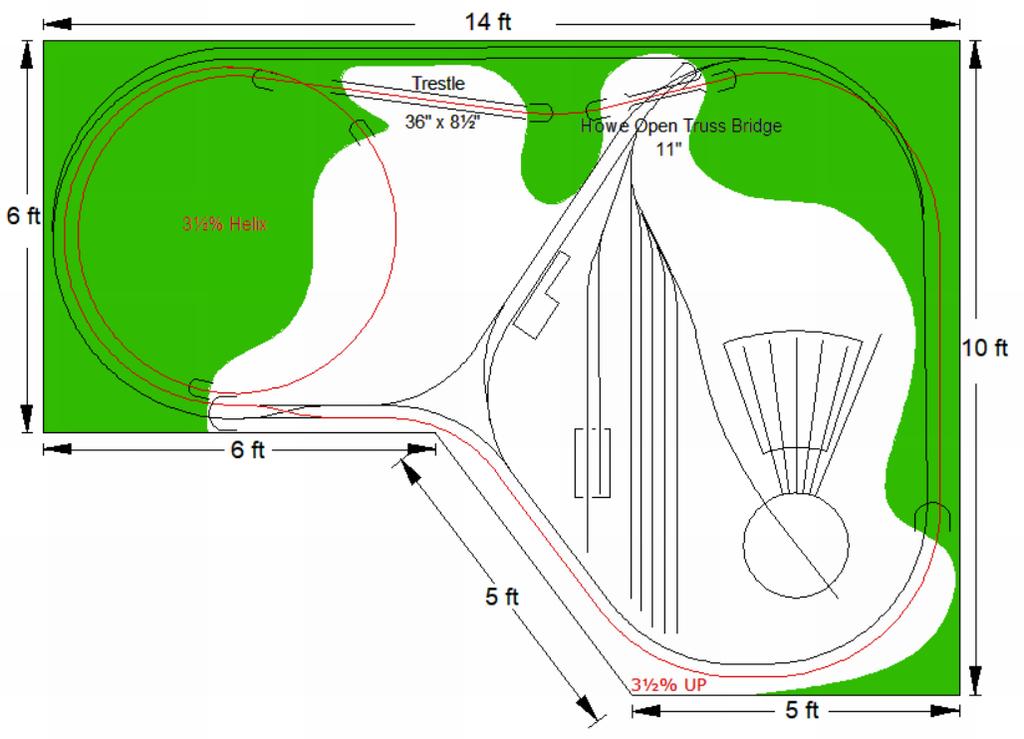
The red track climbs from 0 to 10” then back down to 0 through the helix. A single mainline folded on top of its self with my double crossover connecting the tracks.
All of my layouts have been of twice-around design modeled after my mentor John Allen’s original Gorre & Daphetid layout. My second layout was a 4’ x 8’ duplicate of John’s original 3’7” x 6’8” layout.
I made a wye out of the loop so I could reverse directions.
Mel
My Model Railroad
http://melvineperry.blogspot.com/
Bakersfield, California
I’m beginning to realize that aging is not for wimps.
Keep it simple - there is no need to switch cabs int he middle of the crossover. Either the whole thing should connect to one cab, or the whole thing should connect to the other cab. Two trains can’t run through there at the same time anyway.
Since two traisn cab go straight at the same time, then the top two turnouts and the bottom two turnouts can be different blocks, same as any other block on the layout. But the diamond int he middle - that should only connect to one cab or the other, notroute back and forth, ro have one angle be be cab 1 and the other angle be cab 2. You could use the second set of contacts on one Tortoise to feed the diamond from whichever cab is feeding the lead in block. You need two sets, so use the two diagnonal toroises, since for the train to get rhrough, the block it is entering from and the block is it leaving from have to sbe set to the same cab.
An insulated frog diamond is your friend here, like an Atlas one. AN all rail sort like a Fast Tracks one requires far too much switching - or is easily wired with Frog Juicers, but they only work with DCC. It actually shouldn;t be too bad - since only oen train can cross the diamond at a time, if all 4 legs are insulated, the whole thing can be powered by the contacts of the top eft and lower right Tortoise, OR the lower left and top right. Frog power for the turnouts is straightforward, same as any other turnout. Since only one train can occupy the duiamond at a time, if crossing from top left to bottom right, those two sets of contacts would power the entire thing when those two turnouts are set to diverging. The bottom left and upper right would ahve to be set straight. When all 4 are set straight,t he diamond has no power. And then the lower left and top right power the diamond when they are both set to diverging. Forget to set one to diveging - train dies on the diamond because it’s not fully powered. Set all 4 to diverging, it will cause a short, because this is an invalid configuration.
If I remember correctly, I wasn’t able to do bridges or tunnels as the grades would have been too steep. The only changes in elevation are the mainlines and their sidings will be higher than the yard and industrial tracks, with ramps in the sub-roadbeds to make the transitions.
I think this layout might also see duty as a “Christmas pike” with two trains running continuously in opposite directions just to amuse and delight civilians.
Regards,
Bruce
[quote user=“rrinker”]
Keep it simple - there is no need to switch cabs int he middle of the crossover. Either the whole thing should connect to one cab, or the whole thing should connect to the other cab. Two trains can’t run through there at the same time anyway.
Since two traisn cab go straight at the same time, then the top two turnouts and the bottom two turnouts can be different blocks, same as any other block on the layout. But the diamond int he middle - that should only connect to one cab or the other, notroute back and forth, ro have one angle be be cab 1 and the other angle be cab 2. You could use the second set of contacts on one Tortoise to feed the diamond from whichever cab is feeding the lead in block. You need two sets, so use the two diagnonal toroises, since for the train to get rhrough, the block it is entering from and the block is it leaving from have to sbe set to the same cab.
An insulated frog diamond is your friend here, like an Atlas one. AN all rail sort like a Fast Tracks one requires far too much switching - or is easily wired with Frog Juicers, but they only work with DCC. It actually shouldn;t be too bad - since only oen train can cross the diamond at a time, if all 4 legs are insulated, the whole thing can be powered by the contacts of the top eft and lower right Tortoise, OR the lower left and top right. Frog power for the turnouts is straightforward, same as any other turnout. Since only one train can occupy the duiamond at a time, if crossing from top left to bottom right, those two sets of contacts would power the entire thing when those two turnouts are set to diverging. The bottom left and upper right would ahve to be set straight. When all 4 are set straight,t he diamond has no power. And then the lower left and top right power the diamond when they are both set to diverging. Forget to set one to diveging - train dies on the diamond because it’s not fully powered. Set all 4 to diverging, it will cause a short, b
When entertaining civilians simplicity of operations is a good th
The biggest irony of the double crossover is that you don’t really want any curves starting right at the switch points, so by the time you leave some straight track on either side, you could have just used two opposite crossovers.
Now if you you really want to see a wild double crossover, go visit the Severna Park Model Railroad Club.
They have a double crossover - BUT - one of the turnouts is a double slip switch, so three tracks on one side, two tracks on the other side, every route possible, in less than two feet. And the turnout next to the double slip is the opposite hand, so it changes the direction of the mainline, using the curved route as the main.
The third track is the yard lead off the double track mainline. The whole thing is scratch built and now about 55 years old. It worked flawlessly for the many years I was a member there. Here is a link to a photo:
Sheldon
Now that is slick Sheldon!!! I could have built my layout with that design and would have had a double slip too. Didn’t think that way back in 1988 during the design or my layout would have had a double slip.
Mel
My Model Railroad
http://melvineperry.blogspot.com/
Bakersfield, California
I’m beginning to realize that aging is not for wimps.
Friend of mine had something like that on his N scale layout. Only kicker is, it was hand laid with Code 40 to fine scale standards. Physically it was very reliable, vbut even I gave up trying to figure out a combination of Tortoise contacts to set all the frogs correctly. Eventually he discovered that one of the routes he thought he needed was never in fact actually used so he simplified it by making it a single slip and a double crossover. Frog Juicers weren’t around yet, but that would have been the way to go with this thing.
His new layout has nothing more complex than a double crossover. Still handlaid, Still Code 40, still fine scale standard. Locos are no problem, he scratchbuilds those, and lathe turns wheelsets for the rolling stock from standard N scale metal wheelsets.
–Randy
And, once again, a track configuration that can be found on the prototype. At one time, Dearborn Station in downtown Chicago had a double crossover with double slips on two diagonal ends of the double crossover. Gotta love that stuff.
Rich
Bruce, if there is any chance you will decide to use a double crossover, and will need the rotary switch, you might want to order it now just to have it.
I needed a 12 pole double throw rotary switch to control a double crossing with solid frogs and signalling. I ended up ordering a military surplus switch from a former Soviet block country!
It is better to have it and not need it.

-Kevin
In Soviet Russia, switches switch you, or something.
There’s still a wide variety available from the usual electronic parts suppliers, and many of them are actually customizable - you can add as many decks as you need, to a point. Too many and you might need a breaker bar to change the position.
–Randy
Thanks, Kevin.
I’ll check online and see what’s available.
Regards,
Bruce
All that stuff is fascinating…I can stare at pictures of that intricate trackwork for hours, but modeling it…not so much.
That summer I worked for the UP I drew a shift that dragged the outbound City of Los Angeles backwards into LAUPT (now L.A. Union Station) to board passengers. The diesels (E8’s and E9’s) would be brought in separately and coupled onto the train. That was probably the most complex trackage I’ve seen personally, but it would be one big challenge to model that in any scale.
Regards,
Bruce
Another shot of the Severna Park trackwork

+1
Rich