OK, I have pondered on this subject for a while longer, and I am confident that I never owned a poorly running HO scale locomotive.
My Tenshodo 0-8-0 is noisy, but runs great.
I switched to HO after I had an entire fleet of Kato locomotives in N scale. I previously had owned tons of poor running locomotives in N scale, and I guess I learned all my lessons there.
After switching to HO I knew that only god runners were worth buying.
For at least a decade, I only had 4 HO scale locomotives, and they were all good ones.
Tyco 2-8-0, with the awful tender drive. My very first steamer. I think it started breaking down after 15 minutes. What a disapointment for a 10 year old kid.
But the biggest disapointment was the Bachmann Climax B, given the money I paid for it. One hour of running time and the gears broke. The NWSL kit is on the shelf…
The best all-around value: my Bachmann 2-6-0 (new tooling). A fantastic engine for the price…
OK, so I did buy a Tyco F unit, and it ran like garbage. But… I knew that going in. I bought it for nostalgia. That locomotive now has a Proto-Power-West chassis with a Sagami can motor. It runs great, and that was always the plan.
Unfortunately a series of worst engine when I was 11-15 years old. 2 Tyco C-430’s with the drive on the front truck. Ran for a while but then the gears of the drive started to break and fall apart. Loved that Bicentenial paint scheme on one of them.
These were followed by a series of AHM diesels - S2, a pair of SW-1’s with one powwered, a dummy and a matching caboose. The S2 and SW-1 had a single powered truck with traction tires and never ran or tracked well.
I got many years of good use out of the Mantua C-430’s (4 of them) and one of the Tyco crappy Power Torque C-430 units from 1978.
The worst loco I ever owned was the AHM/Rivarossi N&W Y-6B with the three pole motor. 1. the motor sucked 2. Plastic wheel centers? really? Why would any sane person design that? Eventually the wheel centers fail and turn freely on the axle. The only good solution, which is expensive, is replacing the entire axle. The store where I worked had all the parts, so that is what I did: rebuilt one entire Rivarossi Y-6B. Then the only question was: how long will it last till it fails again?
The worst running loco I ever had: Rivarossi Y-6B.
Am I the only one to have (or admit to having) a pair of Marx F-3A units? Actually, they could have been F-2s, since they had three portholes molded into their sides. I made the mistake of trading a guy some model airplanes (non-flying) for these beasts. They were ugly, looked more like they were crying, instead of that EMD bulldog nose. Noisy? When these two took off with a train, conversation was no longer possible, possibly due to the exposed gearing on the truck(s)? Switching? You’ve got to be joking. Right? Trying to start a train of more that seven or eight cars on an 18 inch radius curve, always wound up with half of them laying on their sides, due to stringlining.
About 1960, I found Athearn’s HiF (rubber band drive) GP-“9” (actually a GP-7), F-7, and RDC’s. Not much improvement in operating characteristics but, a whole lot quieter. Then came a Lionel 4-6-2 with a gear drive. Much better all around performance, except for switching (with a 4-6-2?). Lionel, true to their tinplate roots, molded the die cast frame with a solid road pilot, making installation of an operating coupler, a major undertaking. I know, some roads used Pacifics in freight service, but not the one I was modeling. I wanted my airplanes back!!!
All of us here who started out with these hokey pieces of refuse managed to stay in the hobby by finding there were better locomotives to be had. How many people out there figured it was all junk and threw in the towell. I wouldn’t have lasted much longer had I not been enlightened.
Besides Athearn’s GP 35, Kadee couplers and Atlas nickel silver were pivotal to keeping me in the game, even though I’ve expanded beyond those products ('cept Kadee).
What a disservice to the hobby, and the industry the manufacturers of this sub par junk rendered in the long run, to sell a few, or even a lot of cheap disposable articles of landfill. That’s hindsight, but knowing that wouldn’t have changed anything.
It’s still Phriday here, I can Filosofize! [;)] Dan
Back in the late 70’s, my wife bought me a Tyco Chatanooga Choo Choo 2-8-0, for Christmas. It was a poor runner at first and only got worse the more I ran it.
After reading all the responses, I have a question. In the time frame where many of us grew up (50s/60s), were there any brands that produced reliably running HO engines? I grew up in Germany and had a 7’ x 3.5’ Märklin layout, put together by my mom (God bless her soul). I had 5 engines, and they all ran like a charm; the slow-speed control was excellent. The two electric locomotive models even had working pantographs, allowing to run two trains at the same time (one fed by 3rd rail, the other by catenary). Of course, 3-rail AC makes reliable operation a bit easier; but I remember one of my friends had a 2-rail DC Trix layout, and there were no operational problems either.
I started out in HO scale in 1951 with a MDC Roundhouse 0-6-0 as my first locomotive and a couple of years later bought a Varney “little Joe” Dockside switcher, both were and still are great runners.
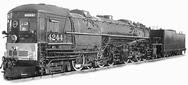
My worst ever locomotive was not one but three Southern Pacific Bachmann pancake motor 4-8-4 GS4s in the 1990s, after about a year the driver wheels fell off all three locomotives.
Beautiful shells but totally worthless runners. I kept the shells and tenders and sold the mechanisms as junk. Later on I used the Bachmann GS4 shells for kitbashing Rivarossi Cab Forwards into AC-9 2-8-8-4 Yellowstone class locomotives.
Penn Line GG1. Compressed length. Zinc wheel centers. Lousy end door inserts. Terrible tiny Pantagraph and top heavy. At the time the only one available.
Most everything in the US that fit that requirement was sold as a kit.
Hobbytown diesels were quite good. Athearn was coming up.
Penn Line seemed to be good. Mantua was kinda pretty good. I think Varney was going downhill in running quality, but there might still have been some good ones available.
I can’t think of any RTR stuff that was good, except brass. I got my brass 4-8-4 in about 1963, and it was very nice. And came painted–RTR.
This is high jacking the thread but you have no idea how bad track was. In the 50s pent up demand for housing resulted in developments of 900 Sq ft. Houses. A really big house was 1100 to 1200 sq. Ft. 18" curves were considered huge. Brass was the only rail choice and 3’ legnths were stapled to fiber strip ties that swelled with moisture content. There were no NMRA standards for anything and Baker loop and hook couplers were the standard for good operation. It was pretty much a Kit and scratch build era. 4’x8’ was considered a luxury layout. Then somebody figured out that ping pong table plywood was available in 5’x10’ pieces plus you needed a tiny basement or a dedicated room in those small houses.