The title of this thread is “You can’t just rip up railroad tracks even if you own it as per STB (at risk tourist lines)” In other words, it’s about “at risk” tourist railroads. It’s not, at least as stated, about “how to find abandonments before 1920”, or the various other questions going beyond the “tourist railroad” issues. Mudchicken is certainly free to address broader issues on this thread, if he chooses to do so. But castigating me (or others) for supposedly not properly addressing his issues is inappropriate.
Let’s review the “tourist railroad” issue that this thread is about without the name calling. The question I initially addressed is when STB authority is required to oust a tourist railroad from a rail line it is using but doesn’t own. This is the scenario presented with most (probably all) of the tourist railroads currently “at risk”. A state or local government entity acquired a rail line, made an agreement to let the tourist road use it, and now wants to oust the tourist railroad to turn the ROW into a trail or for other reasons.
The answer to this question depends on the answer to another question – was the line previously abandoned? In the northeast (where most of the “tourist railroads at risk” seem to be), abandonment could have happened when the northeastern railroads’ final system plan was implemented in the mid 1970’s (off the top of my head, I think it was 1976, but don’t hold me to that). If the line wasn’t abandoned with the final system plan, it could have been subsequently abandoned. How do you find out? Well, you
See my reply note of 6/13/2016, 9:54 PM on this thread for a short description of my background.
Why would you (or I) mind that you’re a female? My railroad had (and still has) several very competent female lawyers at high levels, and we had no trouble at all working with each other. There’s also a strong female presence in other departments. Railroading is very definitely not the “male” dominated industry it was when I started (1973). It’s a change for the better.
You don’t mind. I don’t. Some/most members don’t. But pretty obviously some forum members have been pretty contemptuous of assertive female posters (who have s
Not pretending to any professional expertise, or even distinctive competence, in either surveying or railroad law. But that hasn’t been the topic of contention at all in most of the discussions regarding ‘trail conversion’ of these rail lines. Whether or not the tourist railroad operators get to continue using a line ‘owned’ by another entity is more a matter for contract between the two parties. The big issue is whether the owning entity continues to have any title to, or control over, the ROW real estate when it is no longer being used for railroad purposes.
To my knowledge, that doesn’t become a concern as long as the tracks are still present, even where there is no ‘active’ or current effort to maintain them in usable condition (witness some of the documented washouts on the Adirondack Scenic). But when conscious effort is made to remove the rail infrastructure, in some cases – and the Adirondack line has been definitively identified as one – the complete ownership right of the State agency or agencies concerned disappears, and adjacent landowners (or other entities, notably (as stated on RyPN, at least) ‘forever wild’ organizations controlling adjacent tracts) may well be able to prevent subsequent ‘redevelopment’ as a trail, or anything else. (One point repeatedly made being that a trail that is interrupted by ‘no trespassing’ signs or fences is not very worthwhile for actual public purposes, let a
OMod, Wans and Falcon - I can honestly say I have never (knock wood) been verbally attacked on the forum. Usually silence is what I see. It is nice to hear from some of the gentlemen on here that actually comment on my statements - like I am a real person. But I don’t come here for verification of me, I like reading the information and comments on here. And to enjoy some of the humor. Wans - punch cards - very interesting! I wish I would have known that back then - maybe it would have made classes more interesting. Falcon - I wasn’t pointing to male vs female - except my time frame was such that acceptance was pretty non-existent. I would have preceded your start date by about 10-12 years. And I wanted to be the person in the right hand seat.
Mod - we go back a few years - I remember timidly asking about your screen name. Someone set me straight, but I still bet there is a story behind it.
I would be honored to call you Jen - but only with your full permission, and the understanding that it does not mean I’m ‘presuming’ on friendship in any way.
The screen name is derived from the ‘handle’ that an old girlfriend used – it is a multiple and self-deprecating pun including the sense of ‘overmodulation’ and ‘overmodulation distortion’ (in the radio sense, but applied to ‘other things’ as well), her fashion sense of being ‘over mod’ in the sense of proving anything. I add to it more personal senses of being an upper-level moderator (in the e-mail reflector group sense of reaching common consensus rather than regulating with edicts and bans, and also the nuclear sense). Not quite up to the Rrose Selavy level, of course, but I think not bad in keeping some of the sense alive that at least some things in this world might yet be perfectible.
In response to Overmod’s latest note, you’re making exactly the same point that I made in very summary form. If the railroad’s title to the ROW reverts on cessation of rail use, the removal of the railroad and the conversion of the ROW to a trail could trigger the reversion (unless there’s a state marketable title law that extinguishes the reversion). In that case, the goverment landord would lose title to the reversionary property
This is unlike a “rails-to-trails” situation under the National Trails System Act (NTA). The NTA only applies to a railroad that hasn’t been abandoned, but is being proposed for abandonment. If STB authorizes NTA trail use, the ROW is deemed, as a matter of Federal law, to not be abandoned for rail use, even if the tracks are removed (the holders of any reversionary interests may be entitled to compensation from the U.S. for a “taking” of their property, but that’s a subject for another day).
The NTA option is not available for a ROW that has already been fully “abandoned” through STB or ICC procedures. Therefore, normal state law on whether the property reverts would apply. So, if we are talking about a ROW where the railroad was “abandoned” as an STB regulated common carrier, but is still being used by a tourist railroad, the ouster of the tourist railroad and removal of the track structure could very well trigger reversion.
As I mentioned in my earlier note, I’ve been told of one line used by an “at risk” tourist road where the governmental landlord recognized this problem and condemned the ROW to remove the reversionary interests.
O - well, since my real name is Jenny and since most people will mangle it to Jean, Jeannie, Ginny, is it short for Virginia?, etc and since the only other breathing thing I know is a donkey - which is a Jenny - I shortened it to Jen. And if anyone is uncomfortable with friend, then we can be acquaintences. I am here to learn some more and pleasantries are always enjoyed.
Ref. Posted by cx500 on Monday, June 13, 2016 11:04 PM
As a retired school teacher, I had the opportunity to work as a surveyor’s helper in the summer months. (except for teaching, and railroads, my next love ((‘ceptin my wifee’)) was the survey work.
With that said it is interesting to read about the survey subject here on this thread.
I soon realized as my boss taught, surveying is not a science, it is an art. He said and proved by citing examples he had been involved in……”give me the data from an opposing surveyors viewpoint and I can beat him in court.”.
Lawyers do this all the time, it is their job. If good, they can defend a guilty man into a not guilty verdict. For the sake of justice, we hope the defense had a good lawyer too.
But I digress: For those not aware: it is very difficult to fit a “flat” des
Posted by Paul_D_North_Jr on Sunday, June 12, 2016 9:46 PM
Accurate/precise: Because this is something so easily accepted as the same, as a chem/physics teacher among many other things this was one that was so much fun to show the difference and get that concept across to the student. VERY important to know the difference. Endmrw0614161635
In the case of the Adirondack - adjacent properties are for the most part now owned by the state of NY.
The bigger problem with the Adirondack (and the corridor) is the environmental preservationist groups who will insist that the ROW assume the characteristics of the surrounding land, which in many cases is wilderness or primitive and may restrict use even by hikers.
As PennCentral was transitioned to Conrail, PennCntral kept a lot of the non rail real estate. And became American Financial. Did any of the non-Conrail track ROW’s transition to PennCentral and thence to AF?
Yes - and there are plenty of lawsuits to go with those unwanted pieces. Indiana had a pair of the better known incidences. (PC/APU was selling R/W’s that they had no fee interest in…The courts scolded PC/APU as they well should have)
Not pertaining to PennCentral, but the Reading: Just today I was reviewing documents for a portion of the Schuylkill & Lehigh Branch (Railroad) of the former Reading Railroad. It was abandoned circa 1965, and the tracks removed from most of it; a portion where that didn’t happen is now the '‘landlocked’ Wanamaker, Kempton & Southern RR (tourist line). I presume it still has good title to its property, as it’s been operating there about 50 years now.
And a few miles to the southwest is the quaintly named unincorporated village of Virginville [swg]. On the southwest side of said 'burg is a long and narrow (60 ft. wide) strip of land that was conveyed from the Reading Company to the Reading R/W Company, Inc. I’ve not yet researched and reviewed the deeds back to 18?? which would govern what rights and ‘color of title’ (quality) held by the present owners. One aspect that jumped out at me was the deed for the recent (?) conveyance was executed in 1988, but not recorded until 2000 . . . [:-^] Those knowledgeable in such matters (i.e., the race to the Recorder of Deeds Office vs. notice of the transaction as affecting the bona fide purchaser status, which varies by state) will appreciate the negative possibilities inherent in those facts.
The amazing part here is that, as late as 1933, the only reference to the company’s now-famous initialism is in tiny print at the bottom.
I actually started Googling “International Method of Punch Card Accounting” thinking it had to be a competitor carefully avoiding the use of a famous competitor’s name and trademarks… I had not really recognized that CTR in the early twenties considered “International” the name of the ‘business machines’, and wasn’t using “International Business Machines” as the product name – here it is carrying over.
Thanks again for providing something I wouldn’t have recognized on my own!
Wanswheel - this is for you: I tried to look up the meaning and all I got was your postings. So now I know who; I would like to know what is a wanswheel?
Mookie, my brother Jerry (1945-1990) said “wanswheel” when he wanted to ride his tricycle and my brother Joe (1940-2007) never let him forget it. They laughed about it for decades.
Mike
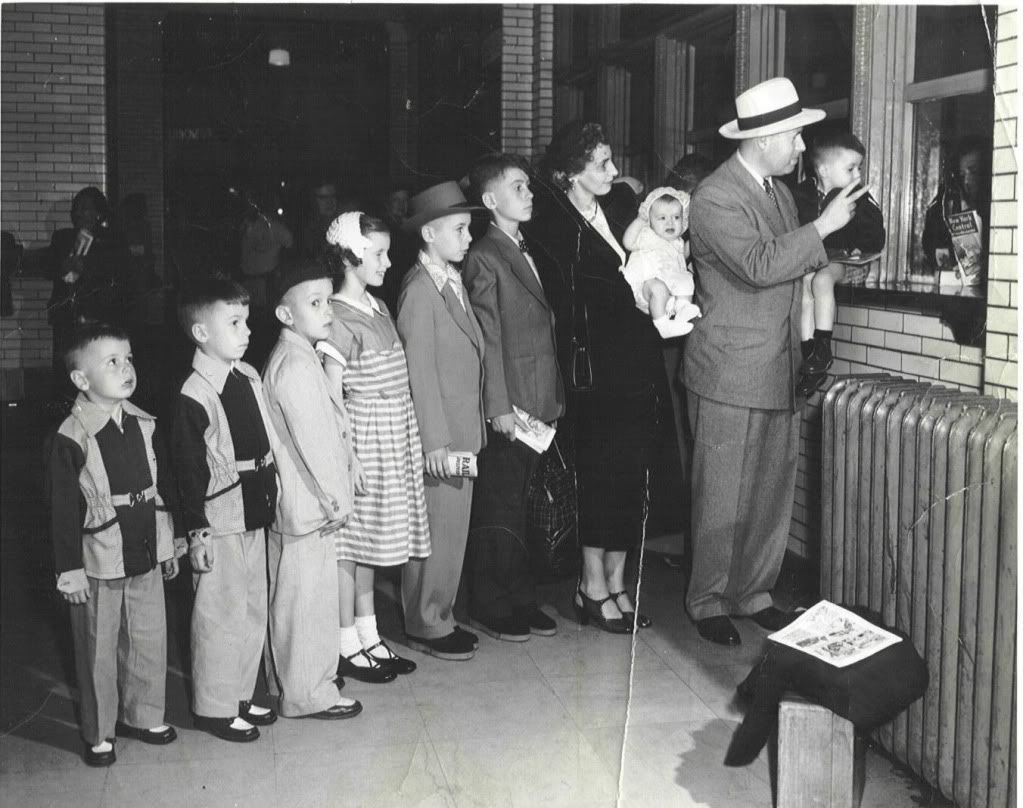
Jimmy, Michael, Jerry, Rosey, George, Joseph, Mom, Ginny, Dad and Tommy. Steve wasn’t born yet. La Salle St. Station 1953.
Well, I would have never thought of that! I was just sure it was some really important part for a ship or maybe a power plant.
I love the picture. The hat your sister is wearing - I wore one at Easter for church for a couple of years. And the shoes on the 3 youngest - my Dad bought a pair of them. They were so different from his usual Thom McAn, Florsheims.
Thank you for sharing. Brought back many great memories.