I am going to need to make some hydrocal castings with stonework details on at least 4 faces, specifically astonework arch that will be viewed from front, back and both sides. While I have successfully cast hydrocal rock faces, they are basically 2-D, or at least you don’t have to worry about casting the details on both the front and back, and you don’t have to worry about keeping everthing square and level…
So what is the best way to go about making molds for this type of project? What mold material do you use? How do you keep the pieces of the mold aligned during the casting process? How do you get the hydrocal into the mold, while getting the air out (so there aren’t bubbles in the finished piece)? Any tips on mixing and pouring the hydrocal?
Any references to ‘how to’ articles that you would recommend?
Hi Paul: Have you considered using a material, other than hydrocal? Here’s an alternative, two carved foam stone faces with carved foam (pink or blue) foam sandwiched between them. Something like this? Both sides are identical.
I find that Hydrocal is much too expensive for construction of a large arch bridge. I use it only where a super hard waterproof surface is required, such as river beds or vertical mountain outcrops that get a lot of rough usage. For a large stone arch bridge, I would cut the arch from two layers of 3/4" plywood, covered with heavy wire window screen. The two sections can be layed flat while applying and carving the “plaster”, or foam. Since the cut rock surface is, merely, decorative and supports no weight a thick layer is not required. The use of a Dremel tool circular saw blade is the ideal tool for carving foam, and a fine bladed putty knifie with patching plaster, makes cutting the random horizontal and vertical stone faces quite easy. Then you apply a dark shade of grey or black for the crevices, and then wipe off the surface. The tan or light grey color of the surface of the rocks can be stippled on with a nearly dry brush. The two halves can be either joined directly, or separated with spacers, with heavy wire screen across the top. Incidentally, Hydrocal can be painted, but does not accept stain. Bob Hahn
For each arch, I would make two castings. Since the arches are symmetrical, you only need one mold. Make each casting half the thickness of the arch, and then mount them back-to-back to complete the model. You’ll need to play with the seams, of course, but that can be done with a bit of hydrocal to fill the gap, then carving through it to finish the stonework.
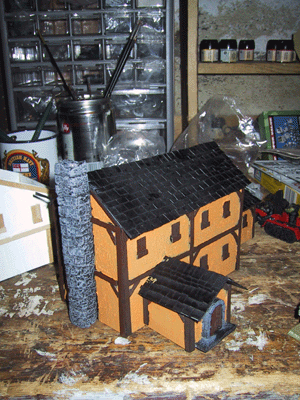
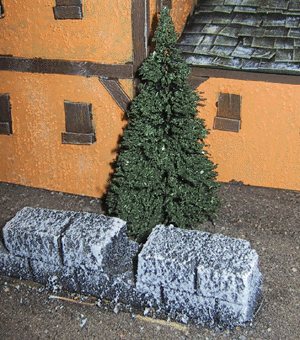
Actually, you can do a lot with foam and paint. While not applicable to this hobby, the chimny on this piece (and I know it’s hard to see clearly) is a single piece of pink foam “etched” to look like individual rock.
or these larger stones (note that these are not the best examples out there)
i find it best to lay out the work, and use nothing more than a mechanical pencil with a think lead to “etch” the depressions. Any other similarly shaped device should work as well.
Thanks for the thought. However, I am already concerned about the thickness of these castings. The arches and the pillars are about 20" actual thickness, which scale out to 1/8-inch in N-scale. That means that I would need to cast, flatten or square-up, and then bond 2 x 1/16th-inch thick castings. If the castings are made of hydrocal, so that they absorb stains, then this is going to be some very delicate work. And, the castings on each side of the structure would be pretty much identical, at least as far as the stonework enscribed on them.
I had thought just to enscribe both sides and do a single, 1/8th inch thick casting. I could then use 4 identical castings of the main arches, using front-rear pairs on each side of the structure.
Please keep those ideas coming folks!!! I am still looking for how to’s on 3-D casting!!!
Since these have to be so thin, I think I would do a single-sided casting of the front face, and then hand-carve the details on the back side of it.
Something else which might work: Make up a flat mold for the front face, and another for the back. Make each of these just 1/16th inch deep. Put one of the molds on a piece of cardboard or other stiff material so that you can pick it up without bending it. Pour the hydrocal in each one. Wait 5-10 minutes (depending on how you mix your hydrocal, temperature, humidity, etc. You’ll have to experiment.) Put a thin piece of styrene over one of the molds, and invert it on top of the other mold, so the styrene is between the two castings. At this point, the hydrocal will be set up but not completely hard, so there’s still some flex to it. Slide out the styrene, tweak the alignment, and wait for the hydrocal to set completely. You might get away with using plastic wrap instead of styrene for this.
If the goal is strength, why not just leave the styrene in the plaster (or leave a piece in the plaster) to act like “rebar” in concrete? Or else perhaps make a woven wire armature grid and put that in the plaster instead.
The styrene is just used to keep the hydrocal in the mold when you flip it over, since it’s still not set at this point. I don’t think strength is an issue here.
But, your reply got me thinking about this again. Since these arches are symmetrical, you only need to make 1 casting at a time. First, make one casting of one face, our 1/16th inch thick model. Once it’s set, remove it from the mold and trim off any crud around the edges. Then, pour another casting. While that one is still wet, take the first casting, turn it face up, and put it back-to-back on top of the fresh pour. This way, there won’t be a gap between the back faces of the two castings, and they will probably hold together by themselves.
That actually might work and is certainly worth a try, I think. Worst case is I have the bottom half of a multi-piece mold and the top half of another. Since I need 4 arches, and I really do need to have at least two different faces for the main arch (differents faces of these for each side of the structure) I will still need to create 2 molds, but at least I could think about mix & match, rather than doing the whole thing at once in multi-piece molds.