I’ve always found the 4-8-2 to be a very interesting wheel arrangement as it was really the last wheel arrangement to come on the scene before the “superpower” way of thinking took off. It could be considered either a 4-6-2 with an extra driving axle or a 2-8-2 with an additional leading axle. Because of this steady arrangement, it is an arrangement suited well for both fast passenger and goods trains. For every railway using the type for express trains, there was another using it as a freight workhorse.
The very first true 4-8-2s were designed by D. A. Hendrie for the Natal Government Railways, as an extension of his earlier 4-8-0s with a larger firebox in 1909. The 4-8-2 there would become the most widespread type in all of South Africa. It is interesting to think about how the role of the 4-8-0 locomotive on South African Railways was much larger there than probably anywhere else in the world. The 4-8-2 is about as suitable an arrangement for South African conditions as there was (besides the garratts, but that’s another story) , as four driving axles along with three leading/trailing was essential for plenty of adhesive weight meanwhile keeping axle loading down, on the lightly laid twisting rails that plagued South Africa the region over.
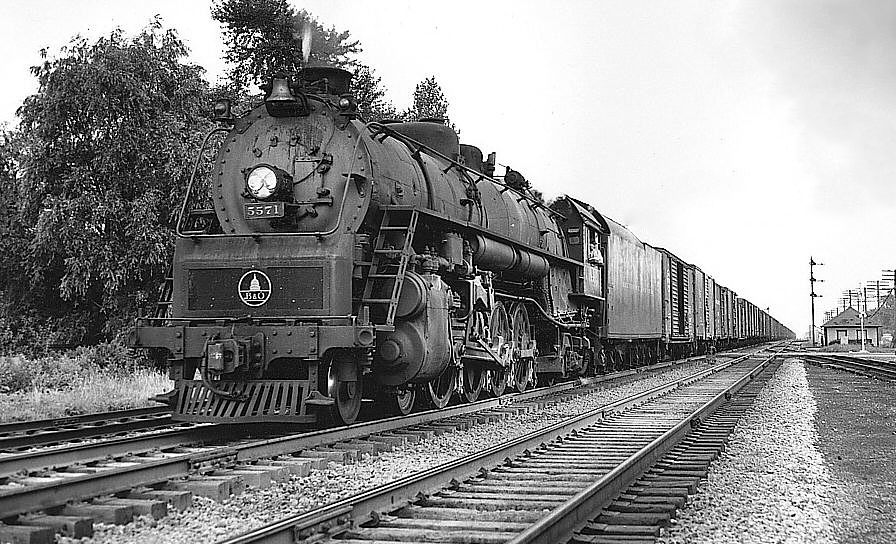
The first United States 4-8-2s were in the employment of the C&O as the J-1 design, in 1911. Unlike the Hendrie 4-8-2s, this was basically an enlarged 4-6-2 for passenger trains over the Appalachians.
The 4-8-2s used by the New York Central, the “Mohawks” were also an enlarged 4-6-2, essentially a K-11 type with an extra axle. But here the axle was used for heavy goods trains over flat terrain rather than extra adhesion in the mountains. The NYC system obviously took a liking to them, as 185 L-1s would be built starting in 1916, followed by another 300, as L-2s in the late 1920s all for goods trains.
The 4-8-2 caught on with more companies later on, with many being built in the 1
Yeah Betty’s …fixed it. It happens. Been a stressful week.
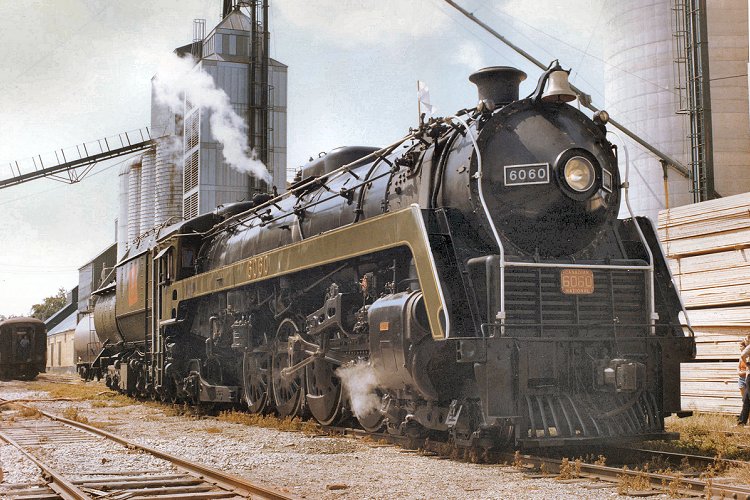
CNR had little to no use for their monster fleet of 4-8-4’s West of Winnipeg and especially in the Rockies were the mountain type prevailed and lived up to it’s name.
The CPR ever being the complete opposite of the CNR only had 2 of them, never out West, and always in the East. Only 2 Northerns too!
Paterson-George Collection
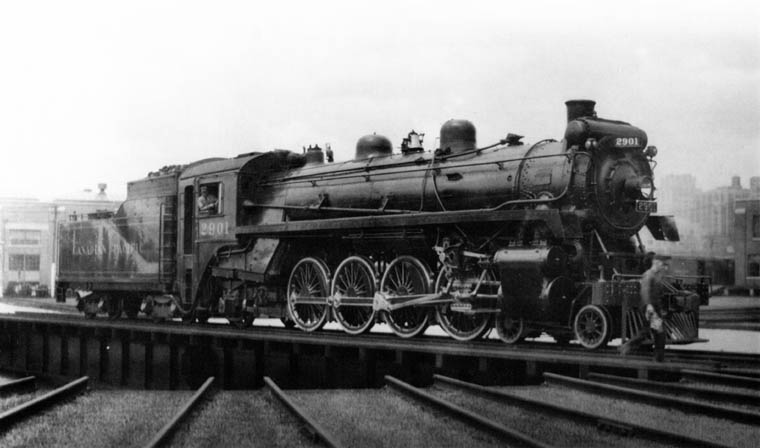
Posing proudly with typical John Street polish, No. 2901, class I1a 4-8-2 stands for her portrait in the summer of 1932. This was in the days when good unobstructed photos could be shot of locomotives on the turntable. In later years heavy timber handrails were constructed along the sides after someone had fallen into the pit. The 2900 - 2901 were the only 4-8-2 Mountains on the CPR system. These two engines were built at Angus during July and August, 1914. They were built for passenger service and spent their lives on the Eastern Lines. The twins spent a big part of their lives at Toronto, where, in their early years they were assigned to the north end and were housed at West Toronto. They were not allowed to run downtown because of certain weight restrictions in effect at that time. They were uncoupled at West Toronto and a lighter engine hauled the train to the Union Station. In the late 1920s and 1930s they were assigned to John Street.
I’ll admit I don’t know as much about the JAs compared to anything in South Africa, but I’ve always found it interesting how NZR already had a well-sized fleet of 4-8-4s and then decided to introduce more 4-8-2 designs after, which wasn’t something that happened much elsewhere.
4-8-2s were a popular choice in general for 3ft 6inch gauge railways. You could find many examples on Australia’s 3ft 6in network and Tasmania as well. The 4-8-2 was well suited for these sort of lines where large pulling power and adhesion was needed while keeping axle loading down.
An exception is Japan where they were more satisfied with 2-8-2 locomotives. Along with that, Japan was the one to introduce the true 2-8-2 arrangement. New Zealand was the one to introduce the 4-6-2 type too while I’m at it. It does make sense that some of the most versatile and adaptable wheel arrangements ever on later steam locomotives would have been born in the demaning conditions of the 3ft 6inch railways.
In a nod to our South African friend, I always thought the Great Northern 2500s with their Vanderbilt tenders bore similarities in their broadside view to the SAR 19D 4-8-2 units.
4-8-2+2-8-4 was a popular arrangement for garratts in general, for the same reason the 4-8-2 was.
The EAR was the first to use the type but South Africa had the most I believe. The 8 members of class GL were the most powerful garratts of all, with ~89,000 lbs tractive force. The later GM/GMAM were the most numerous Garratt class of all.
The Soviet Union had a sole 4-8-2+2-8-4 Garratt that was dimensionally the largest ever constructed but I think came just short of the GL class in terms of power. Nothing ever came of it as the Soviets weren’t used to the technology.
The most famous EAR 4-8-2+2-8-4 garratts were the class 59 which were the largest steam locomotives to ever run the metre gauge.
Didn’t the 4-8-4 generally haver a large firebox that the 4-8-2? Thus it would have been able to achieve a bigger head of steam faster than its smaller cousin… so overall the 4-8-4 would have been a faster more powerful beast.
First, neither the speed nor the power of a locomotive is determined by its firebox size; in fact, a 4-8-4 will have higher weight and higher running resistance than a 4-8-2 of equal adhesive weight, cylinder dimensions and boiler pressure. The difference is in the radiant area in deep firebox and chamber that the two carrying axles permit, but that is significant in other ways. I realize this is a matter of the semantics you were using, but it’s important not to confuse “more radiant uptake for steam generation” with higher performance.
It was well-understood in England that a good 4-6-0 could easily do the work of a Pacific … up to a point, yes, but that point was far beyond what was required by actual normal train working. Some of this was circumstantial, but most of it involved great firing skill/experience, a consistent and high grade of coal, etc. It also reflects the ability of the ‘locomotive’ boiler to be significantly over-driven (in other words, show a high grate limit when economy is not considered) in ways that produce higher steam generation and practical superheat.
What the 4-8-4 gave, initially, was essentially the same thing that a Berk gave over an equivalent Mikado: better fuel economy for a given high performance level, more than enough to cover the added losses due to weight and length and so forth. In many cases this is more circumstantial than dimensional, as is illustrated even better by the reasons Lima proposed six-wheel trailers to make double-Belpaire “4-8-4s” even better performers. Most of the early 4-8-4s were, in fact, heavy freight engines of deplorable performance, and only the advent of better balancing practice
A bit of history is in order. The 2-8-2, 4-8-4 the 2-8-8-4 Yellowstones were pioneered in the US by the Northern Pacific. The NP was blessed with huge on line coal reserves in Montana, but it was poor quality lignite that required larger than then normal fireboxes to generate enough heat to drive the engine. Poor fuel forced larger fire boxes, which forced more trailing axles.
By contranst the Great Northern used either good Pittsburg Seam coal, or good British Columbia coal, or oil so they did not need the large fireboxes, and thus extra trailing wheels that the NP did. In fact, the GN actively avoided trailing wheels with its 2-8-8-0 N class locos, and built 2-8-2 engines with very high axle loadings and tractive effort.
Note that both the C&O and NYC had access to good coal and did very well with 4-8-2 designs. The point is, think about the quality of the fuel.
Up until the early 1920’s, the NP was getting coal for Montana operations from Red Lodge and Bear Creek, with the Colstrip mines coming online about 1923. Red Lodge/Bear Creek coal was fairly good bituminous coal, with Colstrip being sub-bituminous (not quite as bad as lignite).