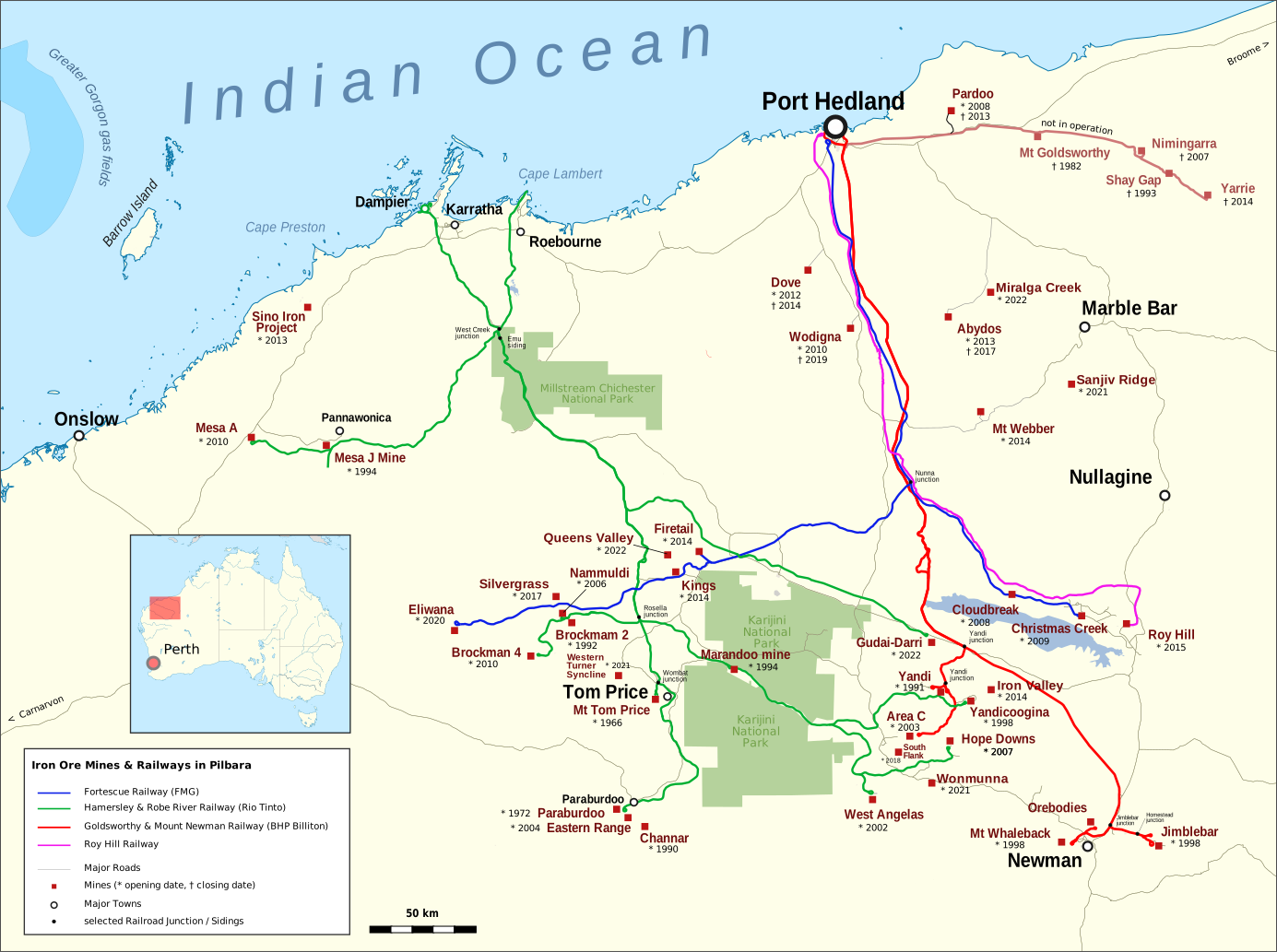
The technical limits being pushed in the Pilbara Region by it’s iron ore railways has always been eye catching. For those not familiar. The Pilbara Region in Western Australia holds some of the worlds largest deposits of iron ore. BHP-Billiton, Roy Hill, Rio Tinto and Foretescue Metals Group are the operators in the region. FMG is now running trains with the highest axle load in the world. It has lifted it’s axle load from; 40 tonne, to 42 tonne, and now 43.5 tonne. With 45 tonne coming and 50 tonne on the horizon. All this is attainable by an improved lighter truck with beefed up components that’s in testing as we speak. Throw in some preventative rail maintenance. A suite of bearing and load detectors with ECP equipped rolling stock and you get a very efficient railroad.
P.S. 43,500KG(43.5 tonne)=95,700lbs. Our current axle load in the US is 71,500lbs. From what I understand UP’s Overland Route is rated for 315,000lb GRW (Hopefully Jeff will chime in on this) which breaks down to 78,750lbs. per axle.
In an environment where temperatures can range from below freezing to more than 40oC, the Fortescue Railway is built to cope with extremes. Structures and earthworks are designed to withstand 1-in-100 year weather events – when the rains come to this arid region, dry river beds quickly become raging torrents which in some cases can be several kilometres wide. Following storms, inspections are carried out using helicopters and road-rail vehicles in order to quickly restore operations.
Much of the time the railroads in the Pilbara are in conditions that are likened to those on Mercury, with the mentioned temperature swings of arid continental regions. You can bet all of the operations in that area, not just Fortescue, need (and have) a first-class track engineering and maintenance operation. Most likely reference and resource will be Peter Clark, who I believe has firsthand experience with some of this.
Yes, the original UP side is shown in the time tables for 315,000 tons. The exCNW side isn’t in the current UP time tables, only good for 286K. However, some of the last CNW time tables did show the east/west main good for 315K.
The Pilbara is very arid being a part of the Australian Outback, and host some pretty intense heat in the summer. Temperatures regulary exceed 90F during most of the year. Here’s more on Pilbaras climate.
Having been called in by Overmod, I must admit that this is a subject in which I have personal experience, having been employed in rail-wheel interaction studies by BHP from 1975 to 1978 on both BHP and Rio Tinto systems. I have visited every so often, most recently in 2017.
Firstly, the climate: for most of the year it is hot and dry, but in summer there can be cyclones that bring very heavy rain several times during a season. By now most of the watercourses have adequate bridges and culverts but there can be track damage in other areas (and you need to get the water out of the open cut mines.)
FMG have pioneered very effective track inspection using video monitoring from track inspection vehicles with automated artificial intelligence examination of the images. Similar automated inspection of vehicle wheels is carried out at fixed locations on track, including measurement of flange thickness. In a presentation, a photo was shown that had been detected showing a possible crack on the rail surface which turned out to be a large spider which had been run down on the rail head. So manual interpretation is still needed, but the smallest defect can be located.
An interesting change has been the change from G type (7" x 12") bearings to shorter bearings of the same diameter. It was found that at maximum load, the bending in the axle between the roller bearings caused premature failure, but with the same bearings closer together, they ran for longer with no problems.
If I may split hairs, in the metric system, a tonne is a measure of mass and axle loads should be given in units of force, Newtons or in this case kiloNewtons. So we are talking about axle loads of 43.5 x 9.8 = 426 kN.
I measured axle loads in excess of that back in 1978, because BHP’s iron ore loader at Mount Whaleback was a 45 degree chute facing the front of the wagon and many wagons had more than 400kN on both axles of the leading truck, and sometimes half that on the trailing truck.
Having been called in by Overmod, I must admit that this is a subject in which I have personal experience, having been employed in rail-wheel interaction studies by BHP from 1975 to 1978 on both BHP and Rio Tinto systems. I have visited every so often, most recently in 2017.
Firstly, the climate: for most of the year it is hot and dry, but in summer there can be cyclones that bring very heavy rain several times during a season. By now most of the watercourses have adequate bridges and culverts but there can be track damage in other areas (and you need to get the water out of the open cut mines.)
FMG have pioneered very effective track inspection using video monitoring from track inspection vehicles with automated artificial intelligence examination of the images. Similar automated inspection of vehicle wheels is carried out at fixed locations on track, including measurement of flange thickness. In a presentation, a photo was shown that had been detected showing a possible crack on the rail surface which turned out to be a large spider which had been run down on the rail head. So manual interpretation is still needed, but the smallest defect can be located.
An interesting change has been the change from G type (7" x 12") bearings to shorter bearings of the same diameter. It was found that at maximum load, the bending in the axle between the roller bearings caused premature failure, but with the same bearings closer together, they ran for longer with no problems.
If I may split hairs, in the metric system, a tonne is a measure of mass and axle loads should be given in units of force, Newtons or in this case kiloNewtons. So we are talking about axle loads of 43.5 x 9.8 = 426 kN.
I measured axle loads in excess of that back in 1978, because BHP’s iron ore loader at Mount Whaleback was a 45 degree chute facing the front of the wagon and many wagon
Most all cars today are built with 110T. trucks for 286k lbs. or 71,500 lbs. axle load but the intermediate trucks on doublestack cars use 125T. trucks with 38" wheels which can handle the 78,750 lbs. axle load and I suspect that is why the UP track rating.
Thanks for your excellent write-up on the Australian RR’s, Peter. Here’s a link to Timken’s Short G bearing:
For those interested in the detail-design improvement in the AP-2 vs. earlier short G bearings, see this paper (which also synopsizes the original Timken IHHA presentation from 2009):
I would say the same thing regarding the 125-ton trucks. Yet UP is the only C1 with a mainline rated at 315K GRW. Everyone else is still 286K GRW as far as I know. 315K is the future GRW. I wonder if UP just wanted to have it’s main artery the Overland Route ahead of the game.
Great information, and appreciate the detail. What’s your outlook on Roy Hill?
Roy Hill is the most recent of the operating Pilbara Railways. It runs parallel to the BHP and Fortescue lines for about half its length. The ore wagons are basically similar to those of Fortescue. All the latest techniques are in use, for the track: heavy rail, concrete ties, spring rail clips and deep ballast. All locomotives and wagons are fitted with ECP brakes.
Here is a map, including two proposed lines that were not built. Roy Hill is shown as “Hancock” the name of the owner. Roy Hill is the name of a nearby cattle ranch.
The last two lines on the list were not built.
Photographs of the locomotives and rolling stock of the Pilbara railways can be found at
As Peter mentioned FMG went from 40 to 42 TAL in 2014-15 and so the GVM of their ore cars went from 160 to 168 metric tonnes , 43.5 TAL would make them 174 tonnes .
45 TAL x 4 = 180 gross tonnes and 50TAL = 200 gross tonnes . The latter would make them heavier than their locomotives .
It will be interesting to see how 137 lb/yd rail copes with 45-50 tonne axle loads .
Also something else to consider . For the same 42,000 tonne trains the car numbers could reduce if the GVM was higher . For example 250 x 168T = 42,000T . 242 x 174T = 42,108T and 234 x 180T = 42,120T .
I doubt it would take much longer to load the extra in each ore car , but the significance could be shorter tipping times . FMG I believe uses cars in married pairs and are rotary dumped two at a time . The sooner the empty rake is tipped the sooner the outgoing engines can be attached and set up for departure to the mines .
It could be a while but with 50TAL and 200T gross cars , thats 210 cars instead of 250 for 42,000 tonnes . 40 less cars = 20 less tips and would make a noticeable reduction in train cycle times .
It won’t be the weight of rail that causes the problems; it’ll be the metallurgy of the contact patch.
Time and time again, there have been ‘issues’ when even slight increases in HAL limits have been made. One effect was excessive plastic deformation of the railhead; another was work-hardening followed by the hardened layer breaking into plates when the softer material beneath deformed; another is brittle cracking of head-hardening. The concern is that these start stress-raising cracks, often vertical in the railhead, that then propagate under the increased cycling load either to spalling or breakage.
A sane company would trade off the increased ‘throughput’ of the heavier wheel and rail loading against the increased maintenance needed to keep the operation running. In dedicateed service as in the Pilbara, it would at least in theory be possible to operate with the type of regular grinding expressed in the old ‘magic wear rate’ theory, where you grind to remove the developing railhead deformations before the cracking can propagate, then change the rail regularly as a ‘consumable’ item and cost. Presumably, sooner or later they’ll figure that out for themselves if they haven’t already.
The technologies discussed may be available to US railroads, but why would they adopt it?
The Aussie companies likely stay on their own rails, so it’s important that those rails are top-notch. Losing a US ROW (as happens due to derailments, weather, etc) simply means taking a detour while the problem is repaired. It might hurt income a little, but not as much as not being able to run at all.
The whole point of magic wear rate is that, with carefully scheduled grinding and perhaps heat treatment, the integrity of the rail in service can be improved, even under severe HAL conditions, at the expense of quicker overall effective wear. That replaces potential rail breakage or damage with regular schedulable operations, perhaps only a few more than would be already scheduled for a heavy-traffic line.
If they use CBTC, it would be relatively easy, at least in principle, to schedule the traffic around the required scheduled grinds. Any detection of actual defects in the railhead might be determined by instrumented cars or locomotives, at reasonable cost (note the number of laser geometry car solutions already running cost-effectively here) and maintenance for them scheduled as above using little more than a Brandt unit for the equipment and personnel.
The key is not to pretend that 50-ton loading is just an increment up from 42 ton or whatever. The next “item for attention” – no surprise to anyone who has been watching the East Palestine show – is going to be the increased load, especially shock load or point damage/spalling, to the bearing components. I’d expect lots of surprise problems increasingly short of historical MTTF… better have good onboard bearing monitoring in the works.